
SAM/SAH 介导了母体叶酸缺乏诱导的新生大鼠子代神经细胞凋亡:Bcl-2、Bax 和 Caspase-3 的表达。
SAM/SAH Mediates Parental Folate Deficiency-Induced Neural Cell Apoptosis in Neonatal Rat Offspring: The Expression of Bcl-2, Bax, and Caspase-3.
机构信息
Department of Nutrition and Food Science, School of Public Health, Tianjin Medical University, Tianjin 300070, China.
Tianjin Key Laboratory of Environment, Nutrition and Public Health, Tianjin 300070, China.
出版信息
Int J Mol Sci. 2023 Sep 25;24(19):14508. doi: 10.3390/ijms241914508.
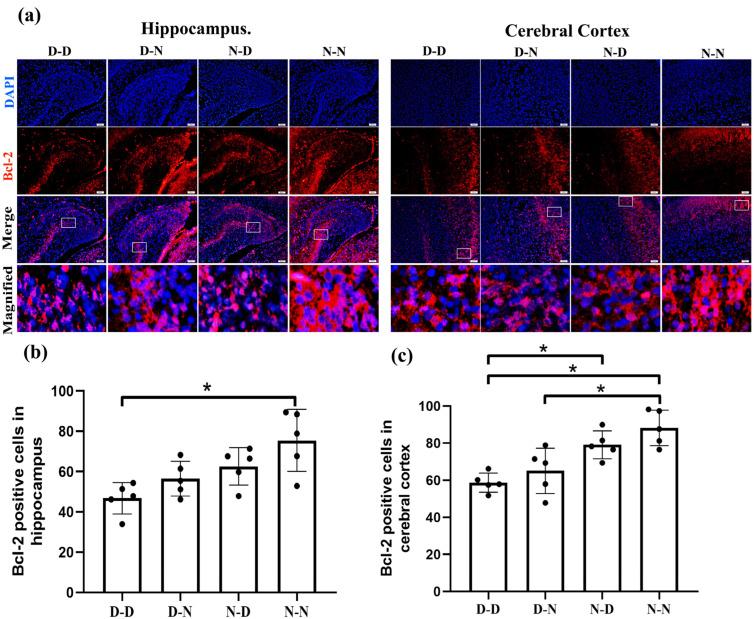
Research demonstrated that folate deficiency in either the mother or father could impact the biological functions of the offspring's of neural cells. Folate deficiency can also impair the methionine cycle, thus contributing to the conversion of S-adenosylmethionine (SAM) to S-adenosylhomocysteine (SAH), which could potentially cause damage to the central nervous system. The study focused on the effect of parental folate deficiency on neural cell apoptosis in offspring neonatal rats and whether it is mediated by the levels of SAM and SAH in brains. The experimental design was conducted by feeding female and male Sprague Dawley (SD) rats with either folate-deficient or folate-normal diets, sacrificing the offspring within 24 h and isolating their brain tissue. Rats were divided into four groups: the maternal-folate-deficient and paternal-folate-deficient (D-D) group; the maternal-folate-deficient and paternal-folate-normal (D-N) group; the maternal-folate-normal and paternal-folate-deficient (N-D) group; and the maternal-folate-normal and paternal-folate-normal (N-N) group. There was down-regulation of B-cell lymphoma 2 (Bcl-2) expression, up-regulation of Bcl-2-associated X protein (Bax) and Caspase-3 expression of neural cells, and pathological changes in the brain ultrastructure, as well as decreased SAM levels, increased SAH levels, and a decreased SAM/SAH ratio in the rat fetal brain via parental folate deficiency. In conclusion, parental folate deficiency could induce the apoptosis of neural cells in neonatal offspring rats, while biparental folate deficiency had the greatest effect on offspring, and the unilateral effect was greater in mothers than in fathers. This process may be mediated by the levels of SAM and SAH in the rat fetal brain.
研究表明,母亲或父亲叶酸缺乏都可能影响后代神经细胞的生物学功能。叶酸缺乏还会损害蛋氨酸循环,从而导致 S-腺苷甲硫氨酸(SAM)向 S-腺苷同型半胱氨酸(SAH)的转化,这可能对中枢神经系统造成损害。该研究专注于父母叶酸缺乏对新生大鼠后代神经细胞凋亡的影响,以及它是否通过大脑中 SAM 和 SAH 的水平来介导。实验设计通过用叶酸缺乏或正常饮食喂养雌性和雄性 Sprague Dawley(SD)大鼠,在 24 小时内处死后代并分离其脑组织来进行。大鼠分为四组:母源性叶酸缺乏和父源性叶酸缺乏(D-D)组;母源性叶酸缺乏和父源性叶酸正常(D-N)组;母源性叶酸正常和父源性叶酸缺乏(N-D)组;以及母源性叶酸正常和父源性叶酸正常(N-N)组。神经细胞的 B 细胞淋巴瘤 2(Bcl-2)表达下调,Bcl-2 相关 X 蛋白(Bax)和 Caspase-3 表达上调,脑超微结构发生病变,以及 SAM 水平降低,SAH 水平升高,SAM/SAH 比值降低。总之,父母叶酸缺乏可诱导新生大鼠后代神经细胞凋亡,而双亲叶酸缺乏对后代的影响最大,母亲的单侧影响大于父亲。这个过程可能是通过大鼠胎脑中 SAM 和 SAH 的水平来介导的。



 Zotero 插件