
父母叶酸缺乏抑制大鼠子代神经干细胞增殖并增加其凋亡:端粒损耗加剧作为潜在机制。
Parental Folate Deficiency Inhibits Proliferation and Increases Apoptosis of Neural Stem Cells in Rat Offspring: Aggravating Telomere Attrition as a Potential Mechanism.
机构信息
Department of Nutrition and Food Science, School of Public Health, Tianjin Medical University, Tianjin 300070, China.
Tianjin Key Laboratory of Environment, Nutrition and Public Health, Tianjin 300070, China.
出版信息
Nutrients. 2023 Jun 22;15(13):2843. doi: 10.3390/nu15132843.
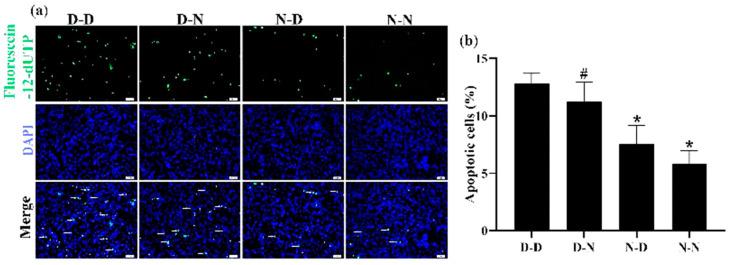
The effect of maternal folate status on the fetal central nervous system (CNS) is well recognized, while evidence is emerging that such an association also exists between fathers and offspring. The biological functions of telomeres and telomerase are also related to neural cell proliferation and apoptosis. The study aimed to investigate the effect of parental folate deficiency on the proliferation and apoptosis of neural stem cells (NSCs) in neonatal offspring and the role of telomeres in this effect. In this study, rats were divided into four groups: maternal folate-deficient and paternal folate-deficient diet (D-D) group; maternal folate-deficient and paternal folate-normal diet (D-N) group; maternal folate-normal and paternal folate-deficient diet (N-D) group; and the maternal folate-normal and paternal folate-normal diet (N-N) group. The offspring were sacrificed at postnatal day 0 (PND0), and NSCs were cultured from the hippocampus and striatum tissues of offspring for future assay. The results revealed that parental folate deficiency decreased folate levels, increased homocysteine (Hcy) levels of the offspring's brain tissue, inhibited proliferation, increased apoptosis, shortened telomere length, and aggravated telomere attrition of offspring NSCs in vivo and in vitro. In vitro experiments further showed that offspring NSCs telomerase activity was inhibited due to parental folate deficiency. In conclusion, parental folate deficiency inhibited the proliferation and increased apoptosis of offspring NSCs, maternal folate deficiency had more adverse effects than paternal, and the mechanisms may involve the telomere attrition of NSCs.
母体叶酸状态对胎儿中枢神经系统(CNS)的影响已得到充分认识,而证据也表明父亲和后代之间也存在这种关联。端粒和端粒酶的生物学功能也与神经细胞的增殖和凋亡有关。本研究旨在探讨父母叶酸缺乏对新生后代神经干细胞(NSC)增殖和凋亡的影响,以及端粒在这种影响中的作用。在这项研究中,大鼠被分为四组:母体叶酸缺乏和父体叶酸缺乏饮食(D-D)组;母体叶酸缺乏和父体叶酸正常饮食(D-N)组;母体叶酸正常和父体叶酸缺乏饮食(N-D)组;以及母体叶酸正常和父体叶酸正常饮食(N-N)组。在出生后第 0 天(PND0)处死后代,并从后代海马和纹状体组织中培养 NSCs 以备将来检测。结果表明,父母叶酸缺乏会降低叶酸水平,增加后代脑组织同型半胱氨酸(Hcy)水平,抑制增殖,增加凋亡,缩短端粒长度,并加重体内和体外后代 NSCs 的端粒磨损。体外实验进一步表明,由于父母叶酸缺乏,后代 NSCs 的端粒酶活性受到抑制。总之,父母叶酸缺乏会抑制后代 NSCs 的增殖并增加其凋亡,母体叶酸缺乏的影响比父体更大,其机制可能涉及 NSCs 的端粒磨损。



 Zotero 插件