
mRNA疫苗在传染病和癌症治疗中的临床分析与应用
Clinical Analysis and Applications of mRNA Vaccines in Infectious Diseases and Cancer Treatment.
作者信息
Ankrah Paa Kwesi, Ilesanmi Ajibola, Akinyemi Amos O, Lasehinde Victor, Adurosakin Oluwapelumi E, Ajayi Oluwatobi H
机构信息
Division of Infectious Diseases, Duke University, Durham, USA.
Center for Human Systems Immunology, Duke University, Durham, USA.
出版信息
Cureus. 2023 Oct 2;15(10):e46354. doi: 10.7759/cureus.46354. eCollection 2023 Oct.
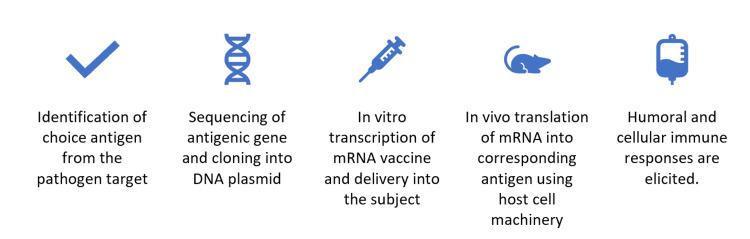
Vaccination, for centuries, has been a potent preventive technique to treat morbidities. The messenger RNA (mRNA) vaccine technology is an innovative biomedical approach utilized in developing antigen-specific vaccines that can generate adaptive immune responses, triggering both humoral and cellular immunity to enhance the body's defense against specific infections. This review provides a comprehensive, comparative analysis of mRNA vaccine technology and conventional vaccines by focusing on the structures, components, and classifications. An exploratory analysis of the similarities and differences between mRNA vaccine technology and live-attenuated vaccines highlights the mechanisms by which mRNA vaccines elicit immune responses. This review extensively discusses the production, stability, synthesis, and delivery processes associated with mRNA vaccines, showcasing the advancements and technological superiority of this approach over conventional vaccine technologies. Additionally, the potential of mRNA vaccine technology as a potent alternative for the development of vaccine candidates targeting HIV and cancer is examined.
几个世纪以来,疫苗接种一直是治疗疾病的一种有效预防技术。信使核糖核酸(mRNA)疫苗技术是一种创新的生物医学方法,用于开发抗原特异性疫苗,这种疫苗能够产生适应性免疫反应,激发体液免疫和细胞免疫,以增强机体对特定感染的防御能力。本综述通过聚焦于结构、成分和分类,对mRNA疫苗技术和传统疫苗进行了全面的比较分析。对mRNA疫苗技术与减毒活疫苗之间异同的探索性分析,突出了mRNA疫苗引发免疫反应的机制。本综述广泛讨论了与mRNA疫苗相关的生产、稳定性、合成和递送过程,展示了该方法相对于传统疫苗技术的进步和技术优势。此外,还研究了mRNA疫苗技术作为开发针对艾滋病毒和癌症的候选疫苗的有力替代方案的潜力。


 Zotero 插件