
应激的生态效应在亚抑制性抗生素处理下驱动细菌的进化能力。
Ecological effects of stress drive bacterial evolvability under sub-inhibitory antibiotic treatments.
作者信息
Vasse Marie, Bonhoeffer Sebastian, Frenoy Antoine
机构信息
Institute for Integrative Biology, ETH Zürich, Zurich, Switzerland.
Université Grenoble Alpes, CNRS UMR 5525, Grenoble, France.
出版信息
ISME Commun. 2022 Sep 2;2(1):80. doi: 10.1038/s43705-022-00157-w.
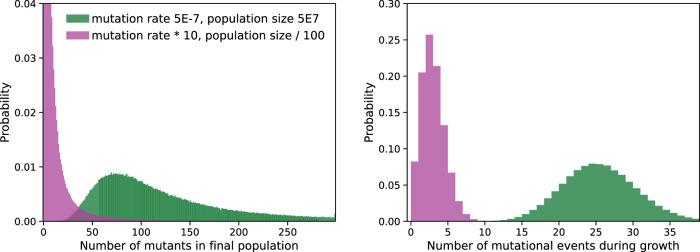
Stress is thought to increase mutation rate and thus to accelerate evolution. In the context of antibiotic resistance, sub-inhibitory treatments could then lead to enhanced evolvability, thereby fuelling the adaptation of pathogens. Combining wet-lab experiments, stochastic simulations and a meta-analysis of the literature, we found that the increase in mutation rates triggered by antibiotic treatments is often cancelled out by reduced population size, resulting in no overall increase in genetic diversity. A careful analysis of the effect of ecological factors on genetic diversity showed that the potential for regrowth during recovery phase after treatment plays a crucial role in evolvability, being the main factor associated with increased genetic diversity in experimental data.
压力被认为会增加突变率,从而加速进化。在抗生素耐药性的背景下,亚抑制性治疗可能会导致进化能力增强,从而推动病原体的适应性。结合湿实验室实验、随机模拟和文献荟萃分析,我们发现抗生素治疗引发的突变率增加通常会被种群规模的减小所抵消,导致遗传多样性没有总体增加。对生态因素对遗传多样性影响的仔细分析表明,治疗后恢复阶段的再生潜力在进化能力中起着关键作用,是与实验数据中遗传多样性增加相关的主要因素。


 Zotero 插件