
电子健康心理教育干预对痴呆症患者非专业照护者的心理生物学影响:意大利 COVID-19 大流行期间的一项试点研究。
Psychobiological effects of an eHealth psychoeducational intervention to informal caregivers of persons with dementia: a pilot study during the COVID-19 pandemic in Italy.
机构信息
Laboratory of Alzheimer's Neuroimaging and Epidemiology, IRCCS Istituto Centro San Giovanni di Dio Fatebenefratelli, Via Pilastroni 4, 25125, Brescia, Italy.
Biological Psychiatry Unit, IRCCS Istituto Centro San Giovanni di Dio Fatebenefratelli, Brescia, Italy.
出版信息
Aging Clin Exp Res. 2023 Dec;35(12):3085-3096. doi: 10.1007/s40520-023-02610-9. Epub 2023 Nov 9.
BACKGROUND
The workload associated with caring for a person with dementia (PwD) could negatively affect informal caregivers' physical and mental health. According to the recent literature, there is a need for studies testing the implementation of affordable and accessible interventions for improving caregivers' well-being.
AIMS
This study aimed to explore the feasibility and effectiveness of an 8 week eHealth psychoeducation intervention held during the COVID-19 pandemic in Italy in reducing the psychological burden and neuroendocrine markers of stress in caregivers of PwD.
METHODS
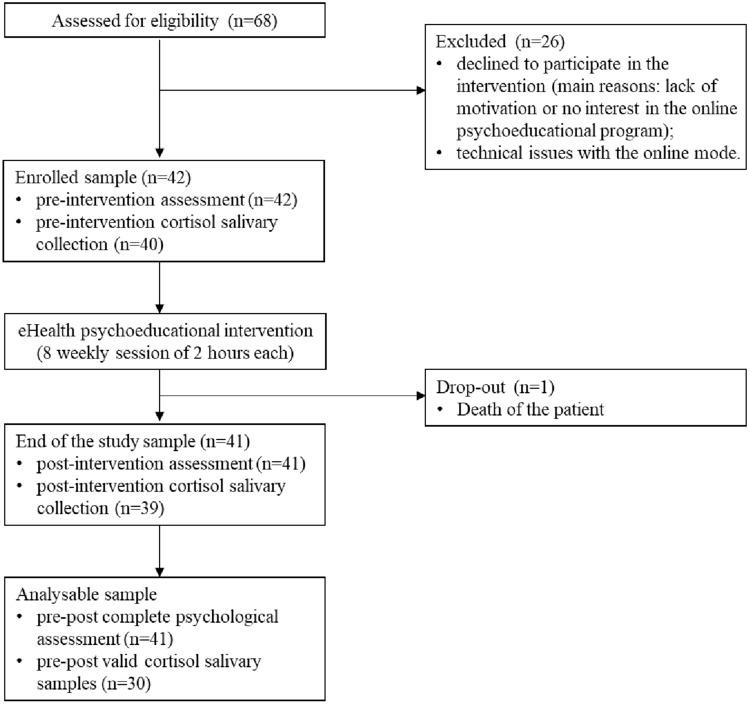
Forty-one informal caregivers of PwD completed the eHealth psychoeducation intervention. Self-reported (i.e., caregiver burden, anxiety symptoms, depressive symptoms, and caregiver self-efficacy) and cortisol measurements were collected before and after the intervention.
RESULTS
Following the intervention, the caregivers' self-efficacy regarding the ability to respond to disruptive behaviours improved (t = - 2.817, p = 0.007), anxiety and burden levels decreased (state anxiety: t = 3.170, p = 0.003; trait anxiety: t = 2.327, p = 0.025; caregiver burden: t = 2.290, p = 0.027), while depressive symptoms and cortisol levels did not change significantly. Correlation analyses showed that the increase in self-efficacy was positively associated with the improvement of caregiver burden from pre- to post-intervention (r = 0.386, p = 0.014). The intervention had a low rate of dropout (n = 1, due to the patient's death) and high levels of appreciation.
DISCUSSION
The positive evidence and participation rate support the feasibility and effectiveness of the proposed eHealth psychoeducational intervention to meet the need for knowledge of disease management and possibly reduce detrimental effects on caregivers' psychological well-being.
CONCLUSION
Further placebo-controlled trials are needed to test the generalizability and specificity of our results.
背景
照顾痴呆症患者(PwD)的工作量可能会对非专业照护者的身心健康产生负面影响。根据最近的文献,需要研究测试实施负担得起且可及的干预措施,以改善照护者的幸福感。
目的
本研究旨在探讨在意大利 COVID-19 大流行期间实施 8 周的电子健康心理教育干预措施,以减轻 PwD 照护者的心理负担和神经内分泌应激标志物的可行性和有效性。
方法
41 名 PwD 的非专业照护者完成了电子健康心理教育干预。在干预前后收集了自我报告的(即照护者负担、焦虑症状、抑郁症状和照护者自我效能感)和皮质醇测量结果。
结果
干预后,照护者应对破坏性行为的能力自我效能感提高(t=-2.817,p=0.007),焦虑和负担水平降低(状态焦虑:t=3.170,p=0.003;特质焦虑:t=2.327,p=0.025;照护者负担:t=2.290,p=0.027),而抑郁症状和皮质醇水平没有显著变化。相关分析表明,自我效能感的提高与干预前后照护者负担的改善呈正相关(r=0.386,p=0.014)。该干预措施的辍学率(n=1,由于患者死亡)低,且受到高度赞赏。
讨论
积极的证据和参与率支持所提出的电子健康心理教育干预措施的可行性和有效性,以满足疾病管理知识的需求,并可能减轻对照护者心理幸福感的不利影响。
结论
需要进一步进行安慰剂对照试验,以测试我们结果的普遍性和特异性。


 Zotero 插件