
2014-2021 年英格兰的受控阿片类药物私人处方:一项回顾性观察研究。
Private prescribing of controlled opioids in England, 2014-2021: a retrospective observational study.
机构信息
Oxford Medical School, Medical Sciences Divisional Office, University of Oxford, Oxford.
Bennett Institute for Applied Data Science, Nuffield Department of Primary Care Health Sciences, University of Oxford, Oxford; specialist pharmacist, NHS England.
出版信息
Br J Gen Pract. 2024 Jan 25;74(739):e126-e132. doi: 10.3399/BJGP.2023.0146. Print 2024 Feb.
BACKGROUND
Trends in NHS opioid prescribing have been well published, yet trends in private prescribing of opioids have not been widely established.
AIM
To assess trends and geographical variation in controlled opioids prescribed by private prescribers in England.
DESIGN AND SETTING
This was a retrospective observational study in English primary health care.
METHOD
Data on Schedule 2 and 3 controlled opioids ('controlled opioids') were obtained from the NHS Business Services Authority (BSA) using Freedom of Information (FOI) requests between 1 January 2014 and 30 November 2021. Absolute counts and rates of the number of items dispensed per cumulative number of registered private prescribers were calculated and stratified over time, by opioid type, and geographical region.
RESULTS
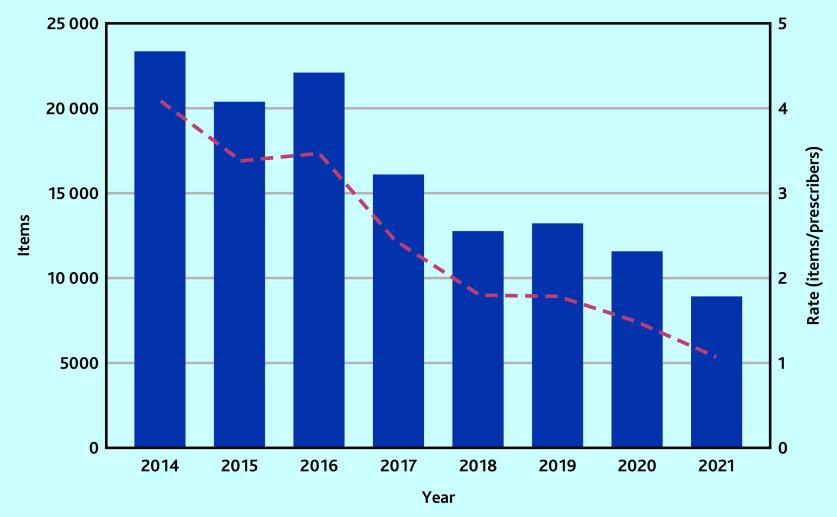
This study found that 128 341 items of controlled opioids were prescribed by private prescribers in England between January 2014 and November 2021, which decreased by 50% from 23 339 items (4.09 items/prescriber) in 2014 to 11 573 items (1.49 items/prescriber) in 2020. Methadone (36%, = 46 660) was the most common controlled opioid prescribed privately, followed by morphine (18%, = 22 543), buprenorphine (16%, = 20 521), and oxycodone (12%, = 15 319). Prescriptions were highest in London (74%, = 94 438), followed by the South-East of England (7%, = 9237). A proportion of items ( = 462; 0.36%) were prescribed by 'unidentified doctors' where the prescription is not readily attributable to an individual prescriber by the BSA.
CONCLUSION
Controlled opioids prescribed by private prescribers in England decreased and were primarily prescribed in London. To ensure patient safety, the monitoring and surveillance of controlled opioids dispensed privately should continue and items linked to 'unidentified doctors' should be addressed further.
背景
英国国民保健制度(NHS)阿片类药物处方的趋势已得到充分报道,但私人开阿片类药物的趋势尚未广泛确定。
目的
评估英格兰私人开处受控阿片类药物的趋势和地域差异。
设计和背景
这是一项在英国初级保健中进行的回顾性观察研究。
方法
使用信息自由(FOI)请求,从 NHS 商业服务管理局(BSA)获得 2014 年 1 月 1 日至 2021 年 11 月 30 日期间附表 2 和 3 类受控阿片类药物(“受控阿片类药物”)的数据。按时间、阿片类药物类型和地理区域对每个累积注册私人开方者开出的受控阿片类药物的数量和比例进行了计算和分层。
结果
本研究发现,2014 年至 2021 年期间,英格兰有 128341 种受控阿片类药物由私人开方者开处,与 2014 年的 23339 种(4.09 种/开方者)相比下降了 50%,至 2020 年的 11573 种(1.49 种/开方者)。美沙酮(36%,n=46660)是最常见的私人开处的受控阿片类药物,其次是吗啡(18%,n=22543)、丁丙诺啡(16%,n=20521)和羟考酮(12%,n=15319)。处方量最高的是伦敦(74%,n=94438),其次是英格兰东南部(7%,n=9237)。BSA 无法明确归属给个人开方者的“未识别医生”开出了一定比例的处方(n=462;0.36%)。
结论
英格兰私人开处的受控阿片类药物减少,主要在伦敦开处。为确保患者安全,应继续监测和监督私人开处的受控阿片类药物,并进一步解决与“未识别医生”相关的处方。



 Zotero 插件