
分子应对机制:重编程 tRNA 以调控应激反应蛋白的密码子偏爱性翻译。
Molecular Coping Mechanisms: Reprogramming tRNAs To Regulate Codon-Biased Translation of Stress Response Proteins.
机构信息
Antimicrobial Resistance Interdisciplinary Research Group, Singapore-MIT Alliance for Research and Technology Centre, Singapore 138602, Singapore.
Department of Biological Sciences, University at Albany, Albany, New York 12222, United States.
出版信息
Acc Chem Res. 2023 Dec 5;56(23):3504-3514. doi: 10.1021/acs.accounts.3c00572. Epub 2023 Nov 22.
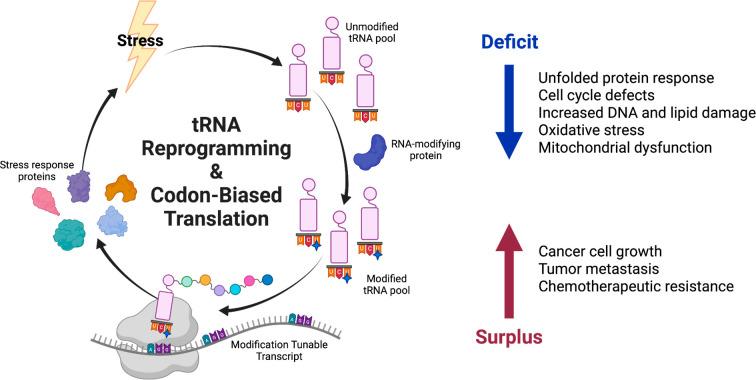
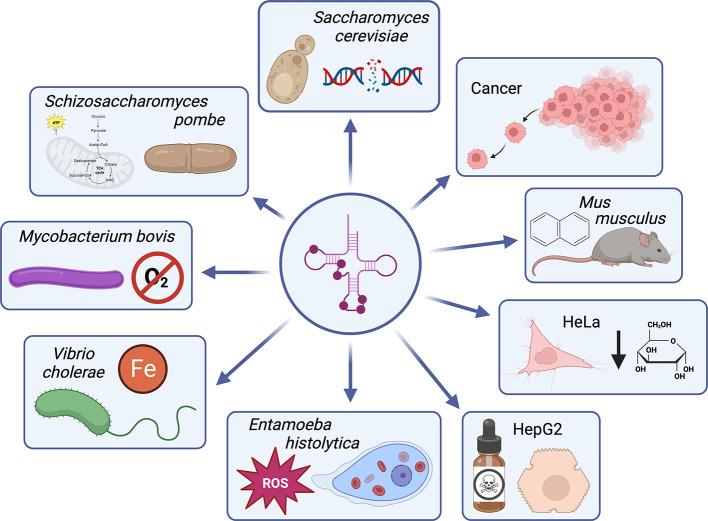
As part of the classic central dogma of molecular biology, transfer RNAs (tRNAs) are integral to protein translation as the adaptor molecules that link the genetic code in messenger RNA (mRNA) to the amino acids in the growing peptide chain. tRNA function is complicated by the existence of 61 codons to specify 20 amino acids, with most amino acids coded by two or more synonymous codons. Further, there are often fewer tRNAs with unique anticodons than there are synonymous codons for an amino acid, with a single anticodon able to decode several codons by "wobbling" of the base pairs arising between the third base of the codon and the first position on the anticodon. The complications introduced by synonymous codons and wobble base pairing began to resolve in the 1960s with the discovery of dozens of chemical modifications of the ribonucleotides in tRNA, which, by analogy to the epigenome, are now collectively referred to as the epitranscriptome for not changing the genetic code inherent to all RNA sequences. tRNA modifications were found to stabilize codon-anticodon interactions, prevent misinitiation of translation, and promote translational fidelity, among other functions, with modification deficiencies causing pathological phenotypes. This led to hypotheses that modification-dependent tRNA decoding efficiencies might play regulatory roles in cells. However, it was only with the advent of systems biology and convergent "omic" technologies that the higher level function of synonymous codons and tRNA modifications began to emerge.Here, we describe our laboratories' discovery of tRNA reprogramming and codon-biased translation as a mechanism linking tRNA modifications and synonymous codon usage to regulation of gene expression at the level of translation. Taking a historical approach, we recount how we discovered that the 8-10 modifications in each tRNA molecule undergo unique reprogramming in response to cellular stresses to promote translation of mRNA transcripts with unique codon usage patterns. These modification tunable transcripts (MoTTs) are enriched with specific codons that are differentially decoded by modified tRNAs and that fall into functional families of genes encoding proteins necessary to survive the specific stress. By developing and applying systems-level technologies, we showed that cells lacking specific tRNA modifications are sensitized to certain cellular stresses by mistranslation of proteins, disruption of mitochondrial function, and failure to translate critical stress response proteins. In essence, tRNA reprogramming serves as a cellular coping strategy, enabling rapid translation of proteins required for stress-specific cell response programs. Notably, this phenomenon has now been characterized in all organisms from viruses to humans and in response to all types of environmental changes. We also elaborate on recent findings that cancer cells hijack this mechanism to promote their own growth, metastasis, and chemotherapeutic resistance. We close by discussing how understanding of codon-biased translation in various systems can be exploited to develop new therapeutics and biomanufacturing processes.
作为分子生物学经典中心法则的一部分,转移 RNA(tRNA)作为连接信使 RNA(mRNA)中的遗传密码和生长肽链中的氨基酸的衔接分子,对于蛋白质翻译至关重要。tRNA 的功能很复杂,因为有 61 个密码子指定 20 种氨基酸,大多数氨基酸由两个或更多同义密码子编码。此外,用于特定氨基酸的具有独特反密码子的 tRNA 通常比该氨基酸的同义密码子少,单个反密码子通过密码子的第三个碱基与反密码子的第一位之间产生的碱基对“摆动”可以解码几个密码子。同义密码子和摆动碱基配对带来的复杂性在 20 世纪 60 年代随着对 tRNA 中核糖核苷酸的数十种化学修饰的发现而得到解决,这些修饰与表观基因组类似,现在统称为表转录组,因为它们不会改变所有 RNA 序列固有的遗传密码。tRNA 修饰被发现可以稳定密码子-反密码子相互作用,防止翻译起始错误,并提高翻译保真度,此外还有其他功能,修饰不足会导致病理表型。这导致了这样的假设,即依赖修饰的 tRNA 解码效率可能在细胞中发挥调节作用。然而,只有随着系统生物学和趋同的“组学”技术的出现,同义密码子和 tRNA 修饰的更高水平功能才开始显现。在这里,我们描述了我们实验室发现的 tRNA 重编程和密码子偏倚翻译作为一种机制,将 tRNA 修饰和同义密码子使用与翻译水平的基因表达调控联系起来。我们采用历史方法,讲述了我们如何发现每个 tRNA 分子中的 8-10 种修饰会根据细胞应激进行独特的重编程,以促进具有独特密码子使用模式的 mRNA 转录本的翻译。这些修饰可调转录本(MoTTs)富含特定的密码子,这些密码子被修饰的 tRNA 不同地解码,并分为编码应对特定应激所需蛋白质的基因的功能家族。通过开发和应用系统级技术,我们表明,缺乏特定 tRNA 修饰的细胞由于蛋白质翻译错误、线粒体功能中断和无法翻译关键应激反应蛋白而对某些细胞应激变得敏感。本质上,tRNA 重编程是一种细胞应对策略,可快速翻译应激特异性细胞反应程序所需的蛋白质。值得注意的是,这种现象现在已经在从病毒到人类的所有生物体中以及对所有类型的环境变化的响应中得到了描述。我们还详细介绍了最近的发现,即癌细胞劫持了这种机制来促进自身生长、转移和化疗耐药性。最后,我们讨论了如何利用对各种系统中密码子偏倚翻译的理解来开发新的治疗方法和生物制造工艺。


 Zotero 插件