
脯氨酸代谢中的关键酶——脯氨酸脱氢酶能否成为癌症治疗的新靶点?
Can proline dehydrogenase-a key enzyme involved in proline metabolism-be a novel target for cancer therapy?
作者信息
Xu Xiangyuan, Zhang Guangtao, Chen Yijia, Xu Weina, Liu Yujing, Ji Guang, Xu Hanchen
机构信息
Institute of Digestive Diseases, Longhua Hospital, Shanghai University of Traditional Chinese Medicine, Shanghai, China.
Shanghai Frontiers Science Center of Disease and Syndrome Biology of Inflammatory Cancer Transformation, Shanghai, China.
出版信息
Front Oncol. 2023 Nov 6;13:1254439. doi: 10.3389/fonc.2023.1254439. eCollection 2023.
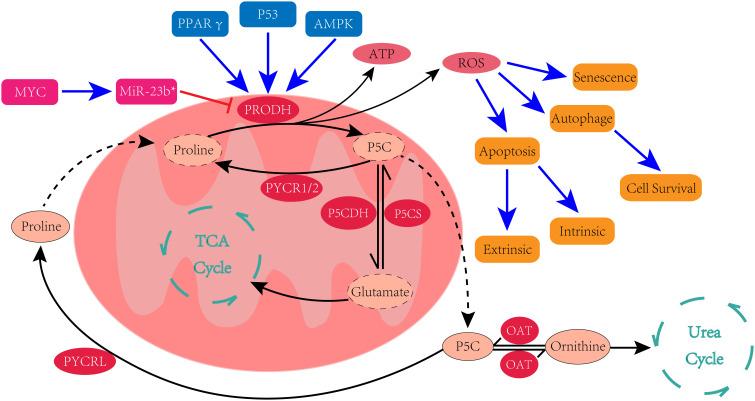
Emerging evidence suggests that proline metabolism is important for regulating the survival and death of different types of cancer cells. Proline dehydrogenase (PRODH), an enzyme catalyzing proline catabolism, and the degradation products of proline by PRODH, such as ATP and ROS, are known to play critical roles in cancer progression. Notably, the role of PRODH in cancer is still complicated and unclear, and primarily depends on the cancer type and tumor microenvironment. For instance, PRODH induces apoptosis and senescence through ROS signaling in different types of cancers, while as a protumor factor, PRODH promotes malignant phenotypes of certain tumors under stresses such as hypoxia. In order to assess whether PRODH can serve as a novel target for cancer therapy, we will provide an overview of the biological functions of PRODH and its double-edged role in cancer in this article.
新出现的证据表明,脯氨酸代谢对于调节不同类型癌细胞的存活和死亡至关重要。脯氨酸脱氢酶(PRODH)是一种催化脯氨酸分解代谢的酶,已知PRODH催化产生的脯氨酸降解产物,如ATP和ROS,在癌症进展中起关键作用。值得注意的是,PRODH在癌症中的作用仍然复杂且不明确,主要取决于癌症类型和肿瘤微环境。例如,PRODH通过ROS信号在不同类型的癌症中诱导细胞凋亡和衰老,而作为一种促肿瘤因子,PRODH在缺氧等应激条件下促进某些肿瘤的恶性表型。为了评估PRODH是否可作为癌症治疗的新靶点,我们将在本文中概述PRODH的生物学功能及其在癌症中的双刃剑作用。
 Zotero 插件