
脯氨酸可转化氨基酸的接口 P5C 及其在细胞存活和凋亡调控中的作用。
P5C as an Interface of Proline Interconvertible Amino Acids and Its Role in Regulation of Cell Survival and Apoptosis.
机构信息
Department of Medicinal Chemistry, Medical University of Bialystok, 15-089 Białystok, Poland.
出版信息
Int J Mol Sci. 2021 Oct 29;22(21):11763. doi: 10.3390/ijms222111763.
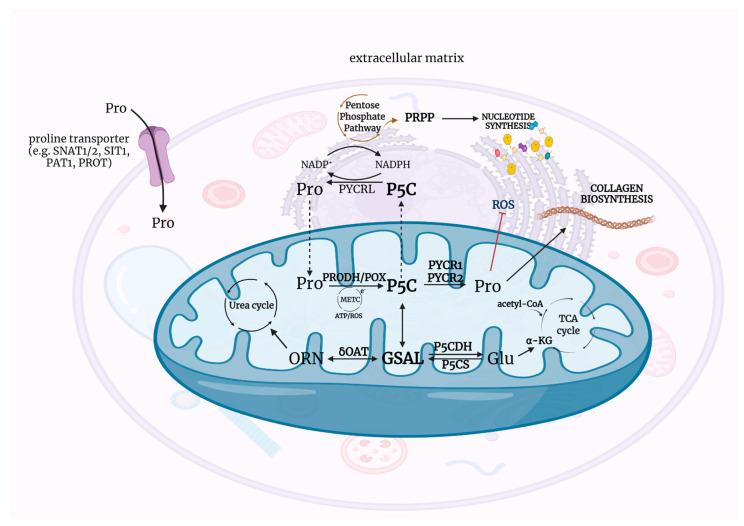
Studies of cancer metabolism have focused on the production of energy and the interconversion of carbons between cell cycles. More recently, amino acid metabolism, especially non-essential amino acids (NEAAs), has been investigated, underlining their regulatory role. One of the important mediators in energy production and interconversion of carbons in the cell is Δ-pyrroline-5-carboxylate (P5C)-the physiological intracellular intermediate of the interconversion of proline, ornithine, and glutamate. As a central component of these conversions, it links the tricarboxylic acid cycle (TCA), urea cycle (UC), and proline cycle (PC). P5C has a cyclic structure containing a tertiary nitrogen atom (N) and is in tautomeric equilibrium with the open-chain form of L-glutamate--semialdehyde (GSAL). P5C is produced by P5C synthase (P5CS) from glutamate, and ornithine via ornithine -amino acid transferase (OAT). It can also be converted to glutamate by P5C dehydrogenase (P5CDH). P5C is both a direct precursor of proline and a product of its degradation. The conversion of P5C to proline is catalyzed by P5C reductase (PYCR), while proline to P5C by proline dehydrogenase/oxidase (PRODH/POX). P5C-proline-P5C interconversion forms a functional redox couple. Their transformations are accompanied by the transfer of a reducing-oxidizing potential, that affect the NADP+/NADPH ratio and a wide variety of processes, e.g., the synthesis of phosphoribosyl pyrophosphate (PRPP), and purine ribonucleotides, which are crucial for DNA synthesis. This review focuses on the metabolism of P5C in the cell as an interconversion mediator of proline, glutamate, and ornithine and its role in the regulation of survival and death with particular emphasis on the metabolic context.
癌症代谢的研究主要集中在能量的产生和细胞周期中碳的相互转化上。最近,人们研究了氨基酸代谢,特别是非必需氨基酸(NEAAs),强调了它们的调节作用。在细胞中能量产生和碳的相互转化中,重要的调节因子之一是 δ-吡咯啉-5-羧酸(P5C)——脯氨酸、鸟氨酸和谷氨酸相互转化的生理细胞内中间产物。作为这些转化的核心成分,它连接三羧酸循环(TCA)、尿素循环(UC)和脯氨酸循环(PC)。P5C 具有包含叔氮原子(N)的环状结构,并且处于与 L-谷氨酸-半醛(GSAL)的开链形式的互变异构平衡中。P5C 由谷氨酸和鸟氨酸通过鸟氨酸 -氨基酸转移酶(OAT)在 P5C 合酶(P5CS)的作用下产生。它也可以通过 P5C 脱氢酶(P5CDH)转化为谷氨酸。P5C 既是脯氨酸的直接前体,也是其降解的产物。P5C 向脯氨酸的转化由 P5C 还原酶(PYCR)催化,而脯氨酸向 P5C 的转化由脯氨酸脱氢酶/氧化酶(PRODH/POX)催化。P5C-脯氨酸-P5C 相互转化形成功能氧化还原偶联。它们的转化伴随着氧化还原电势的转移,影响 NADP+/NADPH 比值和各种过程,例如,磷酸核糖焦磷酸(PRPP)和嘌呤核苷酸的合成,这对 DNA 合成至关重要。本综述重点讨论了细胞中 P5C 作为脯氨酸、谷氨酸和鸟氨酸相互转化的媒介的代谢及其在调节存活和死亡中的作用,特别强调了代谢背景。

 Zotero 插件