
老年人接种新冠mRNA疫苗及突破性感染后的T细胞反应动态
Dynamics of T-cell Responses Following COVID-19 mRNA Vaccination and Breakthrough Infection in Older Adults.
作者信息
Datwani Sneha, Kalikawe Rebecca, Mwimanzi Francis, Speckmaier Sarah, Liang Richard, Sang Yurou, Waterworth Rachel, Yaseen Fatima, Lapointe Hope R, Barad Evan, DeMarco Mari L, Holmes Daniel T, Simons Janet, Montaner Julio S G, Romney Marc G, Brumme Zabrina L, Brockman Mark A
机构信息
Faculty of Health Sciences, Simon Fraser University, Burnaby, Canada.
British Columbia Centre for Excellence in HIV/AIDS, Vancouver, Canada.
出版信息
Pathog Immun. 2023 Nov 17;8(1):117-135. doi: 10.20411/pai.v8i1.613. eCollection 2023.
INTRODUCTION
While older adults generally mount weaker antibody responses to a primary COVID-19 vaccine series, T-cell responses remain less well characterized in this population. We compared SARS-CoV-2 spike-specific T-cell responses after 2- and 3-dose COVID-19 mRNA vaccination and subsequent breakthrough infection in older and younger adults.
METHODS
We quantified CD4+ and CD8+ T-cells reactive to overlapping peptides spanning the ancestral SARS-CoV-2 spike protein in 40 older adults (median age 79) and 50 younger health care workers (median age 39), all COVID-19 naive, using an activation-induced marker assay. T-cell responses were further assessed in 24 participants, including 8 older adults, who subsequently experienced their first SARS-CoV-2 breakthrough infection.
RESULTS
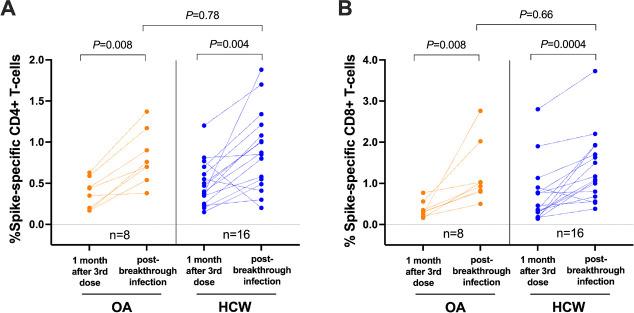
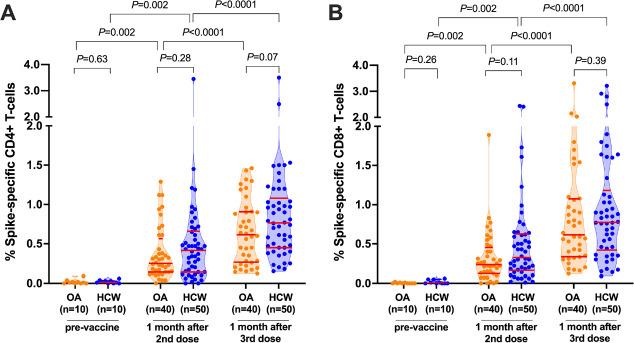
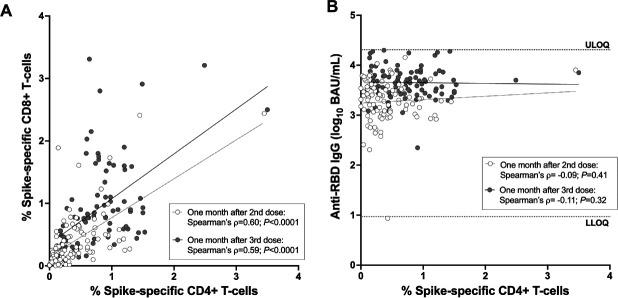
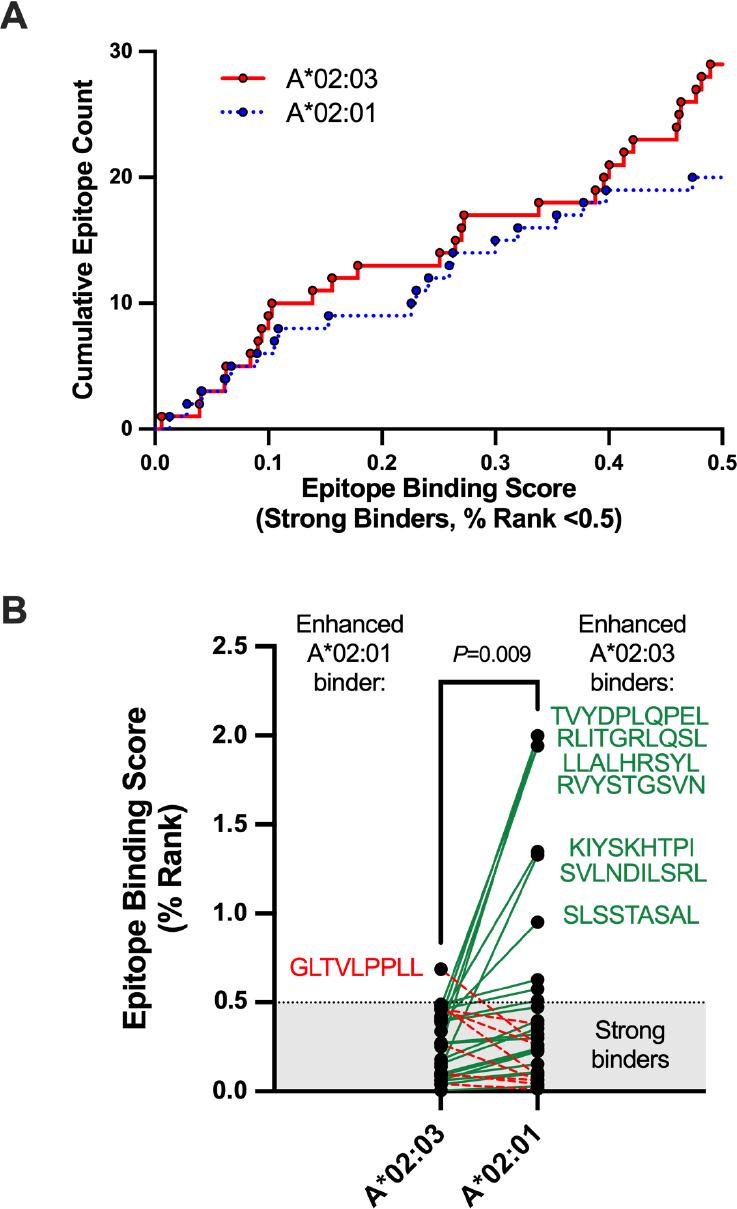
A third COVID-19 mRNA vaccine dose significantly boosted spike-specific CD4+ and CD8+ T-cell frequencies to above 2-dose levels in older and younger adults. T-cell frequencies did not significantly differ between older and younger adults after either dose. Multivariable analyses adjusting for sociodemographic, health, and vaccine-related variables confirmed that older age was not associated with impaired cellular responses. Instead, the strongest predictors of CD4+ and CD8+ T-cell frequencies post-third-dose were their corresponding post-second-dose frequencies. Breakthrough infection significantly increased both CD4+ and CD8+ T-cell frequencies, to comparable levels in older and younger adults. Exploratory analyses revealed an association between HLA-A02:03 and higher post-vaccination CD8+ T-cell frequencies, which may be attributable to numerous strong-binding HLA-A02:03-specific CD8+ T-cell epitopes in the spike protein.
CONCLUSION
Older adults mount robust T-cell responses to 2- and 3-dose COVID-19 mRNA vaccination, which are further boosted following breakthrough infection.
引言
虽然老年人对新冠病毒-19 疫苗初种系列的抗体反应通常较弱,但该人群的 T 细胞反应特征仍不太明确。我们比较了老年人和年轻人在接种 2 剂和 3 剂新冠病毒-19 mRNA 疫苗后以及随后发生突破性感染后的新冠病毒刺突蛋白特异性 T 细胞反应。
方法
我们使用激活诱导标记分析法,对 40 名老年人(中位年龄 79 岁)和 50 名年轻医护人员(中位年龄 39 岁)中针对涵盖原始新冠病毒刺突蛋白的重叠肽产生反应的 CD4+和 CD8+T 细胞进行了定量,所有参与者均未感染过新冠病毒-19。在 24 名参与者中进一步评估了 T 细胞反应,其中包括 8 名随后经历首次新冠病毒突破性感染的老年人。
结果
第三剂新冠病毒-19 mRNA 疫苗显著提高了老年人和年轻人中刺突蛋白特异性 CD4+和 CD8+T 细胞频率,使其高于 2 剂接种后的水平。两剂接种后,老年人和年轻人的 T 细胞频率无显著差异。在对社会人口统计学、健康状况和疫苗相关变量进行调整的多变量分析中,证实年龄较大与细胞反应受损无关。相反,第三剂接种后 CD4+和 CD8+T 细胞频率的最强预测因素是其相应的第二剂接种后的频率。突破性感染显著增加了 CD4+和 CD8+T 细胞频率,在老年人和年轻人中达到了相当的水平。探索性分析揭示了 HLA-A02:03 与接种疫苗后较高的 CD8+T 细胞频率之间的关联,这可能归因于刺突蛋白中众多与 HLA-A
 Zotero 插件