
γc 家族细胞因子对过继转移 T 细胞干性的新认识。
New insights into the stemness of adoptively transferred T cells by γc family cytokines.
机构信息
Department of Gynecological Oncology, Tongji Hospital, Tongji Medical College, Huazhong University of Science and Technology, Wuhan, China.
National Clinical Research Center for Obstetrics and Gynecology, Cancer Biology Research Center (Key Laboratory of the Ministry of Education), Tongji Hospital, Tongji Medical College, Huazhong University of Science and Technology, Wuhan, China.
出版信息
Cell Commun Signal. 2023 Dec 4;21(1):347. doi: 10.1186/s12964-023-01354-3.
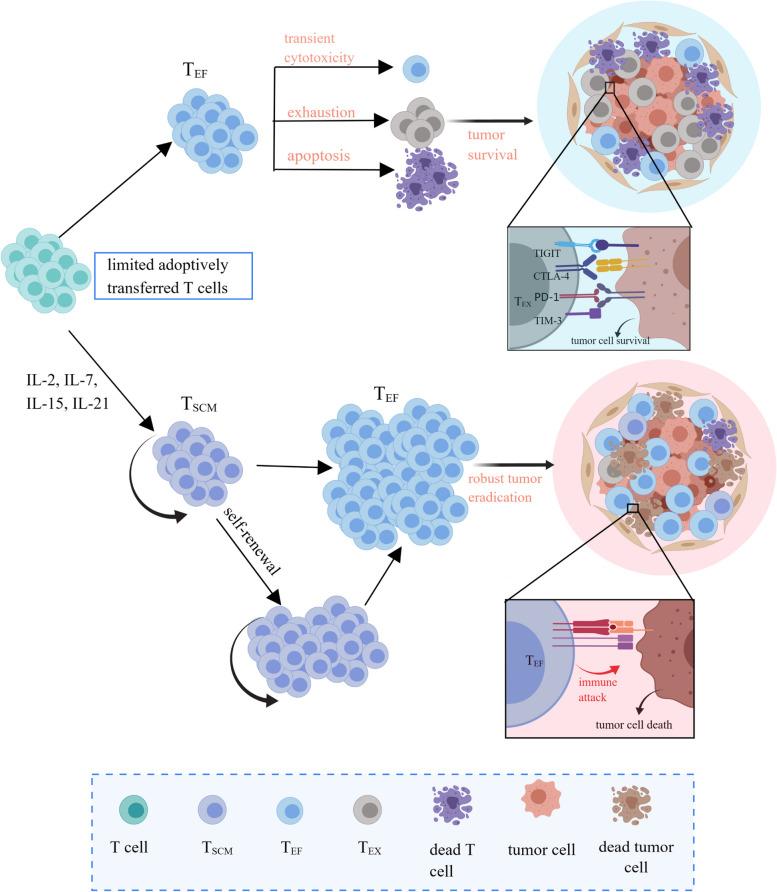
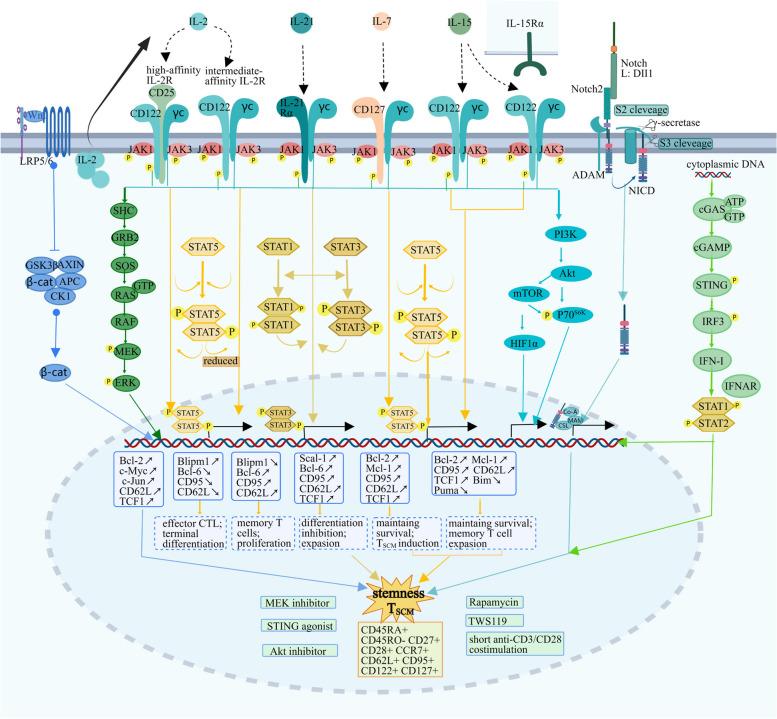
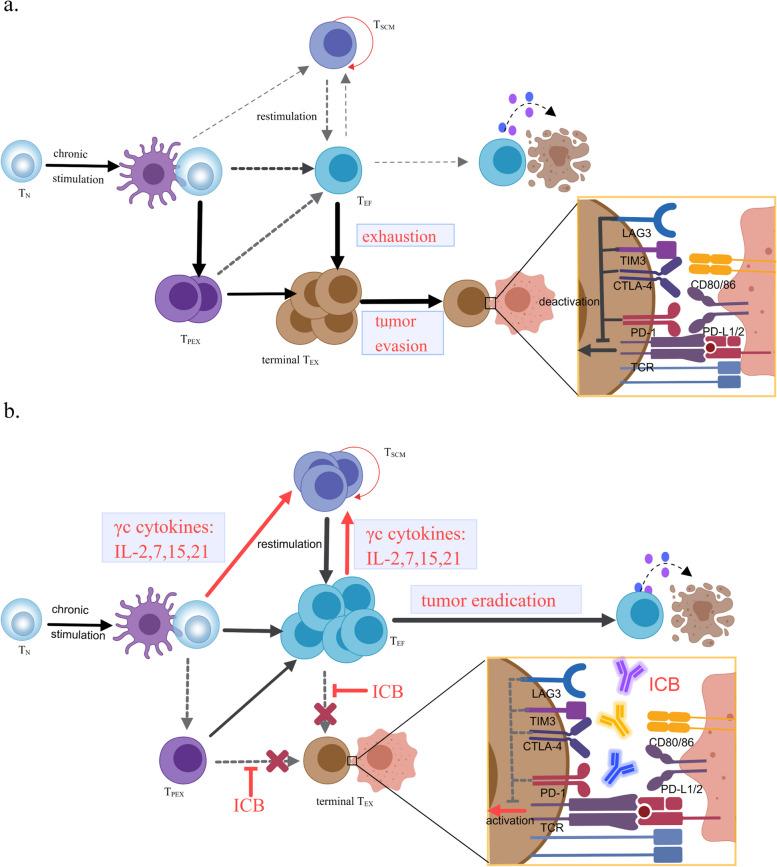
T cell-based adoptive cell therapy (ACT) has exhibited excellent antitumoral efficacy exemplified by the clinical breakthrough of chimeric antigen receptor therapy (CAR-T) in hematologic malignancies. It relies on the pool of functional T cells to retain the developmental potential to serially kill targeted cells. However, failure in the continuous supply and persistence of functional T cells has been recognized as a critical barrier to sustainable responses. Conferring stemness on infused T cells, yielding stem cell-like memory T cells (T) characterized by constant self-renewal and multilineage differentiation similar to pluripotent stem cells, is indeed necessary and promising for enhancing T cell function and sustaining antitumor immunity. Therefore, it is crucial to identify T cell induction regulators and acquire more T cells as resource cells during production and after infusion to improve antitumoral efficacy. Recently, four common cytokine receptor γ chain (γc) family cytokines, encompassing interleukin-2 (IL-2), IL-7, IL-15, and IL-21, have been widely used in the development of long-lived adoptively transferred T in vitro. However, challenges, including their non-specific toxicities and off-target effects, have led to substantial efforts for the development of engineered versions to unleash their full potential in the induction and maintenance of T cell stemness in ACT. In this review, we summarize the roles of the four γc family cytokines in the orchestration of adoptively transferred T cell stemness, introduce their engineered versions that modulate T cell formation and demonstrate the potential of their various combinations. Video Abstract.
基于 T 细胞的过继细胞疗法 (ACT) 具有出色的抗肿瘤疗效,嵌合抗原受体疗法 (CAR-T) 在血液恶性肿瘤中的临床突破就是例证。它依赖于功能 T 细胞池,以保持连续杀伤靶细胞的发育潜力。然而,功能性 T 细胞的持续供应和持续存在的失败已被认为是可持续反应的关键障碍。赋予输注的 T 细胞干性,产生类似于多能干细胞的具有持续自我更新和多谱系分化特性的干细胞样记忆 T 细胞(T),确实是增强 T 细胞功能和维持抗肿瘤免疫所必需和有前途的。因此,确定 T 细胞诱导调节剂并在生产和输注后获得更多作为资源细胞的 T 细胞,以提高抗肿瘤疗效至关重要。最近,四种常见的细胞因子受体γ链(γc)家族细胞因子,包括白细胞介素-2 (IL-2)、IL-7、IL-15 和 IL-21,已广泛用于体外长期过继转移 T 的开发。然而,包括非特异性毒性和脱靶效应在内的挑战,促使人们大力开发工程化版本,以充分发挥它们在 ACT 中诱导和维持 T 细胞干性中的潜力。在这篇综述中,我们总结了这四种 γc 家族细胞因子在过继转移 T 细胞干性协调中的作用,介绍了它们调节 T 细胞形成的工程化版本,并展示了它们各种组合的潜力。视频摘要。

 Zotero 插件