
间歇性补充非瑟酮可通过减少细胞衰老来改善老年小鼠的动脉功能。
Intermittent supplementation with fisetin improves arterial function in old mice by decreasing cellular senescence.
作者信息
Mahoney Sophia A, Venkatasubramanian Ravinandan, Darrah Mary A, Ludwig Katelyn R, VanDongen Nicholas S, Greenberg Nathan T, Longtine Abigail G, Hutton David A, Brunt Vienna E, Campisi Judith, Melov Simon, Seals Douglas R, Rossman Matthew J, Clayton Zachary S
机构信息
Department of Integrative Physiology, University of Colorado Boulder, Boulder, Colorado, USA.
Buck Institute for Research on Aging, Novato, California, USA.
出版信息
Aging Cell. 2024 Mar;23(3):e14060. doi: 10.1111/acel.14060. Epub 2023 Dec 7.
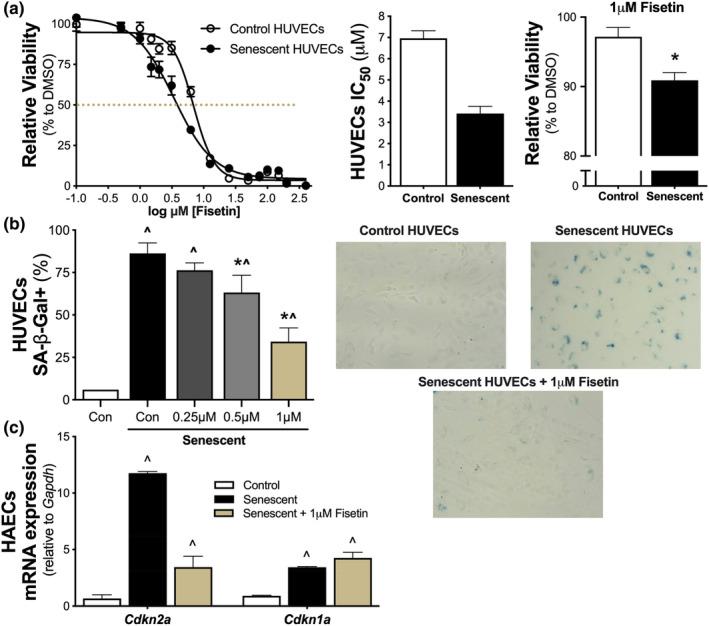
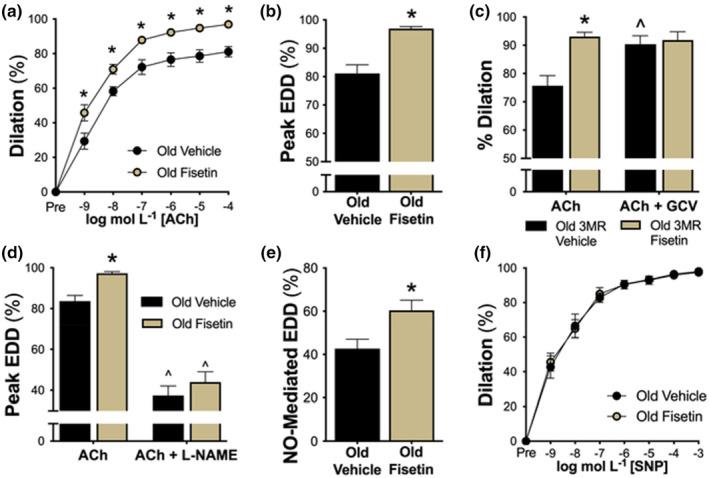
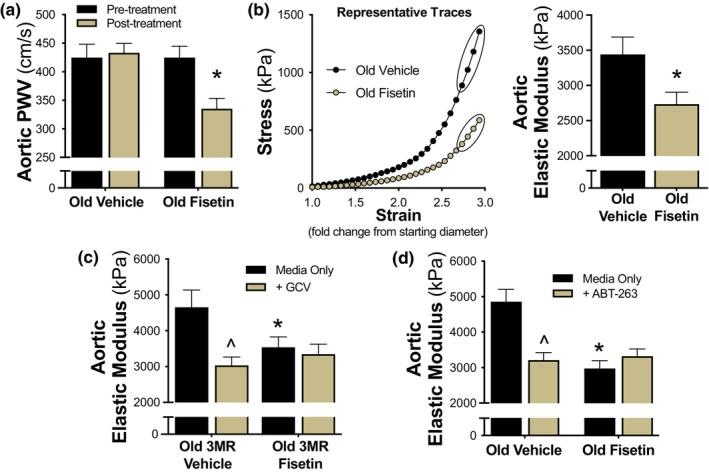
Cellular senescence and the senescence-associated secretory phenotype (SASP) contribute to age-related arterial dysfunction, in part, by promoting oxidative stress and inflammation, which reduce the bioavailability of the vasodilatory molecule nitric oxide (NO). In the present study, we assessed the efficacy of fisetin, a natural compound, as a senolytic to reduce vascular cell senescence and SASP factors and improve arterial function in old mice. We found that fisetin decreased cellular senescence in human endothelial cell culture. In old mice, vascular cell senescence and SASP-related inflammation were lower 1 week after the final dose of oral intermittent (1 week on-2 weeks off-1 weeks on dosing) fisetin supplementation. Old fisetin-supplemented mice had higher endothelial function. Leveraging old p16-3MR mice, a transgenic model allowing genetic clearance of p16 -positive senescent cells, we found that ex vivo removal of senescent cells from arteries isolated from vehicle- but not fisetin-treated mice increased endothelium-dependent dilation, demonstrating that fisetin improved endothelial function through senolysis. Enhanced endothelial function with fisetin was mediated by increased NO bioavailability and reduced cellular- and mitochondrial-related oxidative stress. Arterial stiffness was lower in fisetin-treated mice. Ex vivo genetic senolysis in aorta rings from p16-3MR mice did not further reduce mechanical wall stiffness in fisetin-treated mice, demonstrating lower arterial stiffness after fisetin was due to senolysis. Lower arterial stiffness with fisetin was accompanied by favorable arterial wall remodeling. The findings from this study identify fisetin as promising therapy for clinical translation to target excess cell senescence to treat age-related arterial dysfunction.
细胞衰老和衰老相关分泌表型(SASP)在一定程度上通过促进氧化应激和炎症,导致与年龄相关的动脉功能障碍,而氧化应激和炎症会降低血管舒张分子一氧化氮(NO)的生物利用度。在本研究中,我们评估了天然化合物非瑟酮作为一种衰老细胞溶解剂,在减少老年小鼠血管细胞衰老和SASP因子以及改善动脉功能方面的功效。我们发现非瑟酮可降低人内皮细胞培养中的细胞衰老。在老年小鼠中,口服间歇性(1周给药 - 2周停药 - 1周给药)非瑟酮补充剂最后一剂后1周,血管细胞衰老和SASP相关炎症较低。补充非瑟酮的老年小鼠具有更高的内皮功能。利用老年p16-3MR小鼠(一种允许对p16阳性衰老细胞进行基因清除的转基因模型),我们发现从用载体处理而非非瑟酮处理的小鼠分离的动脉中离体去除衰老细胞可增加内皮依赖性舒张,这表明非瑟酮通过衰老细胞溶解改善了内皮功能。非瑟酮增强的内皮功能是由增加的NO生物利用度以及降低的细胞和线粒体相关氧化应激介导的。非瑟酮处理的小鼠动脉僵硬度较低。对p16-3MR小鼠主动脉环进行的离体基因衰老细胞溶解并未进一步降低非瑟酮处理小鼠的机械壁僵硬度,这表明非瑟酮处理后动脉僵硬度降低是由于衰老细胞溶解。非瑟酮使动脉僵硬度降低的同时伴随着有利的动脉壁重塑。本研究结果表明,非瑟酮有望用于临床转化,以靶向过度的细胞衰老来治疗与年龄相关的动脉功能障碍。



 Zotero 插件