
外泌体环状RNA在胃癌中的调控机制及潜在临床应用
Regulatory mechanism and promising clinical application of exosomal circular RNA in gastric cancer.
作者信息
Han Ming, Zhang Mengyuan, Qi Mei, Zhou Yue, Li Fulong, Fang Shengquan
机构信息
Department of Gastroenterology, Yueyang Hospital of Integrated Traditional Chinese and Western Medicine, Shanghai University of Traditional Chinese Medicine, Shanghai, China.
出版信息
Front Oncol. 2023 Nov 29;13:1236679. doi: 10.3389/fonc.2023.1236679. eCollection 2023.
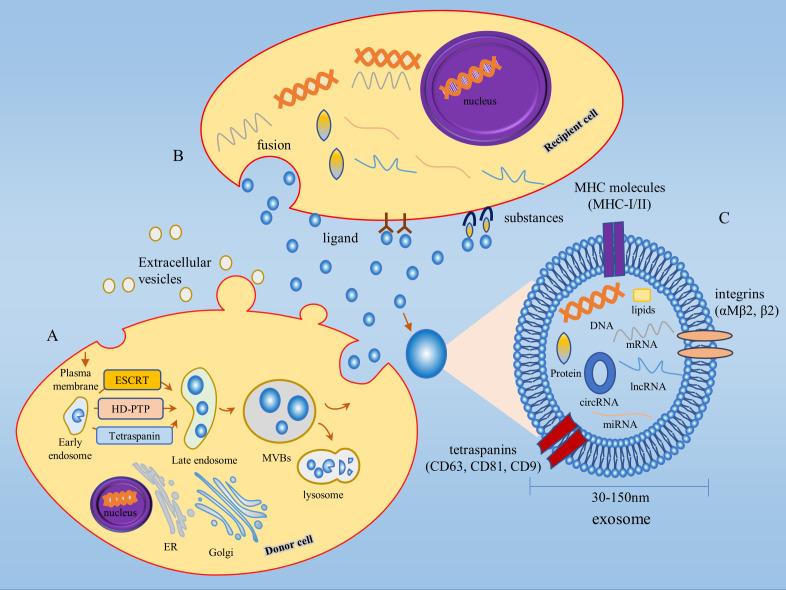
Gastric cancer (GC) is one of the most common malignancies worldwide and the leading cause of cancer-related deaths. Exosomes are nanoscale extracellular vesicles secreted by a variety of cells and play an important role in cellular communication and epigenetics by transporting bioactive substances in the tumor microenvironment (TME). Circular RNA (circRNA) is a type of non-coding RNA (ncRNA) with a specific structure, which is widely enriched in exosomes and is involved in various pathophysiological processes mediated by exosomes. Exosomal circRNAs play a critical role in the development of GC by regulating epithelial-mesenchymal transition (EMT), angiogenesis, proliferation, invasion, migration, and metastasis of GC. Given the biological characteristics of exosomal circRNAs, they have more significant diagnostic sensitivity and specificity in the clinic and may become biomarkers for GC diagnosis and prognosis. In this review, we briefly describe the biogenesis of exosomes and circRNAs and their biological functions, comprehensively summarize the mechanisms of exosomal circRNAs in the development of GC and chemotherapy resistance, and finally, we discuss the potential clinical application value and challenges of exosomal circRNAs in GC.
胃癌(GC)是全球最常见的恶性肿瘤之一,也是癌症相关死亡的主要原因。外泌体是由多种细胞分泌的纳米级细胞外囊泡,通过在肿瘤微环境(TME)中运输生物活性物质,在细胞通讯和表观遗传学中发挥重要作用。环状RNA(circRNA)是一种具有特定结构的非编码RNA(ncRNA),广泛富集于外泌体中,并参与外泌体介导的各种病理生理过程。外泌体circRNA通过调节胃癌的上皮-间质转化(EMT)、血管生成、增殖、侵袭、迁移和转移,在胃癌的发生发展中起关键作用。鉴于外泌体circRNA的生物学特性,它们在临床上具有更高的诊断敏感性和特异性,可能成为胃癌诊断和预后的生物标志物。在本综述中,我们简要描述了外泌体和circRNA的生物发生及其生物学功能,全面总结了外泌体circRNA在胃癌发生发展和化疗耐药中的机制,最后讨论了外泌体circRNA在胃癌中的潜在临床应用价值和挑战。


 Zotero 插件