
免疫检查点抑制剂治疗患者的无癌预测治疗反应和死亡率的 C 反应蛋白早期动力学:一项多中心队列研究。
Early kinetics of C reactive protein for cancer-agnostic prediction of therapy response and mortality in patients treated with immune checkpoint inhibitors: a multicenter cohort study.
机构信息
Division of Oncology; Department of Internal Medicine, Medical University of Graz, Graz, Austria.
Division of Hematology; Department of Internal Medicine, Medical University of Graz, Graz, Austria.
出版信息
J Immunother Cancer. 2023 Dec 14;11(12):e007765. doi: 10.1136/jitc-2023-007765.
BACKGROUND
C reactive protein (CRP) kinetics have recently been suggested as predictive biomarkers for the efficacy of immune checkpoint inhibitor (ICI) therapy in selected cancer types. The aim of this study was to characterize early CRP kinetics as a tumor-agnostic biomarker for ICI treatment outcomes.
METHODS
In this multicenter retrospective cohort study, two independent cohorts of patients with various cancer types undergoing palliative ICI treatment at Austrian academic centers served as the discovery (n=562) and validation cohort (n=474). Four different patterns of CRP kinetics in the first 3 months of ICI therapy were defined (CRP-flare responders, CRP-responders, CRP non-responders, patients with all-normal CRP). Objective response rate (ORR), progression-free survival (PFS) and overall survival (OS) were defined as coprimary endpoints. Univariable and multivariable logistic regression, landmark analysis and Cox regression including CRP kinetics as time-dependent variable were performed.
RESULTS
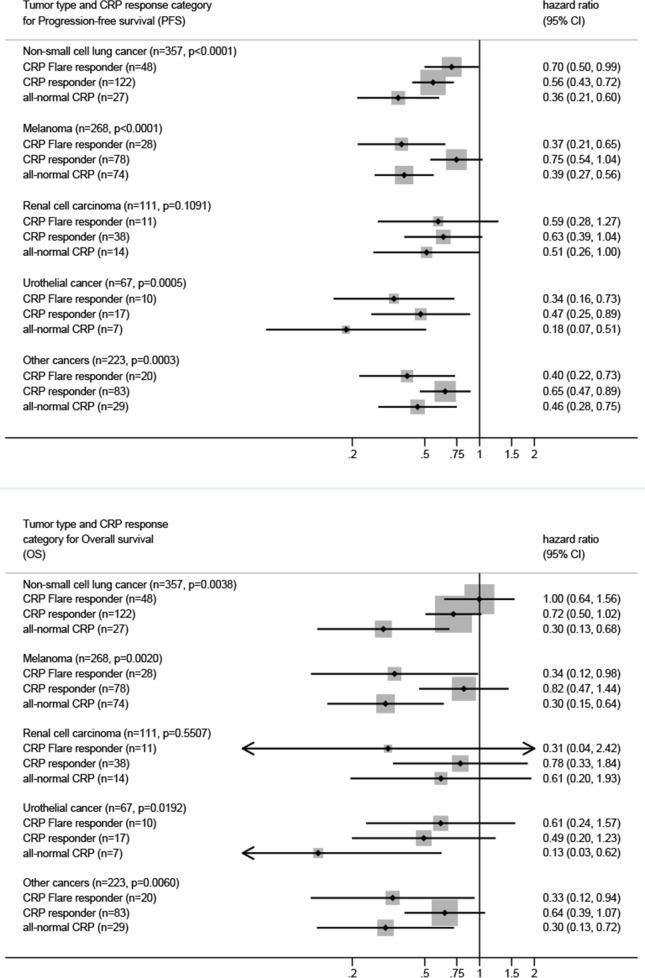
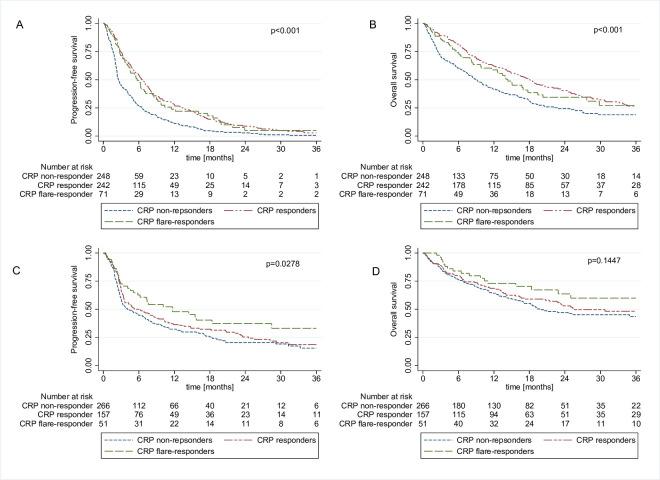
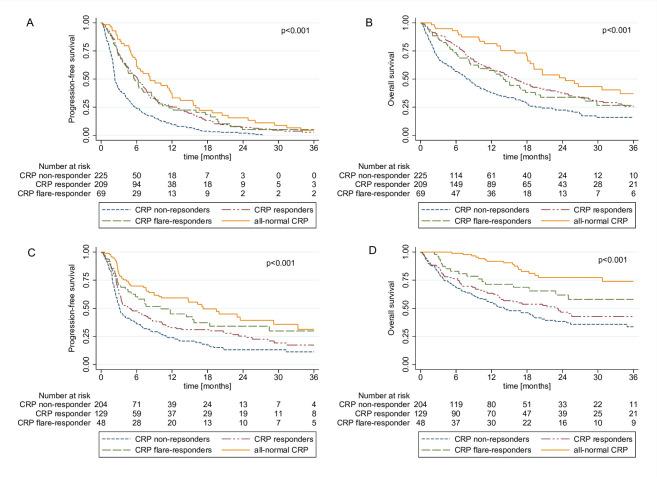
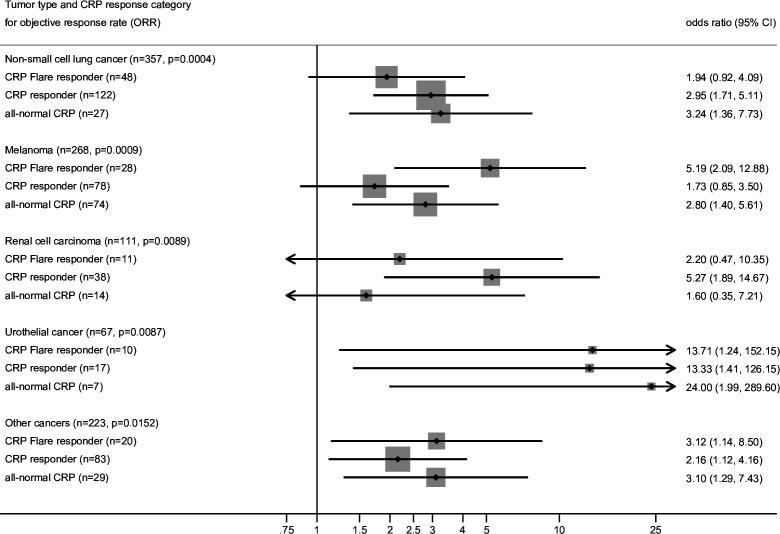
The ORR in patients with all-normal CRP, CRP responders, CRP flare-responders and CRP non-responders was 41%, 38%, 31% and 12%, respectively. The median OS and PFS estimates were 24.5 months (95% CI 18.5 to not reached) and 8.2 months (95% CI 5.9 to 12.0) in patients with all-normal CRP, 16.1 months (95% CI 12.6 to 19-8) and 6.1 months (95% CI 4.9 to 7.2) in CRP-responders, 14.0 months (95% CI 8.5 to 19.4) and 5.7 months (95% CI 4.1 to 8.5) in CRP flare-responders and 8.1 months (95% CI 5.8 to 9.9) and 2.3 months (95% CI 2.2 to 2.8) in CRP non-responders (log-rank p for PFS and OS<0.001). These findings prevailed in multivariable analysis and could be fully confirmed in our validation cohort. Pooled subgroup analysis suggested a consistent predictive significance of early CRP kinetics for treatment efficacy and outcome independent of cancer type.
CONCLUSION
Early CRP kinetics represent a tumor-agnostic predictor for treatment response, progression risk and mortality in patients with cancer undergoing ICI therapy.
背景
C 反应蛋白(CRP)动力学最近被认为是预测免疫检查点抑制剂(ICI)治疗在某些癌症类型中的疗效的生物标志物。本研究的目的是描述 CRP 动力学作为肿瘤无关的 ICI 治疗结果的生物标志物。
方法
在这项多中心回顾性队列研究中,来自奥地利学术中心接受姑息性 ICI 治疗的不同癌症类型的患者的两个独立队列作为发现队列(n=562)和验证队列(n=474)。在 ICI 治疗的前 3 个月内定义了 CRP 动力学的四种不同模式(CRP 爆发反应者、CRP 反应者、CRP 无反应者、所有 CRP 正常的患者)。客观缓解率(ORR)、无进展生存期(PFS)和总生存期(OS)定义为主要终点。进行单变量和多变量逻辑回归、 landmark 分析和 Cox 回归,包括 CRP 动力学作为时间依赖性变量。
结果
所有 CRP 正常、CRP 反应者、CRP 爆发反应者和 CRP 无反应者的 ORR 分别为 41%、38%、31%和 12%。所有 CRP 正常患者的中位 OS 和 PFS 估计值分别为 24.5 个月(95%CI 18.5 至未达到)和 8.2 个月(95%CI 5.9 至 12.0),CRP 反应者为 16.1 个月(95%CI 12.6 至 19-8)和 6.1 个月(95%CI 4.9 至 7.2),CRP 爆发反应者为 14.0 个月(95%CI 8.5 至 19.4)和 5.7 个月(95%CI 4.1 至 8.5),CRP 无反应者为 8.1 个月(95%CI 5.8 至 9.9)和 2.3 个月(95%CI 2.2 至 2.8)(log-rank p<0.001,用于 PFS 和 OS)。这些发现在多变量分析中成立,并可在我们的验证队列中完全证实。合并亚组分析表明,早期 CRP 动力学对接受 ICI 治疗的癌症患者的治疗效果和结局具有一致的预测意义,与癌症类型无关。
结论
早期 CRP 动力学是肿瘤无关的预测因子,可预测癌症患者接受 ICI 治疗的反应、进展风险和死亡率。
 Zotero 插件