
基于可穿戴惯性传感器的多模态人体活动识别的深度小波卷积神经网络
Deep Wavelet Convolutional Neural Networks for Multimodal Human Activity Recognition Using Wearable Inertial Sensors.
机构信息
Department of Informatics, National Institute of Informatics, Tokyo 101-0003, Japan.
Department of Computer Engineering, School of Information and Communication Technology, Hanoi University of Science and Technology, Hanoi 11615, Vietnam.
出版信息
Sensors (Basel). 2023 Dec 9;23(24):9721. doi: 10.3390/s23249721.
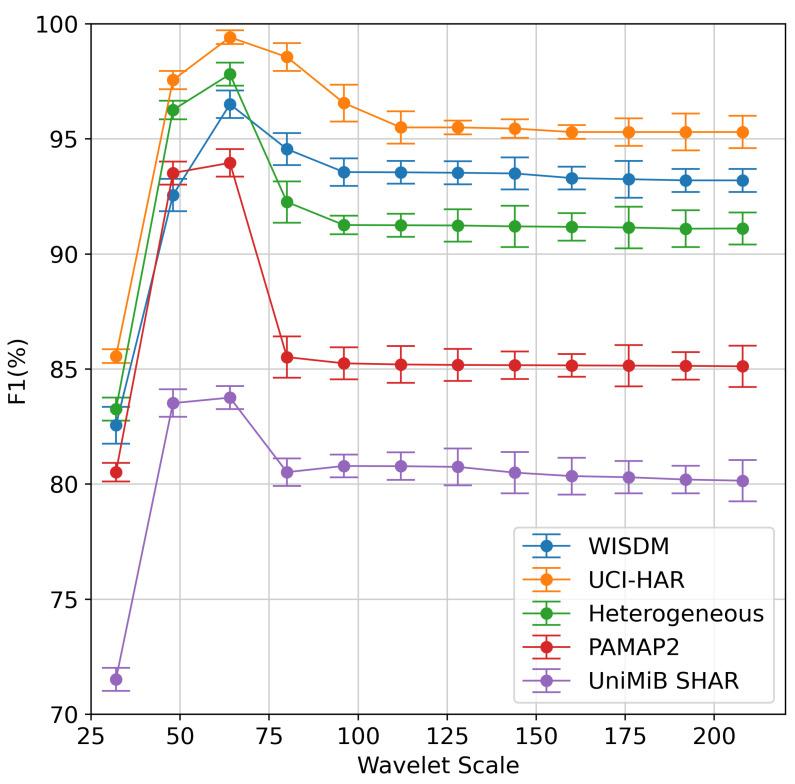
Recent advances in wearable systems have made inertial sensors, such as accelerometers and gyroscopes, compact, lightweight, multimodal, low-cost, and highly accurate. Wearable inertial sensor-based multimodal human activity recognition (HAR) methods utilize the rich sensing data from embedded multimodal sensors to infer human activities. However, existing HAR approaches either rely on domain knowledge or fail to address the time-frequency dependencies of multimodal sensor signals. In this paper, we propose a novel method called deep wavelet convolutional neural networks (DWCNN) designed to learn features from the time-frequency domain and improve accuracy for multimodal HAR. DWCNN introduces a framework that combines continuous wavelet transforms (CWT) with enhanced deep convolutional neural networks (DCNN) to capture the dependencies of sensing signals in the time-frequency domain, thereby enhancing the feature representation ability for multiple wearable inertial sensor-based HAR tasks. Within the CWT, we further propose an algorithm to estimate the wavelet scale parameter. This helps enhance the performance of CWT when computing the time-frequency representation of the input signals. The output of the CWT then serves as input for the proposed DCNN, which consists of residual blocks for extracting features from different modalities and attention blocks for fusing these features of multimodal signals. We conducted extensive experiments on five benchmark HAR datasets: WISDM, UCI-HAR, Heterogeneous, PAMAP2, and UniMiB SHAR. The experimental results demonstrate the superior performance of the proposed model over existing competitors.
近年来,可穿戴系统的发展使得惯性传感器(如加速度计和陀螺仪)变得小巧、轻便、多模态、低成本和高度精确。基于可穿戴惯性传感器的多模态人体活动识别 (HAR) 方法利用嵌入式多模态传感器的丰富传感数据来推断人体活动。然而,现有的 HAR 方法要么依赖于领域知识,要么无法解决多模态传感器信号的时频依赖性。在本文中,我们提出了一种称为深度小波卷积神经网络 (DWCNN) 的新方法,旨在从时频域学习特征,并提高多模态 HAR 的准确性。DWCNN 引入了一个框架,将连续小波变换 (CWT) 与增强的深度卷积神经网络 (DCNN) 相结合,以捕获传感信号在时频域中的依赖性,从而增强基于多个可穿戴惯性传感器的 HAR 任务的特征表示能力。在 CWT 中,我们进一步提出了一种算法来估计小波尺度参数。这有助于在计算输入信号的时频表示时提高 CWT 的性能。CWT 的输出作为所提出的 DCNN 的输入,该 DCNN 由用于从不同模态提取特征的残差块和用于融合多模态信号的这些特征的注意力块组成。我们在五个基准 HAR 数据集上进行了广泛的实验:WISDM、UCI-HAR、Heterogeneous、PAMAP2 和 UniMiB SHAR。实验结果表明,所提出的模型优于现有竞争对手。


 Zotero 插件