
接种不同 COVID-19 疫苗后针对 SARS-CoV-2 产生的口服 IgA 应答的发展。
Development of an Oral IgA Response against SARS-CoV-2 Following Immunization with Different COVID-19 Vaccines.
机构信息
Department of Chemical, Pharmaceutical and Agricultural Sciences, and Laboratorio per le Tecnologie delle Terapie Avanzate (LTTA), Section of Microbiology, University of Ferrara, 44121 Ferrara, Italy.
Department of Chemical, Pharmaceutical and Agricultural Sciences, Laboratory of Biochemistry, Immunology and Microbiology (BIM), University of Ferrara, 44123 Ferrara, Italy.
出版信息
Viruses. 2023 Nov 25;15(12):2319. doi: 10.3390/v15122319.
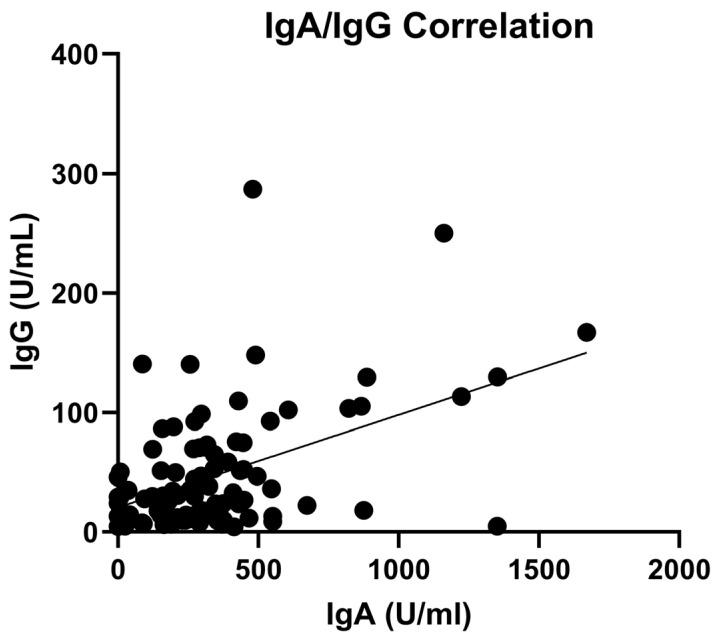
The mucosal immune response is recognized to be important in the early control of infection sustained by viruses with mucosal tissues as the primary site of entry and replication, such as SARS-CoV-2. Mucosal IgA has been consistently reported in the mouth and eye of SARS-CoV-2 infected subjects, where it correlated inversely with COVID-19 symptom severity. Yet, there is still scarce information on the comparative ability of the diverse SARS-CoV-2 vaccines to induce local IgA responses at the virus entry site. Thus, the aim of this study was to assess the presence of anti-SARS-CoV-2 IgA in the saliva of 95 subjects vaccinated with a booster dose and different combinations of vaccines, including mRNA-1273 (Moderna), BNT162b2 (Pfizer-BioNTech), and Vaxzevria (AstraZeneca). The results showed the presence of a mucosal response in 93.7% of vaccinated subjects, with a mean IgA titer of 351.5 ± 31.77 U/mL, strongly correlating with the serum anti-SARS-CoV-2 IgG titer ( < 0.0001). No statistically significant differences emerged between the vaccine types, although the salivary IgA titer appeared slightly higher after receiving a booster dose of the mRNA-1273 vaccine (Moderna) following two doses of BNT162b2 (Pfizer-BioNTech), compared to the other vaccine combinations. These data confirm what was previously reported at the eye level and suggest that monitoring salivary IgA may be a useful tool for driving forward vaccine design and surveillance strategies, potentially leading to novel routes of vaccine administration and boosting.
黏膜免疫反应被认为在控制以黏膜组织为主要入侵和复制部位的病毒感染方面至关重要,例如 SARS-CoV-2。SARS-CoV-2 感染患者的口腔和眼部一直有黏膜 IgA 被报道,其与 COVID-19 症状严重程度呈负相关。然而,关于不同 SARS-CoV-2 疫苗在病毒入侵部位诱导局部 IgA 反应的比较能力的信息仍然很少。因此,本研究旨在评估 95 名接受加强针和不同疫苗组合(包括 mRNA-1273(Moderna)、BNT162b2(辉瑞-BioNTech)和 Vaxzevria(阿斯利康))接种的受试者的唾液中是否存在抗 SARS-CoV-2 IgA。结果显示,93.7%的接种受试者存在黏膜反应,平均 IgA 滴度为 351.5±31.77 U/mL,与血清抗 SARS-CoV-2 IgG 滴度强烈相关(<0.0001)。疫苗类型之间没有出现统计学上的显著差异,尽管在接受 BNT162b2(辉瑞-BioNTech)两剂接种后,mRNA-1273(Moderna)加强针接种后,唾液 IgA 滴度似乎略高,与其他疫苗组合相比。这些数据证实了之前在眼部水平的报道,并表明监测唾液 IgA 可能是推动疫苗设计和监测策略的有用工具,可能导致新的疫苗接种途径和增强。



 Zotero 插件