
新型冠状病毒肺炎信使核糖核酸疫苗接种后的血清及唾液免疫球蛋白G和免疫球蛋白A反应
Serum and Salivary IgG and IgA Response After COVID-19 Messenger RNA Vaccination.
作者信息
Gorochov Guy, Ropers Jacques, Launay Odile, Dorgham Karim, da Mata-Jardin Omaira, Lebbah Said, Durier Christine, Bauer Rebecca, Radenne Anne, Desaint Corinne, Vieillard Louis-Victorien, Rekacewicz Claire, Lachatre Marie, Parfait Béatrice, Batteux Frédéric, Hupé Philippe, Ninove Läétitia, Lefebvre Maeva, Conrad Anne, Dussol Bertrand, Maakaroun-Vermesse Zoha, Melica Giovanna, Nicolas Jean-François, Verdon Renaud, Kiladjian Jean-Jacques, Loubet Paul, Schmidt-Mutter Catherine, Dualé Christian, Ansart Séverine, Botelho-Nevers Elisabeth, Lelièvre Jean-Daniel, de Lamballerie Xavier, Kieny Marie-Paule, Tartour Eric, Paul Stéphane
机构信息
Sorbonne Université, Institut National de la Santé et de la Recherche Médicale (INSERM), Centre d'Immunologie et des Maladies Infectieuses (CIMI), Département d'Immunologie, Assistance Publique-Hôpitaux de Paris (AP-HP), Hôpital Pitié-Salpêtrière, Paris, France.
INSERM, Institut Pierre Louis d'Epidémiologie et de Santé Publique, AP-HP, Hôpital Pitié-Salpêtrière, Département de Santé Publique, Unité de Recherche Clinique Paris Sciences et Lettres (PSL)-CFX, Sorbonne Université, Paris, France.
出版信息
JAMA Netw Open. 2024 Apr 1;7(4):e248051. doi: 10.1001/jamanetworkopen.2024.8051.
IMPORTANCE
There is still considerable controversy in the literature regarding the capacity of intramuscular messenger RNA (mRNA) vaccination to induce a mucosal immune response.
OBJECTIVE
To compare serum and salivary IgG and IgA levels among mRNA-vaccinated individuals with or without previous SARS-CoV-2 infection.
DESIGN, SETTING, AND PARTICIPANTS: In this cohort study, SARS-CoV-2-naive participants and those with previous infection were consecutively included in the CoviCompare P and CoviCompare M mRNA vaccination trials and followed up to day 180 after vaccination with either the BNT162b2 (Pfizer-BioNTech) vaccine or the mRNA-1273 (Moderna) vaccine at the beginning of the COVID-19 vaccination campaign (from February 19 to June 8, 2021) in France. Data were analyzed from October 25, 2022, to July 13, 2023.
MAIN OUTCOMES AND MEASURES
An ultrasensitive digital enzyme-linked immunosorbent assay was used for the comparison of SARS-CoV-2 spike-specific serum and salivary IgG and IgA levels. Spike-specific secretory IgA level was also quantified at selected times.
RESULTS
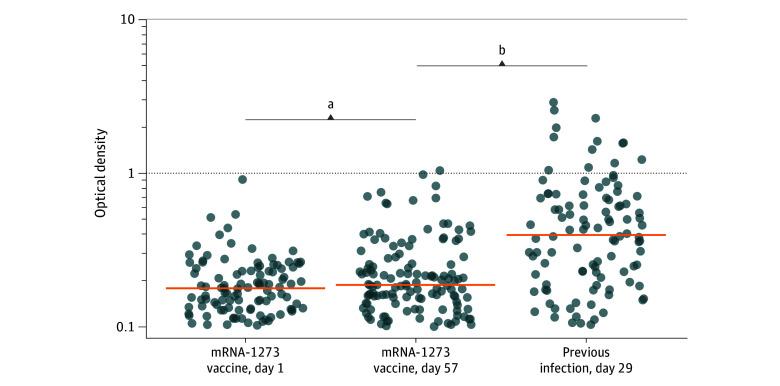
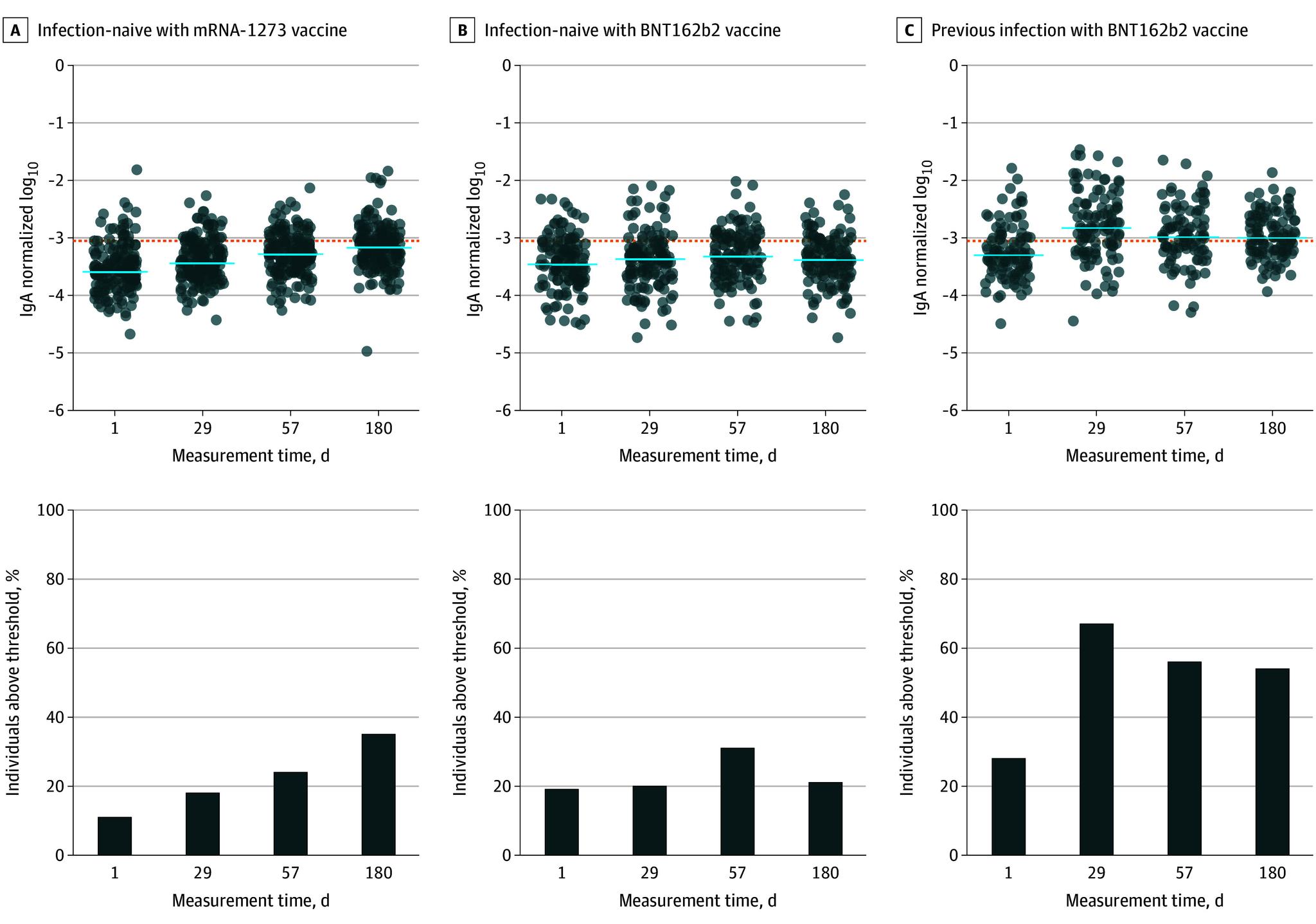
A total of 427 individuals were included in 3 groups: participants with SARS-CoV-2 prior to vaccination who received 1 single dose of BNT162b2 (Pfizer-BioNTech) (n = 120) and SARS-CoV-2-naive individuals who received 2 doses of mRNA-1273 (Moderna) (n = 172) or 2 doses of BNT162b2 (Pfizer-BioNTech) (n = 135). The median age was 68 (IQR, 39-75) years, and 228 (53.4%) were men. SARS-CoV-2 spike-specific IgG saliva levels increased after 1 or 2 vaccine injections in individuals with previous infection and SARS-CoV-2-naive individuals. After vaccination, SARS-CoV-2-specific saliva IgA levels, normalized with respect to total IgA levels, were significantly higher in participants with previous infection, as compared with the most responsive mRNA-1273 (Moderna) recipients (median normalized levels, 155 × 10-5 vs 37 × 10-5 at day 29; 107 × 10-5 vs 54 × 10-5 at day 57; and 104 × 10-5 vs 70 × 10-5 at day 180 [P < .001]). In contrast, compared with day 1, spike-specific IgA levels in the BNT162b2-vaccinated SARS-CoV-2-naive group increased only at day 57 (36 × 10-5 vs 49 × 10-5 [P = .01]). Bona fide multimeric secretory IgA levels were significantly higher in individuals with previous infection compared with SARS-CoV-2-naive individuals after 2 antigenic stimulations (median optical density, 0.36 [IQR, 0.16-0.63] vs 0.16 [IQR, 0.10-0.22]; P < .001).
CONCLUSIONS AND RELEVANCE
The findings of this cohort study suggest that mRNA vaccination was associated with mucosal immunity in individuals without prior SARS-CoV-2 infection, but at much lower levels than in previously infected individuals. Further studies are needed to determine the association between specific saliva IgA levels and prevention of infection or transmission.
重要性
关于肌肉注射信使核糖核酸(mRNA)疫苗诱导黏膜免疫反应的能力,文献中仍存在相当大的争议。
目的
比较接种mRNA疫苗的个体(无论之前是否感染过严重急性呼吸综合征冠状病毒2[SARS-CoV-2])的血清和唾液中免疫球蛋白G(IgG)及免疫球蛋白A(IgA)水平。
设计、地点和参与者:在这项队列研究中,未感染SARS-CoV-2的参与者和既往感染者被连续纳入CoviCompare P和CoviCompare M mRNA疫苗试验,并在2021年2月19日至6月8日法国新冠疫苗接种活动开始时,接受BNT162b2(辉瑞-生物科技公司)疫苗或mRNA-1273(莫德纳公司)疫苗接种,随后随访至接种后180天。数据于2022年10月25日至2023年7月13日进行分析。
主要结局和指标
采用超灵敏数字酶联免疫吸附测定法比较SARS-CoV-2刺突蛋白特异性血清和唾液IgG及IgA水平。还在选定时间对刺突蛋白特异性分泌型IgA水平进行了定量。
结果
共427人被纳入3组:接种疫苗前感染过SARS-CoV-2且接受1剂BNT162b2(辉瑞-生物科技公司)的参与者(n = 120),以及未感染SARS-CoV-2且接受2剂mRNA-1273(莫德纳公司)(n = 172)或2剂BNT162b2(辉瑞-生物科技公司)(n = 135)的个体。中位年龄为68(四分位间距,39 - 75)岁,228名(53.4%)为男性。既往感染个体和未感染SARS-CoV-2个体在接种1剂或2剂疫苗后,SARS-CoV-2刺突蛋白特异性IgG唾液水平均升高。接种疫苗后,与反应最强烈的mRNA-1273(莫德纳公司)接种者相比,既往感染参与者中经总IgA水平标准化后的SARS-CoV-2特异性唾液IgA水平显著更高(第29天的标准化水平中位数,155×10⁻⁵ 比 37×10⁻⁵;第57天,107×10⁻⁵ 比 54×10⁻⁵;第180天,104×10⁻⁵ 比 70×10⁻⁵ [P <.001])。相比之下,与第1天相比,接种BNT162b2的未感染SARS-CoV-2组中刺突蛋白特异性IgA水平仅在第57天升高(36×10⁻⁵ 比 49×10⁻⁵ [P = 0.01])。经过2次抗原刺激后,既往感染个体中的真正多聚体分泌型IgA水平显著高于未感染SARS-CoV-2个体(中位光密度,0.36 [四分位间距,0.16 - 0.63] 比 0.16 [四分位间距,0.10 - 0.22];P <.001)。
结论和意义
这项队列研究的结果表明,mRNA疫苗接种与既往未感染SARS-CoV-2个体中的黏膜免疫相关,但水平远低于既往感染者。需要进一步研究以确定特定唾液IgA水平与预防感染或传播之间的关联。


 Zotero 插件