
表没食子儿茶素没食子酸酯,绿茶的一种成分,抗甲型 H1N1pdm 流感病毒的抗病毒活性的临床前评价。
Pre-Clinical Evaluation of the Antiviral Activity of Epigalocatechin-3-Gallate, a Component of Green Tea, against Influenza A(H1N1)pdm Viruses.
机构信息
WHO Collaborating Centre for Reference and Research on Influenza, at the Peter Doherty Institute for Infection and Immunity, Melbourne, VIC 3000, Australia.
Institute of Nutrition and Functional Foods, Centre Nutrition, Santé et Societé (NUTRISS) Center, Faculté de Sciences de L'agriculture et de L'alimentation (FSAA), Université Laval, Quebec City, QC G1V 4L3, Canada.
出版信息
Viruses. 2023 Dec 16;15(12):2447. doi: 10.3390/v15122447.
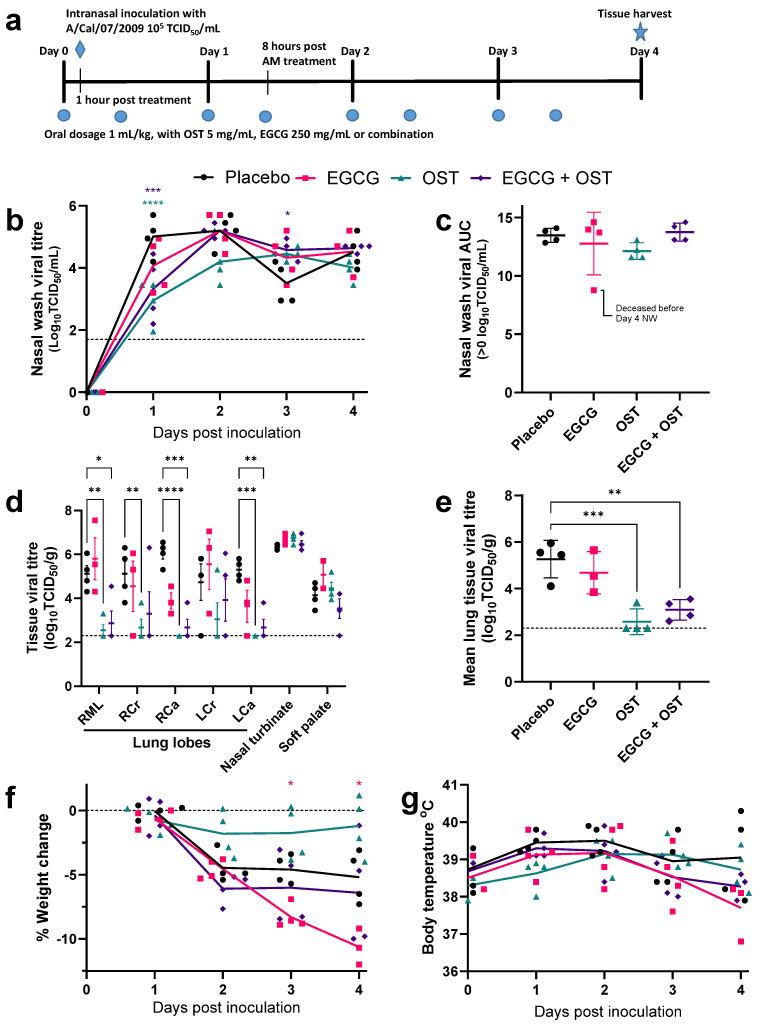
Influenza antiviral drugs are important tools in our fight against both annual influenza epidemics and pandemics. Polyphenols are a group of compounds found in plants, some of which have demonstrated promising antiviral activity. Previous in vitro and mouse studies have outlined the anti-influenza virus effectiveness of the polyphenol epigallocatechin-3-gallate (EGCG); however, no study has utilised the ferret model, which is considered the gold-standard for influenza antiviral studies. This study aimed to explore the antiviral efficacy of EGCG in vitro and in ferrets. We first performed studies in Madin-Darby Canine Kidney (MDCK) and human lung carcinoma (Calu-3) cells, which demonstrated antiviral activity. In MDCK cells, we observed a selective index (SI, CC50/IC50) of 77 (290 µM/3.8 µM) and 96 (290 µM/3.0 µM) against A/California/07/2009 and A/Victoria/2570/2019 (H1N1)pdm09 influenza virus, respectively. Calu-3 cells demonstrated a SI of 16 (420 µM/26 µM) and 18 (420 µM/24 µM). Ferrets infected with A/California/07/2009 influenza virus and treated with EGCG (500 mg/kg/day for 4 days) had no change in respiratory tissue viral titres, in contrast to oseltamivir treatment, which significantly reduced viral load in the lungs of treated animals. Therefore, we demonstrated that although EGCG showed antiviral activity in vitro against influenza viruses, the drug failed to impair viral replication in the respiratory tract of ferrets.
流感抗病毒药物是我们对抗季节性流感流行和大流行的重要工具。多酚是一类存在于植物中的化合物,其中一些具有有希望的抗病毒活性。先前的体外和小鼠研究已经概述了多酚表没食子儿茶素-3-没食子酸酯(EGCG)抗流感病毒的有效性;然而,没有研究利用雪貂模型,该模型被认为是流感抗病毒研究的金标准。本研究旨在探索 EGCG 在体外和雪貂中的抗病毒功效。我们首先在犬肾细胞(MDCK)和人肺癌细胞(Calu-3)中进行了研究,这些细胞显示出抗病毒活性。在 MDCK 细胞中,我们观察到针对 A/California/07/2009 和 A/Victoria/2570/2019(H1N1)pdm09 流感病毒的选择性指数(SI,CC50/IC50)分别为 77(290 µM/3.8 µM)和 96(290 µM/3.0 µM)。Calu-3 细胞显示出 16(420 µM/26 µM)和 18(420 µM/24 µM)的 SI。感染 A/California/07/2009 流感病毒并接受 EGCG(500 mg/kg/天,连用 4 天)治疗的雪貂的呼吸道组织病毒滴度没有变化,而奥司他韦治疗显著降低了治疗动物肺部的病毒载量。因此,我们证明了尽管 EGCG 在体外对流感病毒显示出抗病毒活性,但该药物未能抑制呼吸道中病毒的复制。


 Zotero 插件