
二线利妥昔单抗注射用细胞毒素治疗复发或难治性弥漫性大 B 细胞淋巴瘤的成本效果分析。
Cost-effectiveness of second-line lisocabtagene maraleucel in relapsed or refractory diffuse large B-cell lymphoma.
机构信息
Department of Pharmaceutical and Health Economics, Alfred E. Mann School of Pharmacy and Pharmaceutical Sciences, University of Southern California, Los Angeles, CA.
Leonard D. Schaeffer Center for Health Policy & Economics, University of Southern California, Los Angeles, CA.
出版信息
Blood Adv. 2024 Jan 23;8(2):484-496. doi: 10.1182/bloodadvances.2023011793.
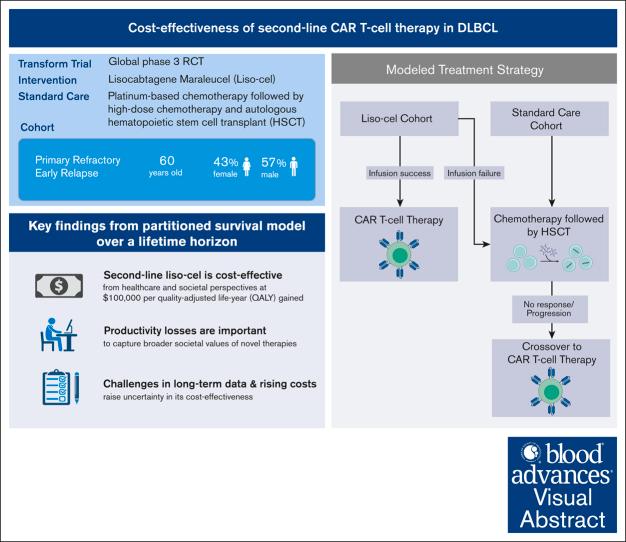
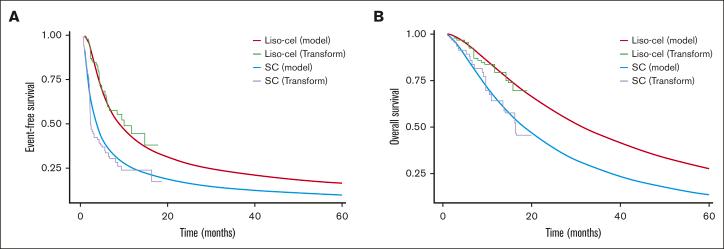
Lisocabtagene maraleucel (liso-cel), a chimeric antigen receptor (CAR) T-cell therapy, received the US Food and Drug Administration approval in 2022 for second-line treatment of diffuse large B-cell lymphoma (DLBCL) for patients with refractory disease or early relapse after first-line chemoimmunotherapy. This decision was based on the TRANSFORM study demonstrating improvements in event-free survival with liso-cel compared with standard care. Given the high costs of CAR T-cell therapies, particularly as they transition to second-line treatment, a cost-effectiveness analysis is essential to determine their economic viability. The study used a partitioned survival model with standard parametric functions to evaluate the cost-effectiveness of liso-cel aganist platinum-based chemotherapy followed by high-dose chemotherapy and autologous hematopoietic stem cell transplantation over a lifetime horizon The analysis relied on data from the TRANSFORM and TRANSCEND trials, established literature, and public data sets to calculate the incremental cost-effectiveness ratio (ICER). For a representative cohort of US adults aged 60 years, ICER of liso-cel was $99 669 per quality-adjusted life-year (QALY) from a health care sector perspective and $68 212 per QALY from a societal perspective, confirming its cost-effectiveness at the $100 000 per QALY threshold. Nonetheless, under certain scenarios, liso-cel surpasses this benchmark but remains within the US acceptable range of $150 000 per QALY. A key finding underlines the importance of incorporating productivity losses into such analyses to capture the broader societal values of novel therapies. Although these therapies offer substantial clinical benefits, their high acquisition costs and limited long-term data critically challenge their economic sustainability.
利妥昔单抗奥佐米星(liso-cel)是一种嵌合抗原受体(CAR)T 细胞疗法,于 2022 年获得美国食品和药物管理局批准,用于一线化疗免疫治疗后疾病复发或难治的弥漫性大 B 细胞淋巴瘤(DLBCL)患者的二线治疗。这一决定是基于 TRANSFORM 研究的结果,该研究表明与标准治疗相比,liso-cel 可改善无事件生存。鉴于 CAR T 细胞疗法的成本高昂,尤其是在向二线治疗过渡时,进行成本效益分析对于确定其经济可行性至关重要。该研究使用分区生存模型和标准参数函数,评估了 liso-cel 与基于铂类的化疗联合大剂量化疗和自体造血干细胞移植在终生范围内的成本效益,分析依赖于 TRANSFORM 和 TRANSCEND 试验的数据、已建立的文献和公共数据集,以计算增量成本效益比(ICER)。对于 60 岁的美国成年人代表性队列,从医疗保健部门的角度来看,liso-cel 的每质量调整生命年(QALY)的增量成本效益比(ICER)为 99669 美元,从社会角度来看为 68212 美元,确认其在每 QALY100000 美元的阈值内具有成本效益。尽管如此,在某些情况下,liso-cel 超过了这一基准,但仍在 150000 美元/QALY 的美国可接受范围内。一项关键发现强调了将生产力损失纳入此类分析的重要性,以捕捉新疗法的更广泛的社会价值。尽管这些疗法提供了显著的临床益处,但它们的高获得成本和有限的长期数据严重挑战了其经济可持续性。



 Zotero 插件