
大气颗粒物对自杀死亡的短期影响。
The short-term effect of ambient particulate matter on suicide death.
机构信息
Department of Biostatistics, Yonsei University Wonju College of Medicine, Wonju, Republic of Korea.
Department of Psychiatry, Yonsei University Wonju College of Medicine, Wonju, Republic of Korea.
出版信息
Environ Health. 2024 Jan 3;23(1):3. doi: 10.1186/s12940-023-01042-2.
BACKGROUND
Air pollution can cause various respiratory and neurological diseases and continuous exposure can lead to death. Previous studies have reported that particulate matter (PM) exposure increases the risk of depression, suicidal thoughts, and suicidal death; however, the results are inconsistent and limited. This study aimed to examine the relationship between short-term PM exposure and suicide deaths, as well as investigate the short-term effects of PM on suicide death within vulnerable groups based on factors such as sex, age group, suicide-related information (note, method, and cause), psychiatric disorders, and physical diseases.
METHODS
Data on a total of 28,670 suicide deaths from 2013 to 2017, provided by the Korea Foundation for Suicide Prevention, were analyzed. The study design employed a time-series analysis with a two-stage approach. In the first step, a generalized additive model combined with a distributed lag nonlinear model was used to estimate the short-term effect of PM exposure on suicide risk specific to each city. In the second step, the estimated results from each city were pooled through a meta-analysis to derive the overall effect. We determined the effects of single lag, cumulative lag, and moving average PM concentrations from days 0-7 before suicide.
RESULTS
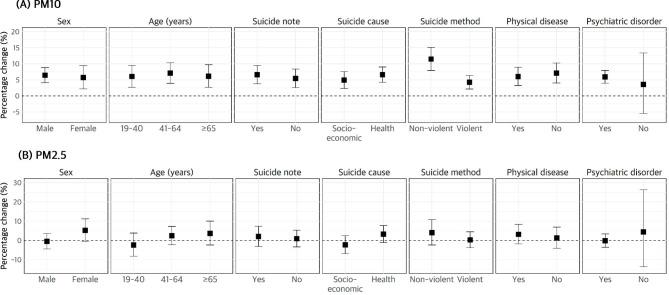
We confirmed an association between exposure to PM (≤ 10 μm in diameter) and deaths due to suicide. In particular, among individuals with psychiatric disorders and those who employed non-violent suicide methods, increased exposure to PM was associated with a higher risk of death by suicide, with percentage changes of 5.92 (95% confidence interval [CI]: 3.95-7.92) and 11.47 (95% CI: 7.95-15.11), respectively. Furthermore, in the group with psychiatric disorders, there was an observed tendency of increasing suicide risk as PM levels increased up to 120 µg/m, whereas in the group with non-violent suicide deaths, there was a pronounced trend of rapid increase in suicide risk with an increase in PM up to 100 µg/m.
CONCLUSIONS
These results show an association between short-term exposure to PM and suicide. Our study adds evidence for the benefits of reducing PM in preventing diseases and improving mental health.
背景
空气污染可导致各种呼吸道和神经疾病,长期暴露于空气污染可导致死亡。先前的研究报告称,颗粒物(PM)暴露会增加抑郁、自杀念头和自杀死亡的风险;然而,结果并不一致且有限。本研究旨在检验短期 PM 暴露与自杀死亡之间的关系,并根据性别、年龄组、自杀相关信息(注意事项、方法和原因)、精神疾病和身体疾病等因素,研究 PM 对自杀死亡的短期影响。
方法
本研究分析了韩国自杀预防基金会提供的 2013 年至 2017 年期间共 28670 例自杀死亡的数据。研究设计采用时间序列分析,采用两阶段方法。在第一阶段,使用广义相加模型结合分布式滞后非线性模型来估计特定于每个城市的 PM 暴露对自杀风险的短期影响。在第二阶段,通过荟萃分析对每个城市的估计结果进行汇总,以得出总体效果。我们确定了自杀前 0-7 天的单滞后、累积滞后和移动平均 PM 浓度的影响。
结果
我们确认了 PM(直径≤10μm)暴露与自杀死亡之间的关联。特别是,在有精神疾病和采用非暴力自杀方法的个体中,PM 暴露增加与自杀死亡风险增加相关,百分比变化分别为 5.92(95%置信区间[CI]:3.95-7.92)和 11.47(95% CI:7.95-15.11)。此外,在有精神疾病的人群中,随着 PM 水平升高,自杀风险呈增加趋势,直至 120μg/m;而在采用非暴力自杀死亡的人群中,随着 PM 水平升高,自杀风险呈急剧增加趋势,直至 100μg/m。
结论
这些结果表明短期 PM 暴露与自杀之间存在关联。我们的研究为减少 PM 以预防疾病和改善心理健康带来的益处提供了证据。

 Zotero 插件