
慢性肾脏病 - 矿物质和骨异常(CKD-MBD)生物标志物在肾脏病诊疗实践中的实际应用。
Real-world usage of Chronic Kidney Disease - Mineral Bone Disorder (CKD-MBD) biomarkers in nephrology practices.
作者信息
Fusaro Maria, Barbuto Simona, Gallieni Maurizio, Cossettini Althea, Re Sartò Giulia Vanessa, Cosmai Laura, Cianciolo Giuseppe, La Manna Gaetano, Nickolas Thomas, Ferrari Serge, Bover Jordi, Haarhaus Mathias, Marino Carmela, Mereu Maria Cristina, Ravera Maura, Plebani Mario, Zaninotto Martina, Cozzolino Mario, Bianchi Stefano, Messa Piergiorgio, Gregorini Mariacristina, Gasperoni Lorenzo, Agosto Caterina, Aghi Andrea, Tripepi Giovanni
机构信息
National Research Council (CNR), Institute of Clinical Physiology (IFC), Pisa, Italy.
Department of Medicine, University of Padova, Padova, Italy.
出版信息
Clin Kidney J. 2023 Nov 29;17(1):sfad290. doi: 10.1093/ckj/sfad290. eCollection 2024 Jan.
BACKGROUND
Chronic kidney disease mineral bone disorder (CKD-MBD) is a condition characterized by alterations of calcium, phosphate, parathyroid hormone (PTH), and fibroblast growth factor 23 (FGF-23) metabolism that in turn promote bone disorders, vascular calcifications, and increase cardiovascular (CV) risk. Nephrologists' awareness of diagnostic, prognostic, and therapeutic tools to manage CKD-MBD plays a primary role in adequately preventing and managing this condition in clinical practice.
METHODS
A national survey (composed of 15 closed questions) was launched to inquire about the use of bone biomarkers in the management of CKD-MBD patients by nephrologists and to gain knowledge about the implementation of guideline recommendations in clinical practice.
RESULTS
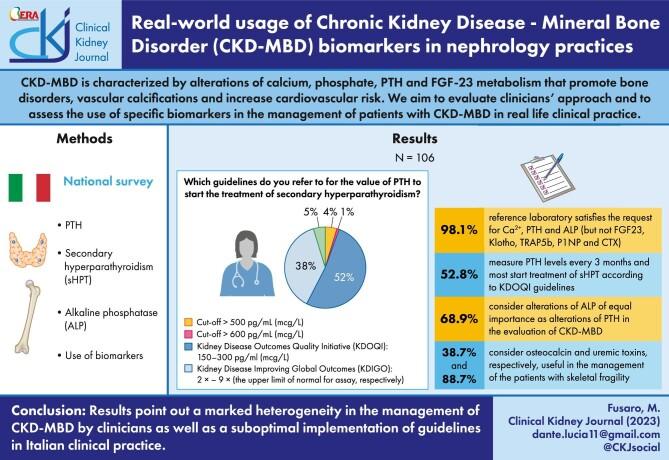
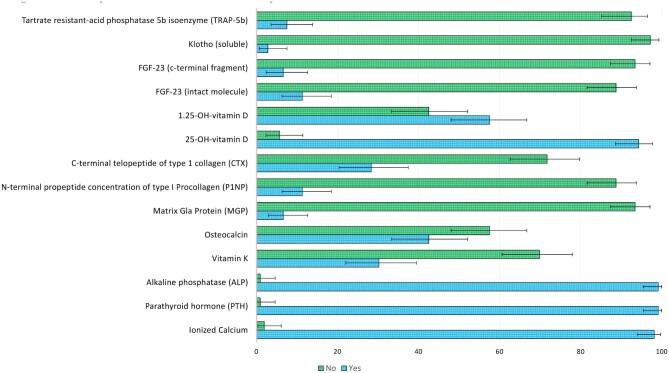
One hundred and six Italian nephrologists participated in the survey for an overall response rate of about 10%. Nephrologists indicated that the laboratories of their hospitals were able to satisfy request of ionized calcium levels, 105 (99.1%) of both PTH and alkaline phosphatase (ALP), 100 (94.3%) of 25(OH)D, and 61 (57.5%) of 1.25(OH)D; while most laboratories did not support the requests of biomarkers such as FGF-23 (intact: 88.7% and c-terminal: 93.4%), Klotho (95.3%; soluble form: 97.2%), tartrate-resistant acid phosphatase 5b (TRAP-5b) (92.5%), C-terminal telopeptide (CTX) (71.7%), and pro-collagen type 1 N-terminal pro-peptide (P1NP) (88.7%). As interesting data regarding Italian nephrologists' behavior to start treatment of secondary hyperparathyroidism (sHPT), the majority of clinicians used KDOQI guidelines ( = 55, 51.9%). In contrast, only 40 nephrologists (37.7%) relied on KDIGO guidelines, which recommended referring to values of PTH between two and nine times the upper limit of the normal range.
CONCLUSION
Results point out a marked heterogeneity in the management of CKD-MBD by clinicians as well as a suboptimal implementation of guidelines in Italian clinical practice.
背景
慢性肾脏病矿物质和骨异常(CKD-MBD)是一种以钙、磷、甲状旁腺激素(PTH)和成纤维细胞生长因子23(FGF-23)代谢改变为特征的疾病,这些改变进而会引发骨病、血管钙化,并增加心血管(CV)风险。肾病学家对管理CKD-MBD的诊断、预后和治疗工具的认识在临床实践中充分预防和管理这种疾病方面起着主要作用。
方法
开展了一项全国性调查(由15个封闭式问题组成),以询问肾病学家在管理CKD-MBD患者时对骨生物标志物的使用情况,并了解临床实践中指南建议的实施情况。
结果
106名意大利肾病学家参与了此次调查,总体回复率约为10%。肾病学家表示,他们医院的实验室能够满足对离子钙水平的检测要求,105名(99.1%)能满足PTH和碱性磷酸酶(ALP)的检测要求,100名(94.3%)能满足25(OH)D的检测要求,61名(57.5%)能满足1,25(OH)D的检测要求;而大多数实验室无法满足对FGF-23(完整形式:88.7%,C端:93.4%)、Klotho(95.3%;可溶性形式:97.2%)、抗酒石酸酸性磷酸酶5b(TRAP-5b)(92.5%)、C端骨桥蛋白(CTX)(71.7%)和I型前胶原N端前肽(P1NP)(88.7%)等生物标志物的检测要求。关于意大利肾病学家开始治疗继发性甲状旁腺功能亢进(sHPT)的行为,有趣的数据是,大多数临床医生使用美国肾脏病预后质量倡议(KDOQI)指南(n = 55,51.9%)。相比之下,只有40名肾病学家(37.7%)依赖KDIGO指南,该指南建议参考PTH值在正常范围上限的2至9倍之间。
结论
结果指出临床医生在CKD-MBD管理方面存在明显异质性,且意大利临床实践中指南的实施情况欠佳。


 Zotero 插件