
在坦桑尼亚西北部实现针对血吸虫病的目标群体大规模药物治疗:探索使用地理统计模型为分区层面的规划提供信息。
Enabling targeted mass drug administration for schistosomiasis in north-western Tanzania: Exploring the use of geostatistical modeling to inform planning at sub-district level.
作者信息
Mathewson Jake D, van der Spek Linda, Mazigo Humphrey D, Kabona George, de Vlas Sake J, Nshala Andreas, Rood Ente J J
机构信息
Kit-Royal Tropical Institute, Epidemiology, Center for Applied Spatial Epidemiology (CASE), Amsterdam, The Netherlands.
School of Medicine, Department of Medical Parasitology & Entomology, Catholic University of Health and Allied Sciences, Mwanza, Tanzania.
出版信息
PLoS Negl Trop Dis. 2024 Jan 16;18(1):e0011896. doi: 10.1371/journal.pntd.0011896. eCollection 2024 Jan.
INTRODUCTION
Schistosomiasis is a parasitic disease in Tanzania affecting over 50% of the population. Current control strategies involve mass drug administration (MDA) campaigns at the district level, which have led to problems of over- and under-treatment in different areas. WHO guidelines have called for more targeted MDA to circumvent these problems, however a scarcity of prevalence data inhibits decision makers from prioritizing sub-district areas for MDA. This study demonstrated how geostatistics can be used to inform planning for targeted MDA.
METHODS
Geostatistical sub-district (ward-level) prevalence estimates were generated through combining a zero-inflated poisson model and kriging approach (regression kriging). To make predictions, the model used prevalence survey data collected in 2021 of 17,400 school children in six regions of Tanzania, along with several open source ecological and socio-demographic variables with known associations with schistosomiasis.
RESULTS
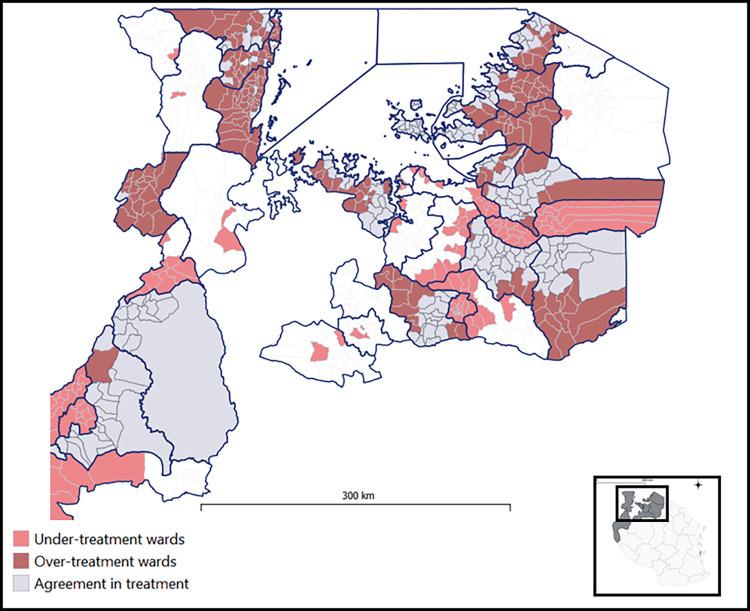
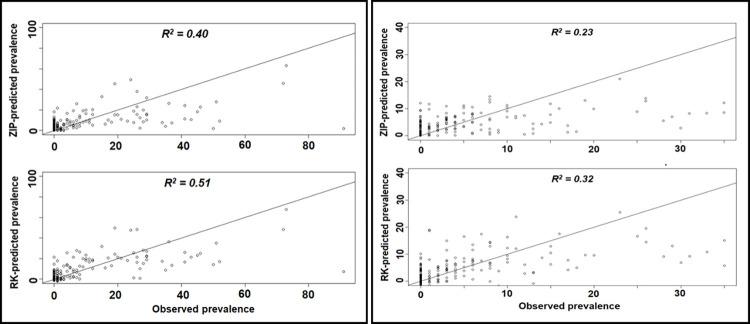
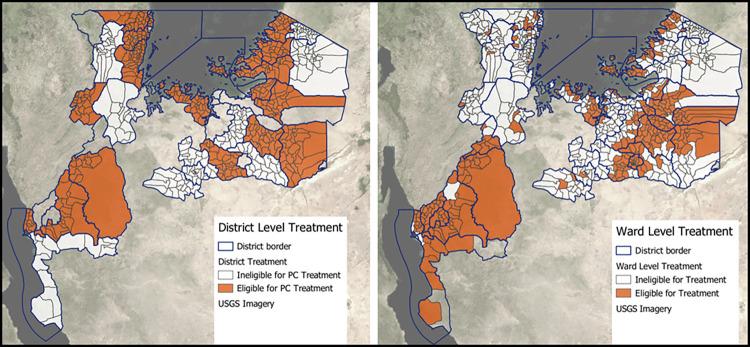
The model results show that regression kriging can be used to effectively predict the ward level parasite prevalence of the two species of Schistosoma endemic to the study area. Kriging was found to further improve the regression model fit, with an adjusted R-squared value of 0.51 and 0.32 for intestinal and urogenital schistosomiasis, respectively. Targeted treatment based on model predictions would represent a shift in treatment away from 193 wards estimated to be over-treated to 149 wards that would have been omitted from the district level MDA.
CONCLUSIONS
Geostatistical models can help to support NTD program efficiency and reduce disease transmission by facilitating WHO recommended targeted MDA treatment through provision of prevalence estimates where data is scarce.
引言
血吸虫病是坦桑尼亚的一种寄生虫病,影响着超过50%的人口。目前的控制策略包括在地区层面开展群体药物治疗(MDA)活动,但这导致了不同地区出现治疗过度和治疗不足的问题。世界卫生组织的指南呼吁采取更具针对性的MDA措施来规避这些问题,然而,患病率数据的匮乏使得决策者难以确定优先开展MDA的分区区域。本研究展示了如何利用地理统计学为有针对性的MDA规划提供信息。
方法
通过结合零膨胀泊松模型和克里金法(回归克里金法)生成地理统计分区( wards级)患病率估计值。为了进行预测,该模型使用了2021年在坦桑尼亚六个地区收集的17400名学童的患病率调查数据,以及几个与血吸虫病有已知关联的开源生态和社会人口变量。
结果
模型结果表明,回归克里金法可有效预测研究区域内两种地方性血吸虫的分区寄生虫患病率。发现克里金法进一步改善了回归模型的拟合度,肠道血吸虫病和泌尿生殖系统血吸虫病的调整R平方值分别为0.51和0.32。基于模型预测的靶向治疗将意味着治疗重点从估计治疗过度的193个分区转移到地区层面MDA本会遗漏的149个分区。
结论
地理统计模型有助于提高被忽视热带病项目的效率,并通过在数据稀缺时提供患病率估计值来促进世界卫生组织推荐的靶向MDA治疗,从而减少疾病传播。



 Zotero 插件