
2015年至2022年塞浦路斯的社区抗生素消费情况
Community Antibiotic Consumption in Cyprus for the Period 2015 to 2022.
作者信息
Mitsoura Eirini, Kopsidas Ioannis, Charalambous Pambos, Papazisis Georgios, Raikos Nikolaos, Pana Zoi Dorothea
机构信息
Medical School, European University of Cyprus, 2404 Nicosia, Cyprus.
Department of Clinical Pharmacology & Clinical Research Unit, School of Medicine, Aristotle University, 54124 Thessaloniki, Greece.
出版信息
Antibiotics (Basel). 2024 Jan 4;13(1):52. doi: 10.3390/antibiotics13010052.
BACKGROUND
Cyprus currently reports to ESAC-Net the total consumption of antimicrobials, without distinguishing between hospital and community-based antibiotic use. As a result, these data can only provide generalized insights into antimicrobial trends in the country.
AIM
This study is a first attempt to retrospectively analyze community antibiotic consumption in Cyprus for the period of 2015 to 2022.
MATERIAL AND METHODS
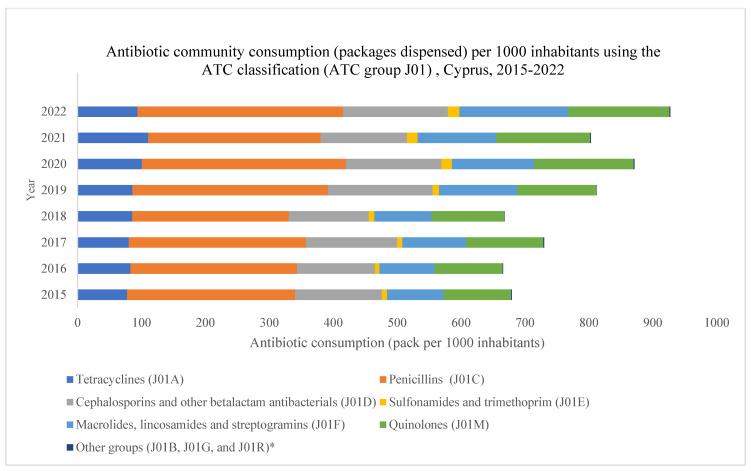
Data on community antimicrobial consumption between 2015 and 2022 were extracted from Pharmatrack's database. Orally administered dispensed antibiotics were categorized under the J01 group of the WHO Anatomical Therapeutic Chemical (ATC) classification and by the WHO's AWaRe classification of antibiotics. Antibiotic consumption was calculated in both packages consumed and per 1000 inhabitants, overall, by year of consumption and districts.
RESULTS
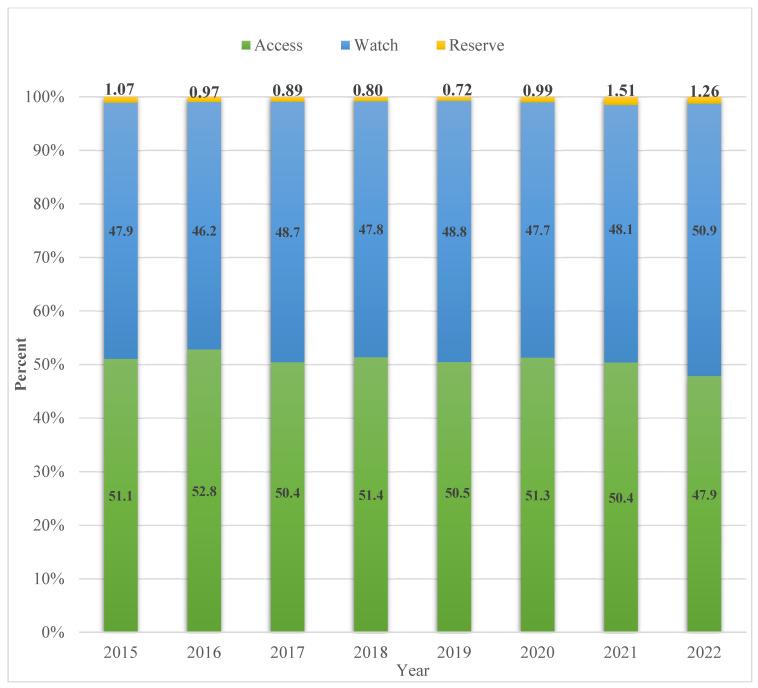
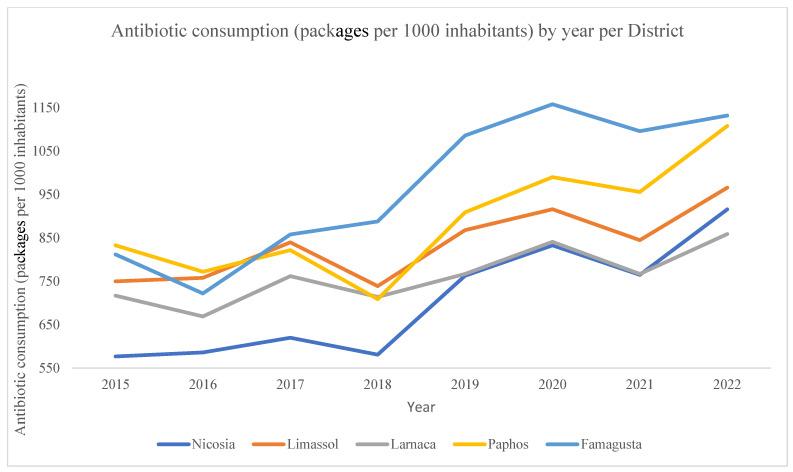
During the period of 2015-2022, there was variability in the mean outpatient antibiotic consumption per 1000 inhabitants among the five districts in Cyprus. Community consumption increased by 38% throughout the study period. Additionally, a decrease of 3% in the consumption of WHO 'Access' antibiotics was observed, accompanied with a concurrent increase of 3% in the 'Watch' group. Specifically, in 2022 the WHO 'Access' group consumption in the Cypriot community was 48%, significantly lower than the WHO's goal of 60% and the EU's goal of 70% for 'Access' antibiotic consumption.
CONCLUSIONS
Antibiotic consumption in the community of Cyprus between 2015 and 2022 demonstrated substantial variability among districts, with higher consumption in less populated areas. There was an increasing trend in community consumption over the years and a decreasing trend in the percentage of 'Access' antibiotics prescribed.
背景
塞浦路斯目前向欧洲抗菌药物消费监测网络(ESAC-Net)报告抗菌药物的总消费量,未区分医院和社区抗生素的使用情况。因此,这些数据只能提供该国抗菌药物使用趋势的大致情况。
目的
本研究首次尝试回顾性分析2015年至2022年期间塞浦路斯社区抗生素的消费情况。
材料与方法
从Pharmatrack数据库中提取2015年至2022年期间社区抗菌药物消费数据。口服配给的抗生素按照世界卫生组织解剖治疗学化学分类(ATC)的J01组以及世界卫生组织抗生素的AWaRe分类进行归类。抗生素消费量按消费的包装数量和每1000居民计算,总体上按消费年份和地区计算。
结果
在2015 - 2022年期间,塞浦路斯五个地区每1000居民的门诊抗生素平均消费量存在差异。在整个研究期间,社区消费量增长了38%。此外,观察到世界卫生组织“可及”类抗生素的消费量下降了3%,同时“慎用”类抗生素的消费量增长了3%。具体而言,2022年塞浦路斯社区中世界卫生组织“可及”类抗生素的消费量为48%,显著低于世界卫生组织设定的60%的目标以及欧盟设定的70%的“可及”类抗生素消费目标。
结论
2015年至2022年期间,塞浦路斯社区抗生素消费在各地区间存在显著差异,人口较少地区的消费量较高。多年来社区消费量呈上升趋势,而“可及性”抗生素处方的百分比呈下降趋势。
 Zotero 插件