
种植体周围炎中炎症小体与微生物群的相关性。
Correlation between Inflammasomes and Microbiota in Peri-Implantitis.
机构信息
Department of Oral Surgery and Implant Dentistry, School of Dentistry, University of Granada, 18071 Granada, Spain.
Instituto de Investigación Biosanitaria ibs.GRANADA, 18012 Granada, Spain.
出版信息
Int J Mol Sci. 2024 Jan 12;25(2):961. doi: 10.3390/ijms25020961.
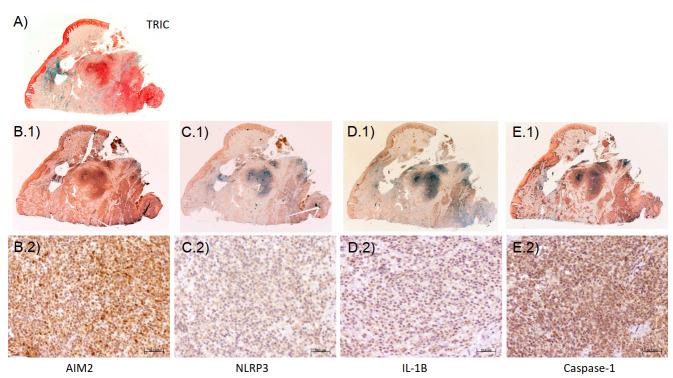
The activation of inflammasomes is thought to induce the inflammatory process around dental implants. No information is available on the correlation between microbiota and inflammasomes in clinical samples from patients suffering peri-implantitis. For this cross-sectional study, 30 biofilm samples were obtained from 19 patients undergoing surgical treatment for peri-implantitis because of the presence of bleeding on probing, probing depth higher than 6 mm, and radiographic bone loss higher than 3 mm. Then, soft tissue samples from around the implant were also collected. The relative abundance of bacteria and alpha-diversity indexes were calculated after analyzing the 16S rRNA gene using next-generation sequencing. The soft-tissue samples were processed for evaluation of the inflammasomes NLRP3 and AIM2 as well as caspase-1 and IL-1β. The relative abundance (mean (SD)) of specific species indicated that the most abundant species were (10.95 (14.17)%), (10.93 (13.18)%), (5.89 (7.23)%), (3.88 (4.94)%), (2.91 (3.19)%), and (2.84 (4.15)%). Several correlations were found between the species and the immunohistochemical detection of the inflammasomes NLRP3 and AIM2 as well as caspase-1 and IL-1β, both in the epithelium and the lamina propria. A network analysis found an important cluster of variables formed by NLRP3 in the lamina propria and AIM2, caspase-1, and IL-1β in the lamina propria and the epithelium with , , , or . Thus, it could be concluded that inflammasomes NLRP3 and AIM2 and their downstream effectors caspase-1 and interleukin-1β can be significantly associated with specific bacteria.
炎性小体的激活被认为会诱导种植牙周围的炎症过程。目前尚不清楚患有种植体周围炎的患者临床样本中的微生物群与炎性小体之间的相关性。在这项横断面研究中,从 19 名因探诊出血、探诊深度大于 6 毫米和放射状骨损失大于 3 毫米而接受种植体周围炎手术治疗的患者中获得了 30 个生物膜样本。然后,还收集了种植体周围的软组织样本。使用下一代测序分析 16S rRNA 基因后,计算了细菌的相对丰度和α多样性指数。对炎性小体 NLRP3 和 AIM2 以及半胱天冬酶-1 和白细胞介素-1β进行处理后,对软组织样本进行了评估。特定物种的相对丰度(平均值(SD))表明,最丰富的物种是 (10.95(14.17)%)、 (10.93(13.18)%)、 (5.89(7.23)%)、 (3.88(4.94)%)、 (2.91(3.19)%)和 (2.84(4.15)%)。在上皮和固有层中,发现了几种物种与 NLRP3、AIM2 以及半胱天冬酶-1 和白细胞介素-1β的免疫组织化学检测之间的相关性。网络分析发现了一个由固有层中的 NLRP3 和 AIM2 以及固有层和上皮中的半胱天冬酶-1 和白细胞介素-1β组成的重要变量簇,具有 、 、 或 。因此,可以得出结论,炎性小体 NLRP3 和 AIM2 及其下游效应子半胱天冬酶-1 和白细胞介素-1β可以与特定细菌显著相关。


 Zotero 插件