
基于质谱的临床癌症生物标志物靶向蛋白质组学的最新进展。
Recent developments in mass-spectrometry-based targeted proteomics of clinical cancer biomarkers.
作者信息
Wenk Deborah, Zuo Charlotte, Kislinger Thomas, Sepiashvili Lusia
机构信息
Princess Margaret Cancer Centre, University Health Network, Toronto, ON, Canada.
Department of Medical Biophysics, University of Toronto, Toronto, ON, Canada.
出版信息
Clin Proteomics. 2024 Jan 30;21(1):6. doi: 10.1186/s12014-024-09452-1.
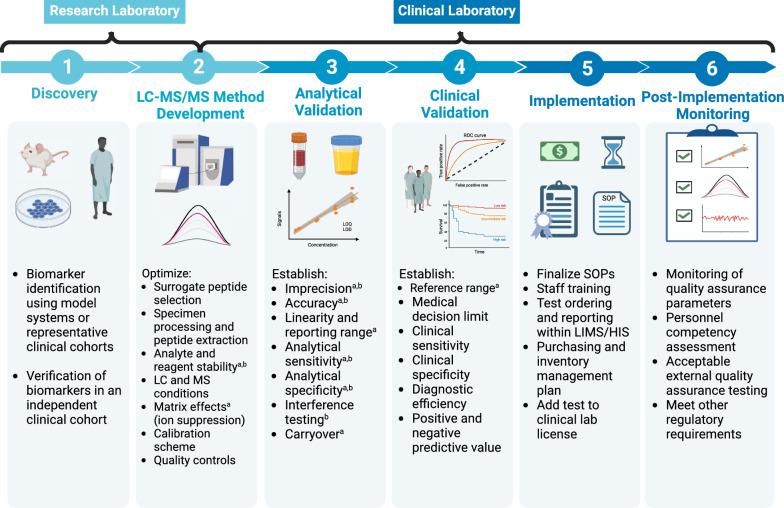
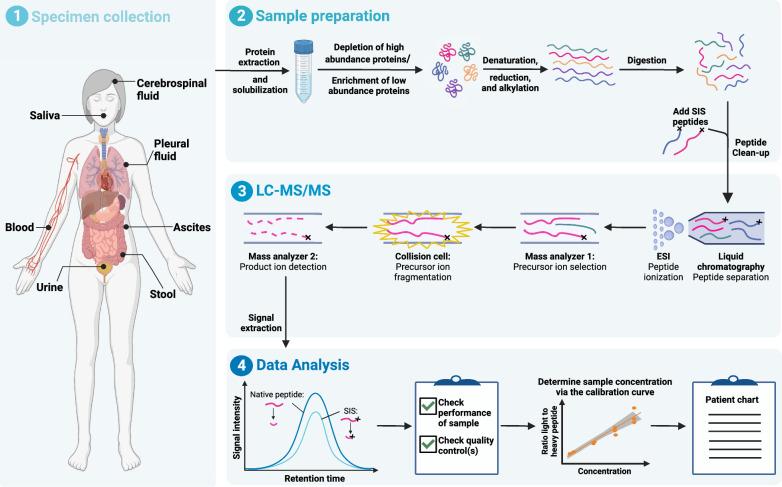
Routine measurement of cancer biomarkers is performed for early detection, risk classification, and treatment monitoring, among other applications, and has substantially contributed to better clinical outcomes for patients. However, there remains an unmet need for clinically validated assays of cancer protein biomarkers. Protein tumor markers are of particular interest since proteins carry out the majority of biological processes and thus dynamically reflect changes in cancer pathophysiology. Mass spectrometry-based targeted proteomics is a powerful tool for absolute peptide and protein quantification in biological matrices with numerous advantages that make it attractive for clinical applications in oncology. The use of liquid chromatography-tandem mass spectrometry (LC-MS/MS) based methodologies has allowed laboratories to overcome challenges associated with immunoassays that are more widely used for tumor marker measurements. Yet, clinical implementation of targeted proteomics methodologies has so far been limited to a few cancer markers. This is due to numerous challenges associated with paucity of robust validation studies of new biomarkers and the labor-intensive and operationally complex nature of LC-MS/MS workflows. The purpose of this review is to provide an overview of targeted proteomics applications in cancer, workflows used in targeted proteomics, and requirements for clinical validation and implementation of targeted proteomics assays. We will also discuss advantages and challenges of targeted MS-based proteomics assays for clinical cancer biomarker analysis and highlight some recent developments that will positively contribute to the implementation of this technique into clinical laboratories.
癌症生物标志物的常规检测用于早期检测、风险分类和治疗监测等多种应用,并为患者带来更好的临床结果做出了重大贡献。然而,临床上对经过验证的癌症蛋白质生物标志物检测方法仍有未满足的需求。蛋白质肿瘤标志物尤其受到关注,因为蛋白质执行大多数生物过程,从而动态反映癌症病理生理学的变化。基于质谱的靶向蛋白质组学是一种用于生物基质中绝对肽和蛋白质定量的强大工具,具有许多优点,使其在肿瘤学临床应用中具有吸引力。基于液相色谱-串联质谱(LC-MS/MS)的方法的使用使实验室能够克服与更广泛用于肿瘤标志物测量的免疫测定相关的挑战。然而,靶向蛋白质组学方法的临床应用迄今为止仅限于少数癌症标志物。这是由于与新生物标志物缺乏强有力的验证研究以及LC-MS/MS工作流程的劳动密集型和操作复杂性相关的众多挑战。本综述的目的是概述靶向蛋白质组学在癌症中的应用、靶向蛋白质组学中使用的工作流程,以及靶向蛋白质组学检测的临床验证和实施要求。我们还将讨论基于靶向质谱的蛋白质组学检测用于临床癌症生物标志物分析的优点和挑战,并强调一些将对该技术在临床实验室中的应用产生积极影响的最新进展。
 Zotero 插件