
中国骨关节炎负担,1990-2019 年:2019 年全球疾病负担研究结果。
Burden of osteoarthritis in China, 1990-2019: findings from the Global Burden of Disease Study 2019.
机构信息
Department of Rheumatology, The First Affiliated Hospital of Harbin Medical University, Harbin City, Heilongjiang Province, People's Republic of China.
Institute of Cancer Prevention and Treatment, Harbin Medical University, No. 6 Baojian Road, Nangang District, Harbin City, Heilongjiang Province, People's Republic of China.
出版信息
Clin Rheumatol. 2024 Mar;43(3):1189-1197. doi: 10.1007/s10067-024-06885-9. Epub 2024 Jan 30.
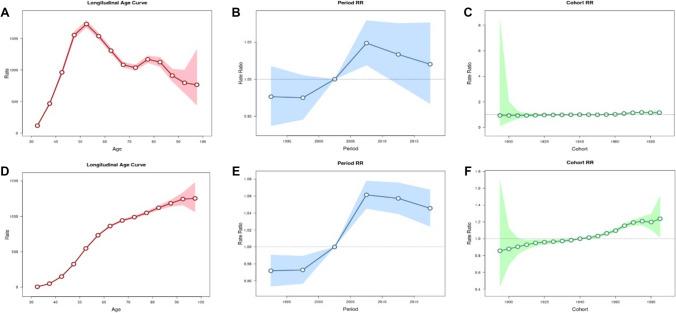
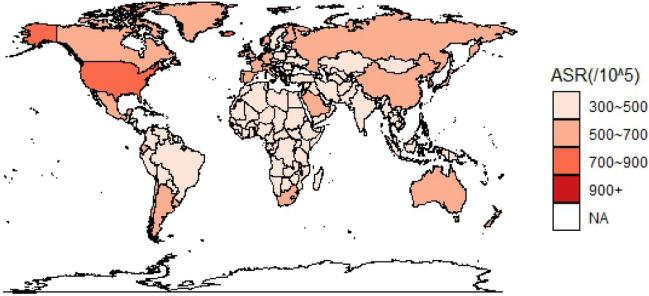
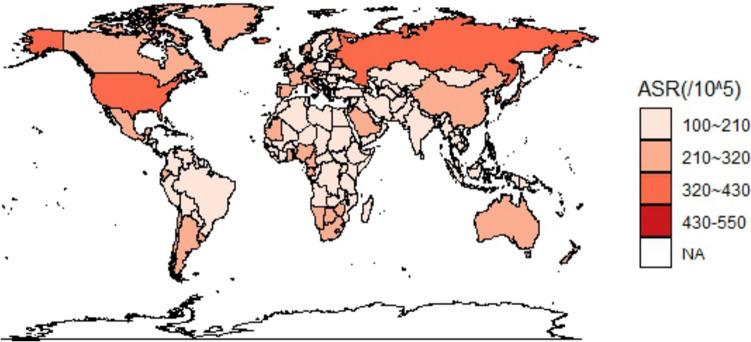
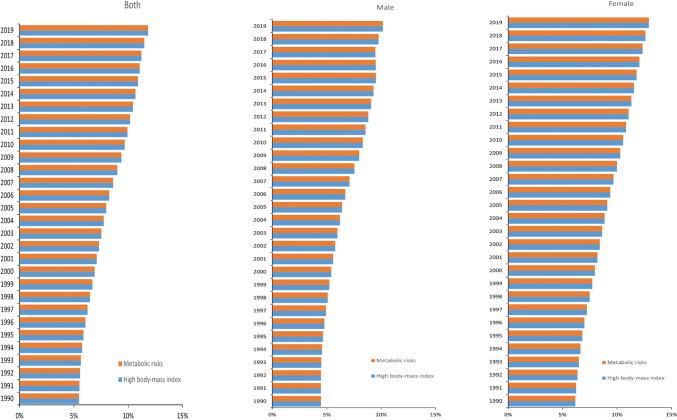
This study aimed to report the most current data on the incidence and disability-adjusted life years (DALY) associated with osteoarthritis in China from 1990 to 2019. Publicly available modelled data from Global Burden of Disease Study (GBD) 2019 were used. The incidence and DALY, due to osteoarthritis in China, stratified by sex, trends of associated risk factors, assess the age, period, and cohort effects on the long-term trends of osteoarthritis incidence and DALY in China from 1990 to 2019. We found that the age-standardized incidence and DALY rates of osteoarthritis in China are higher than the average levels in Asia, Africa, and Oceania. In 2019, the number of cases of osteoarthritis in China was 10,681,311, an increase of 132.66% compared with 1990. the DALY of osteoarthritis in China was 4,724,885 person-years, which was 159.70% higher than that in 1990. In 2019, the incidence and DALY rates of osteoarthritis in China was 750.96/100,000,332.19/100,000. High body-mass as risk factors for osteoarthritis DALY with the population attributable proportion (PAF) increasing steadily from 1990 to 2019. The incidence and DALY rates of three types of osteoarthritis from high to low are osteoarthritis knee, osteoarthritis hand, and osteoarthritis hip. Age-period-cohort model showed that the incidence rate of osteoarthritis in China shows a trend of increasing first and then decreasing with age; concurrently, the DALY rate of osteoarthritis in China increased with age. For the period effect, we found that the period rate ratio (RR) of osteoarthritis incidence and DALY rates kept increasing in the cohort born before 2005-2009, and then, it was gradually reduced by year of birth in the cohort born after 2005-2009. As for cohort effect, the cohort RR of incidence rate of osteoarthritis almost has no change, while the cohort RR of DALY rate of osteoarthritis kept increasing from 1990 to 2019. The burden and impact of osteoarthritis in China are substantial and are increasing. Adopting suitable control and preventive community measures to reduce modifiable risk factors is needed to reduce the current and future burden of osteoarthritis in China. Key Points • This paper analyzes the disease burden of osteoarthritis in China for the first time and discusses the influence on the disease burden of osteoarthritis from the perspectives of age, period, and cohort.
本研究旨在报告 1990 年至 2019 年期间中国骨关节炎的发病率和伤残调整生命年(DALY)的最新数据。使用来自全球疾病负担研究(GBD)2019 的公开可用模型数据。对中国骨关节炎的发病率和 DALY 进行分层,按性别和相关危险因素的趋势进行分层,评估年龄、时期和队列效应对 1990 年至 2019 年中国骨关节炎发病率和 DALY 长期趋势的影响。我们发现,中国骨关节炎的年龄标准化发病率和 DALY 率高于亚洲、非洲和大洋洲的平均水平。2019 年,中国骨关节炎病例数为 10681311 例,与 1990 年相比增加了 132.66%。中国骨关节炎的 DALY 为 4724885 人年,比 1990 年增加了 159.70%。2019 年,中国骨关节炎的发病率和 DALY 率分别为 750.96/10 万和 332.19/10 万。高体重指数是骨关节炎 DALY 的风险因素,其人群归因比例(PAF)从 1990 年到 2019 年稳步上升。三种类型的骨关节炎的发病率和 DALY 率从高到低依次为膝骨关节炎、手骨关节炎和髋骨关节炎。年龄-时期-队列模型显示,中国骨关节炎的发病率呈先增后降的趋势,同时,中国骨关节炎的 DALY 率随年龄增长而增加。就时期效应而言,我们发现,1990 年至 2005-2009 年出生的队列的骨关节炎发病率和 DALY 率的时期率比(RR)持续增加,然后,出生于 2005-2009 年以后的队列的 RR 逐渐降低。至于队列效应,骨关节炎发病率的队列 RR 几乎没有变化,而骨关节炎 DALY 率的队列 RR 从 1990 年到 2019 年持续增加。中国骨关节炎的负担和影响是巨大的,而且还在增加。需要采取适当的控制和预防社区措施来减少可改变的危险因素,以减轻中国当前和未来的骨关节炎负担。主要观点• 本文首次分析了中国骨关节炎的疾病负担,并从年龄、时期和队列的角度讨论了对骨关节炎疾病负担的影响。

 Zotero 插件