
长期使用阿片类药物治疗慢性非癌性疼痛的不良事件:一项叙述性综述
Adverse Events of the Long-Term Use of Opioids for Chronic Non-cancer Pain: A Narrative Review.
作者信息
Altawili Abdullh A, Altawili Mohammed A, Alzarar Amnah H, Abdulrahim Noor M, Alquraish Haidar H, Alahmari Maryam A, Basyouni Marouj H, Almohaya Yara A, Alhabshan Wafa Mohammed S, Alshahrani Abdullah Mohammed A, Alamrad Jafar Faraj A, Aljumaah Ahmad S, Alsalman Mohammed A, Alhafith Abdullah A
机构信息
Internal Medicine and Gastroenterology, King Fahad Specialist Hospital, Tabuk, SAU.
College of Medicine, Alaziziyah Primary Health Care Center, Tabuk, SAU.
出版信息
Cureus. 2024 Jan 1;16(1):e51475. doi: 10.7759/cureus.51475. eCollection 2024 Jan.
BACKGROUND
The long-term use of opioids for chronic non-cancer pain (CNCP) has drawn more attention and debate. Although opioids are frequently used to treat chronic pain, their effectiveness and safety over extended periods are still unknown.
OBJECTIVES
The purpose of this review is to provide an overview of what is currently known about the adverse events of long-term use of opioids in CNCP. It also delivers patient-centered strategies designed to mitigate these risks.
METHODS
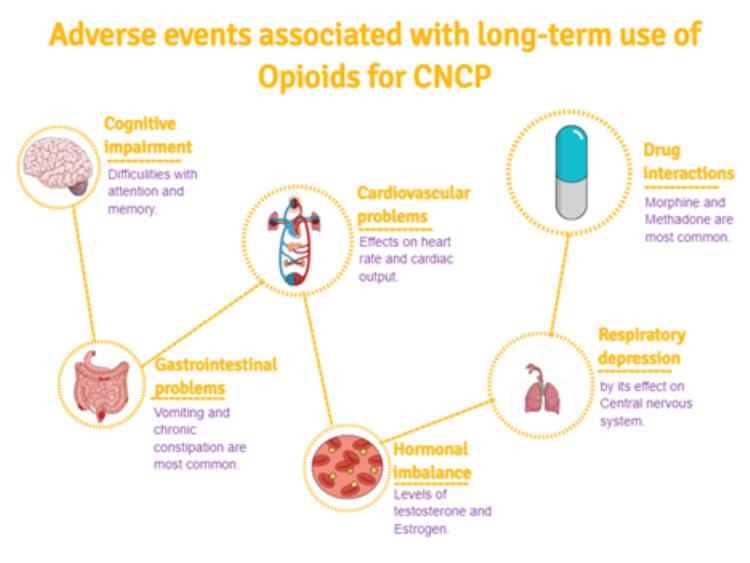
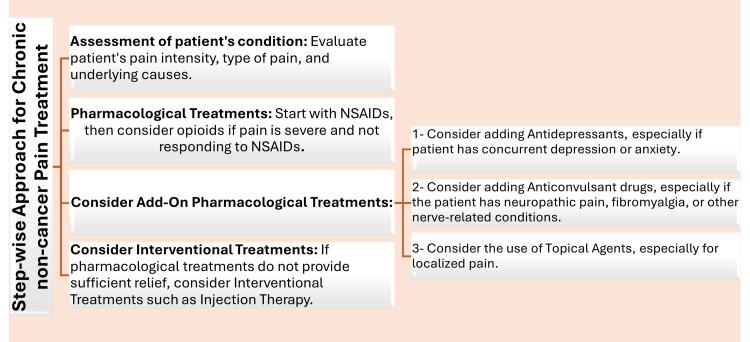
We conducted a literature search in PubMed, MEDLINE, EMBASE, and Web of Science databases. Search terms included CNCP, pain pathophysiology, opioid pharmacodynamics, opioid prescribing trends, guidelines for opioid use, and opioid side effects. Results: Our review highlights that while opioids may provide short-term relief from CNCP, their effectiveness diminishes over time due to the development of opioid tolerance. This tolerance often leads to increased dosages, which can subsequently result in opioid dependence. Additionally, long-term opioid therapy is associated with a spectrum of adverse effects, including constipation, drowsiness, respiratory depression, and potential for drug interactions. Furthermore, our review indicates that alternative pain management strategies play a crucial role in controlling CNCP. They offer significant benefits with fewer adverse events. These strategies include non-opioid medications, physical therapy, cognitive-behavioral therapy (CBT), various interventional procedures, injection therapy, and acupuncture.
CONCLUSION
Using opioids to manage CNCP presents several challenges. Given these challenges, alternative treatments are being considered as viable options. Moreover, it is crucial to customize treatment plans to align with the patients' specific health requirements, existing conditions, and potential risks to ensure the best possible outcomes.
背景
长期使用阿片类药物治疗慢性非癌性疼痛(CNCP)已引起更多关注和争论。尽管阿片类药物常用于治疗慢性疼痛,但其长期疗效和安全性仍不明确。
目的
本综述旨在概述目前已知的长期使用阿片类药物治疗CNCP的不良事件。它还提供了以患者为中心的策略,旨在降低这些风险。
方法
我们在PubMed、MEDLINE、EMBASE和科学网数据库中进行了文献检索。检索词包括CNCP、疼痛病理生理学、阿片类药物药效学、阿片类药物处方趋势、阿片类药物使用指南和阿片类药物副作用。结果:我们的综述强调,虽然阿片类药物可能在短期内缓解CNCP,但由于阿片类药物耐受性的发展,其疗效会随着时间的推移而降低。这种耐受性通常会导致剂量增加,进而可能导致阿片类药物依赖。此外,长期阿片类药物治疗与一系列不良反应相关,包括便秘、嗜睡、呼吸抑制和药物相互作用的可能性。此外,我们的综述表明,替代疼痛管理策略在控制CNCP方面起着至关重要的作用。它们具有显著的益处,不良事件较少。这些策略包括非阿片类药物、物理治疗、认知行为疗法(CBT)、各种介入程序、注射疗法和针灸。
结论
使用阿片类药物治疗CNCP存在若干挑战。鉴于这些挑战,替代治疗正被视为可行的选择。此外,根据患者的具体健康需求、现有状况和潜在风险定制治疗计划至关重要,以确保获得最佳结果。

 Zotero 插件