
循环炎症标志物与成人癌症风险的关联:一项孟德尔随机化分析。
Association between circulating inflammatory markers and adult cancer risk: a Mendelian randomization analysis.
机构信息
MRC Integrative Epidemiology Unit, University of Bristol, Bristol, UK; Population Health Sciences, Bristol Medical School, University of Bristol, Bristol, UK; Department of Epidemiology and Biostatistics, School of Public Health, Imperial College London, St Mary's Campus, London, UK.
MRC Integrative Epidemiology Unit, University of Bristol, Bristol, UK; Population Health Sciences, Bristol Medical School, University of Bristol, Bristol, UK.
出版信息
EBioMedicine. 2024 Feb;100:104991. doi: 10.1016/j.ebiom.2024.104991. Epub 2024 Feb 1.
BACKGROUND
Tumour-promoting inflammation is a "hallmark" of cancer and conventional epidemiological studies have reported links between various inflammatory markers and cancer risk. The causal nature of these relationships and, thus, the suitability of these markers as intervention targets for cancer prevention is unclear.
METHODS
We meta-analysed 6 genome-wide association studies of circulating inflammatory markers comprising 59,969 participants of European ancestry. We then used combined cis-Mendelian randomization and colocalisation analysis to evaluate the causal role of 66 circulating inflammatory markers in risk of 30 adult cancers in 338,294 cancer cases and up to 1,238,345 controls. Genetic instruments for inflammatory markers were constructed using genome-wide significant (P < 5.0 × 10) cis-acting SNPs (i.e., in or ±250 kb from the gene encoding the relevant protein) in weak linkage disequilibrium (LD, r < 0.10). Effect estimates were generated using inverse-variance weighted random-effects models and standard errors were inflated to account for weak LD between variants with reference to the 1000 Genomes Phase 3 CEU panel. A false discovery rate (FDR)-corrected P-value ("q-value") <0.05 was used as a threshold to define "strong evidence" to support associations and 0.05 ≤ q-value < 0.20 to define "suggestive evidence". A colocalisation posterior probability (PPH) >70% was employed to indicate support for shared causal variants across inflammatory markers and cancer outcomes. Findings were replicated in the FinnGen study and then pooled using meta-analysis.
FINDINGS
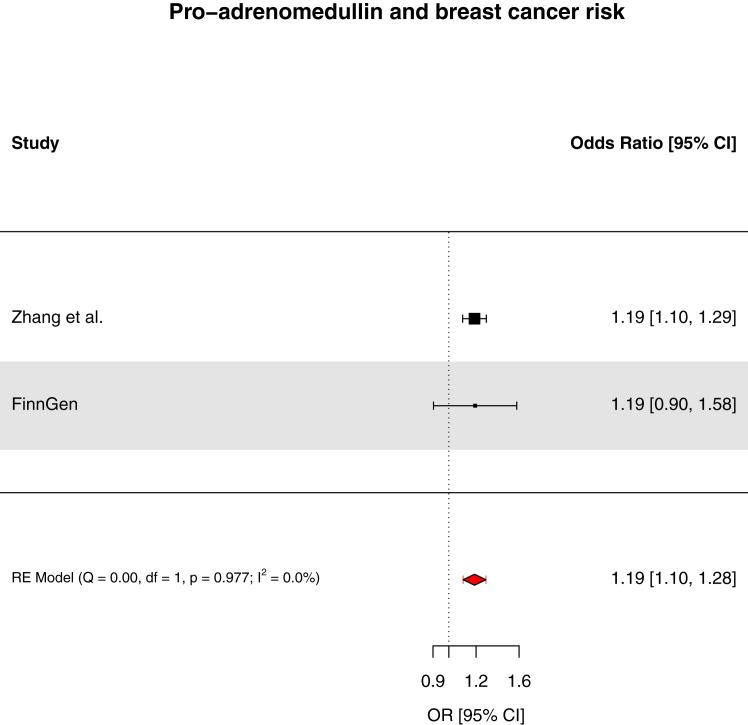
We found strong evidence to support an association of genetically-proxied circulating pro-adrenomedullin concentrations with increased breast cancer risk (OR: 1.19, 95% CI: 1.10-1.29, q-value = 0.033, PPH = 84.3%) and suggestive evidence to support associations of interleukin-23 receptor concentrations with increased pancreatic cancer risk (OR: 1.42, 95% CI: 1.20-1.69, q-value = 0.055, PPH = 73.9%), prothrombin concentrations with decreased basal cell carcinoma risk (OR: 0.66, 95% CI: 0.53-0.81, q-value = 0.067, PPH = 81.8%), and interleukin-1 receptor-like 1 concentrations with decreased triple-negative breast cancer risk (OR: 0.92, 95% CI: 0.88-0.97, q-value = 0.15, PPH = 85.6%). These findings were replicated in pooled analyses with the FinnGen study. Though suggestive evidence was found to support an association of macrophage migration inhibitory factor concentrations with increased bladder cancer risk (OR: 2.46, 95% CI: 1.48-4.10, q-value = 0.072, PPH = 76.1%), this finding was not replicated when pooled with the FinnGen study. For 22 of 30 cancer outcomes examined, there was little evidence (q-value ≥0.20) that any of the 66 circulating inflammatory markers examined were associated with cancer risk.
INTERPRETATION
Our comprehensive joint Mendelian randomization and colocalisation analysis of the role of circulating inflammatory markers in cancer risk identified potential roles for 4 circulating inflammatory markers in risk of 4 site-specific cancers. Contrary to reports from some prior conventional epidemiological studies, we found little evidence of association of circulating inflammatory markers with the majority of site-specific cancers evaluated.
FUNDING
Cancer Research UK (C68933/A28534, C18281/A29019, PPRCPJT∖100005), World Cancer Research Fund (IIG_FULL_2020_022), National Institute for Health Research (NIHR202411, BRC-1215-20011), Medical Research Council (MC_UU_00011/1, MC_UU_00011/3, MC_UU_00011/6, and MC_UU_00011/4), Academy of Finland Project 326291, European Union's Horizon 2020 grant agreement no. 848158 (EarlyCause), French National Cancer Institute (INCa SHSESP20, 2020-076), Versus Arthritis (21173, 21754, 21755), National Institutes of Health (U19 CA203654), National Cancer Institute (U19CA203654).
背景
促进肿瘤的炎症是癌症的“标志”之一,常规的流行病学研究已经报告了各种炎症标志物与癌症风险之间的关联。这些关系的因果性质,以及这些标志物作为癌症预防干预靶点的适宜性尚不清楚。
方法
我们对包含 59969 名欧洲血统参与者的 6 项循环炎症标志物全基因组关联研究进行了荟萃分析。然后,我们使用联合顺式孟德尔随机化和共定位分析来评估 66 种循环炎症标志物在 338294 例癌症病例和高达 1238345 名对照者中 30 种成人癌症风险中的因果作用。炎症标志物的遗传工具是使用全基因组显著(P < 5.0×10)顺式作用单核苷酸多态性(即,在编码相关蛋白的基因内或±250kb 处)构建的,这些单核苷酸多态性与较弱的连锁不平衡(r < 0.10)相关。使用逆方差加权随机效应模型生成效应估计值,并根据 1000 基因组 Phase 3 CEU 面板参考标准,将变异体之间的弱 LD 纳入标准误差。将错误发现率(FDR)校正的 P 值(“q 值”)<0.05 定义为支持关联的“强证据”,0.05≤q 值<0.20 定义为“提示性证据”。采用共定位后验概率(PPH)>70%来表示对炎症标志物和癌症结局之间共享因果变异的支持。在 FinnGen 研究中对这些发现进行了复制,然后使用荟萃分析进行了汇总。
发现
我们发现有强有力的证据支持循环促肾上腺髓质素浓度与乳腺癌风险增加之间存在关联(OR:1.19,95%CI:1.10-1.29,q 值=0.033,PPH=84.3%),并且有提示性证据支持白细胞介素-23 受体浓度与胰腺癌风险增加之间存在关联(OR:1.42,95%CI:1.20-1.69,q 值=0.055,PPH=73.9%),凝血酶原浓度与基底细胞癌风险降低之间存在关联(OR:0.66,95%CI:0.53-0.81,q 值=0.067,PPH=81.8%),白细胞介素-1 受体样 1 浓度与三阴性乳腺癌风险降低之间存在关联(OR:0.92,95%CI:0.88-0.97,q 值=0.15,PPH=85.6%)。这些发现通过与 FinnGen 研究的汇总分析得到了复制。虽然有提示性证据表明巨噬细胞移动抑制因子浓度与膀胱癌风险增加之间存在关联(OR:2.46,95%CI:1.48-4.10,q 值=0.072,PPH=76.1%),但当与 FinnGen 研究汇总时,这一发现并未得到复制。在我们研究的 30 种癌症结果中,有 22 种(q 值≥0.20),几乎没有证据表明我们研究的 66 种循环炎症标志物中的任何一种与癌症风险相关。
解释
我们对循环炎症标志物在癌症风险中的作用进行了全面的联合顺式孟德尔随机化和共定位分析,鉴定出 4 种循环炎症标志物在 4 种特定部位癌症的风险中可能发挥作用。与一些先前的常规流行病学研究的报告相反,我们发现循环炎症标志物与评估的大多数特定部位癌症之间的关联证据很少。
资金
英国癌症研究中心(C68933/A28534、C18281/A29019、PPRCPJT∖100005)、世界癌症研究基金(IIG_FULL_2020_022)、英国国家卫生研究院(NIHR202411、BRC-1215-20011)、医学研究委员会(MC_UU_00011/1、MC_UU_00011/3、MC_UU_00011/6、和 MC_UU_00011/4)、芬兰科学院项目 326291、欧盟地平线 2020 计划 848158(早期Cause)、法国国家癌症研究所(INCa SHSESP20、2020-076)、对抗关节炎(21173、21754、21755)、美国国立卫生研究院(U19 CA203654)、美国国家癌症研究所(U19 CA203654)。




 Zotero 插件