
人工智能与技术协作实验室:创新老龄化研究与阿尔茨海默病照护
Artificial Intelligence and Technology Collaboratories: Innovating aging research and Alzheimer's care.
机构信息
Johns Hopkins Medicine, Johns Hopkins University, School of Medicine, Baltimore, Maryland, USA.
Whiting School of Engineering, Johns Hopkins University, Baltimore, Maryland, USA.
出版信息
Alzheimers Dement. 2024 Apr;20(4):3074-3079. doi: 10.1002/alz.13710. Epub 2024 Feb 7.
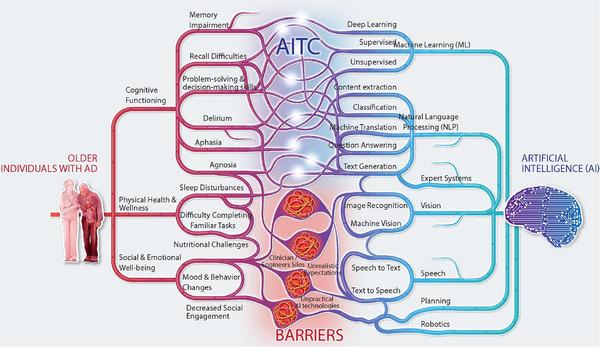
This perspective outlines the Artificial Intelligence and Technology Collaboratories (AITC) at Johns Hopkins University, University of Pennsylvania, and University of Massachusetts, highlighting their roles in developing AI-based technologies for older adult care, particularly targeting Alzheimer's disease (AD). These National Institute on Aging (NIA) centers foster collaboration among clinicians, gerontologists, ethicists, business professionals, and engineers to create AI solutions. Key activities include identifying technology needs, stakeholder engagement, training, mentoring, data integration, and navigating ethical challenges. The objective is to apply these innovations effectively in real-world scenarios, including in rural settings. In addition, the AITC focuses on developing best practices for AI application in the care of older adults, facilitating pilot studies, and addressing ethical concerns related to technology development for older adults with cognitive impairment, with the ultimate aim of improving the lives of older adults and their caregivers. HIGHLIGHTS: Addressing the complex needs of older adults with Alzheimer's disease (AD) requires a comprehensive approach, integrating medical and social support. Current gaps in training, techniques, tools, and expertise hinder uniform access across communities and health care settings. Artificial intelligence (AI) and digital technologies hold promise in transforming care for this demographic. Yet, transitioning these innovations from concept to marketable products presents significant challenges, often stalling promising advancements in the developmental phase. The Artificial Intelligence and Technology Collaboratories (AITC) program, funded by the National Institute on Aging (NIA), presents a viable model. These Collaboratories foster the development and implementation of AI methods and technologies through projects aimed at improving care for older Americans, particularly those with AD, and promote the sharing of best practices in AI and technology integration. Why Does This Matter? The National Institute on Aging (NIA) Artificial Intelligence and Technology Collaboratories (AITC) program's mission is to accelerate the adoption of artificial intelligence (AI) and new technologies for the betterment of older adults, especially those with dementia. By bridging scientific and technological expertise, fostering clinical and industry partnerships, and enhancing the sharing of best practices, this program can significantly improve the health and quality of life for older adults with Alzheimer's disease (AD).
本观点概述了约翰霍普金斯大学、宾夕法尼亚大学和马萨诸塞大学的人工智能和技术合作中心(AITC),重点介绍了它们在为老年护理开发基于人工智能的技术方面的作用,特别是针对阿尔茨海默病(AD)。这些美国国立卫生研究院(NIA)中心促进了临床医生、老年学家、伦理学家、商业专业人士和工程师之间的合作,以创建人工智能解决方案。关键活动包括确定技术需求、利益相关者参与、培训、指导、数据集成和应对道德挑战。目标是将这些创新有效地应用于现实场景中,包括在农村环境中。此外,AITC 还专注于为老年护理中人工智能的应用制定最佳实践,促进试点研究,并解决与认知障碍老年人相关的技术开发的道德问题,最终目标是改善老年人及其护理人员的生活。 重点: 满足患有阿尔茨海默病(AD)的老年人的复杂需求需要综合方法,整合医疗和社会支持。目前,培训、技术、工具和专业知识方面存在差距,阻碍了社区和医疗保健环境之间的统一获取。人工智能(AI)和数字技术有望改变这一年龄段的护理方式。然而,将这些创新从概念转化为可销售的产品面临着重大挑战,往往会使有前途的进展在开发阶段停滞不前。美国国立卫生研究院(NIA)资助的人工智能和技术合作中心(AITC)计划提供了一种可行的模式。这些合作中心通过旨在改善美国老年人,特别是患有 AD 的老年人的护理的项目,促进 AI 方法和技术的开发和实施,并促进 AI 和技术集成的最佳实践的共享。 为什么这很重要? 美国国立卫生研究院(NIA)人工智能和技术合作中心(AITC)计划的使命是通过采用人工智能(AI)和新技术来改善老年人的健康状况,特别是那些患有痴呆症的老年人。通过弥合科学和技术专业知识的差距,促进临床和行业合作伙伴关系,并加强最佳实践的共享,该计划可以显著改善患有阿尔茨海默病(AD)的老年人的健康和生活质量。


 Zotero 插件