
一种基于元学习的可解释阿尔茨海默病诊断集成模型。
A Meta-Learning-Based Ensemble Model for Explainable Alzheimer's Disease Diagnosis.
作者信息
Al-Bakri Fatima Hasan, Bejuri Wan Mohd Yaakob Wan, Al-Andoli Mohamed Nasser, Ikram Raja Rina Raja, Khor Hui Min, Tahir Zulkifli
机构信息
Faculty of Information and Communication Technology, Universiti Teknikal Malaysia Melaka, Melaka 76100, Malaysia.
Faculty of Artificial Intelligence and Cyber Security, Universiti Teknikal Malaysia Melaka, Melaka 76100, Malaysia.
出版信息
Diagnostics (Basel). 2025 Jun 27;15(13):1642. doi: 10.3390/diagnostics15131642.
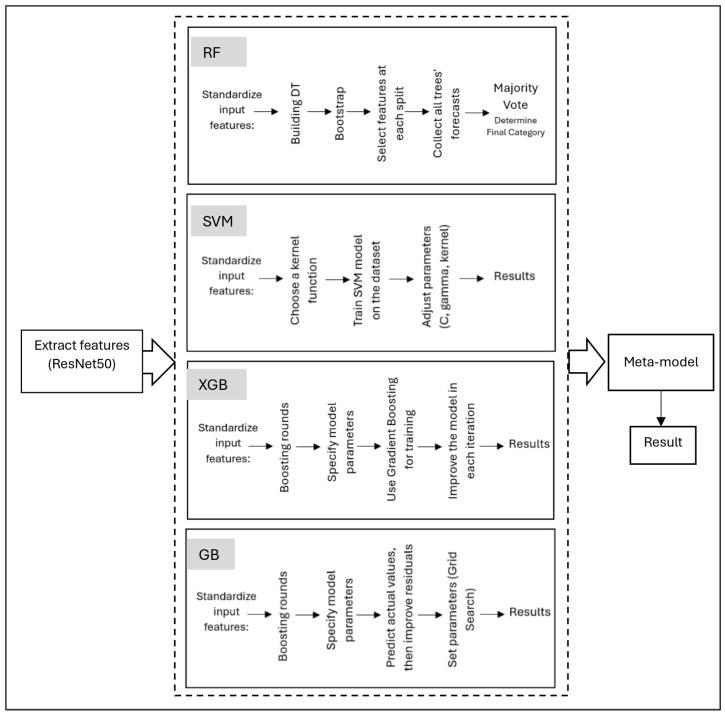
Artificial intelligence (AI) models for Alzheimer's disease (AD) diagnosis often face the challenge of limited explainability, hindering their clinical adoption. Previous studies have relied on full-scale MRI, which increases unnecessary features, creating a "black-box" problem in current XAI models. This study proposes an explainable ensemble-based diagnostic framework trained on both clinical data and mid-slice axial MRI from the ADNI and OASIS datasets. The methodology involves training an ensemble model that integrates Random Forest, Support Vector Machine, XGBoost, and Gradient Boosting classifiers, with meta-logistic regression used for the final decision. The core contribution lies in the exclusive use of mid-slice MRI images, which highlight the lateral ventricles, thus improving the transparency and clinical relevance of the decision-making process. Our mid-slice approach minimizes unnecessary features and enhances model explainability by design. We achieved state-of-the-art diagnostic accuracy: 99% on OASIS and 97.61% on ADNI using clinical data alone; 99.38% on OASIS and 98.62% on ADNI using only mid-slice MRI; and 99% accuracy when combining both modalities. The findings demonstrated significant progress in diagnostic transparency, as the algorithm consistently linked predictions to observed structural changes in the dilated lateral ventricles of the brain, which serve as a clinically reliable biomarker for AD and can be easily verified by medical professionals. This research presents a step toward more transparent AI-driven diagnostics, bridging the gap between accuracy and explainability in XAI.
用于阿尔茨海默病(AD)诊断的人工智能(AI)模型常常面临可解释性有限的挑战,这阻碍了它们在临床中的应用。先前的研究依赖于全尺寸磁共振成像(MRI),这增加了不必要的特征,在当前的可解释人工智能(XAI)模型中造成了“黑箱”问题。本研究提出了一种基于可解释集成的诊断框架,该框架在来自阿尔茨海默病神经成像计划(ADNI)和老年人脑成像数据集(OASIS)的临床数据和中矢状面轴向MRI上进行训练。该方法包括训练一个集成模型,该模型整合了随机森林、支持向量机、极端梯度提升(XGBoost)和梯度提升分类器,并使用元逻辑回归进行最终决策。核心贡献在于专门使用突出侧脑室的中矢状面MRI图像,从而提高了决策过程的透明度和临床相关性。我们的中矢状面方法通过设计最小化了不必要的特征并增强了模型的可解释性。我们取得了领先的诊断准确率:仅使用临床数据时,在OASIS数据集上为99%,在ADNI数据集上为97.61%;仅使用中矢状面MRI时,在OASIS数据集上为99.38%,在ADNI数据集上为98.62%;两种模态结合时准确率为99%。研究结果表明在诊断透明度方面取得了显著进展,因为该算法始终将预测与大脑扩张侧脑室中观察到的结构变化联系起来,这些变化是AD临床上可靠的生物标志物,并且可以很容易地由医学专业人员进行验证。这项研究朝着更透明的人工智能驱动诊断迈出了一步,弥合了可解释人工智能中准确性和可解释性之间的差距。



 Zotero 插件