
循环炎症蛋白 91 种水平与腰椎和骨盆骨折及外周韧带损伤风险的关系:两样本孟德尔随机化研究。
Levels of 91 circulating inflammatory proteins and risk of lumbar spine and pelvic fractures and peripheral ligament injuries: a two-sample mendelian randomization study.
机构信息
Emergency Department, Zigong Fourth People's Hospital, Zigong, China.
Neurology Department, Zigong First People's Hospital, Zigong, China.
出版信息
J Orthop Surg Res. 2024 Mar 1;19(1):161. doi: 10.1186/s13018-024-04637-8.
OBJECTIVE
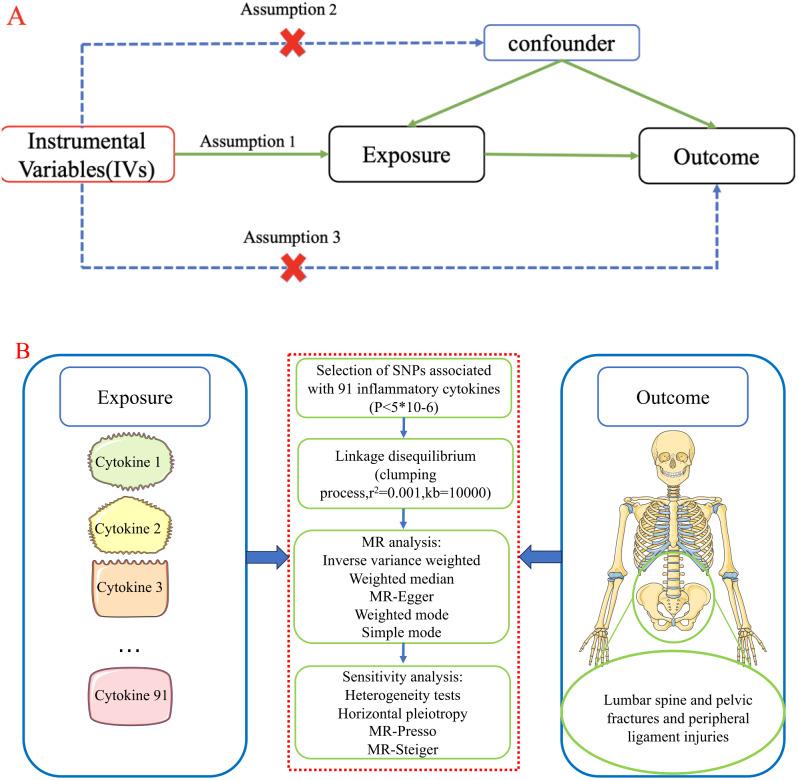
Lumbar spine and pelvic fractures(LPF) are combined with peripheral ligament injuries(PLI), frequently. It has been reported that the site of fracture injury is usually paralleled by the secretion of inflammatory proteins. This study aimed to investigate the causal relationship between 91 circulating inflammatory proteins and LPF and PLI by using a Two-sample Mendelian randomization (MR) analysis.
METHODS
Single nucleotide polymorphisms (SNPs) associated with 91 circulating inflammatory proteins, as exposures were selected from a large genome-wide association study (GWAS). The genetic variant data for LPF and PLI as outcomes from the FinnGen consortium. The inverse-variance-weighted (IVW) method was utilized as the main analysis for exposures and outcomes. In addition, the final results were reinforced by the methods of MR Egger, weighted median, simple mode, and weighted mode. The sensitivity analyses were used to validate the robustness of results and ensure the absence of heterogeneity and horizontal pleiotropy. MR-Steiger was used to assess whether the causal direction was correct to avoid reverse causality.
RESULTS
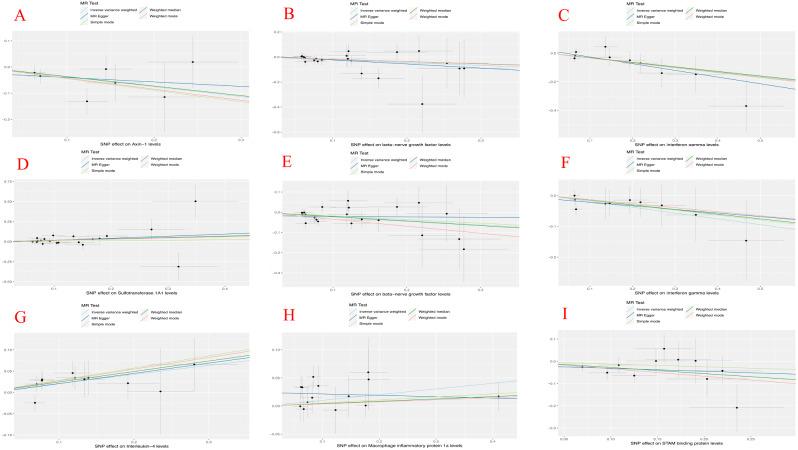
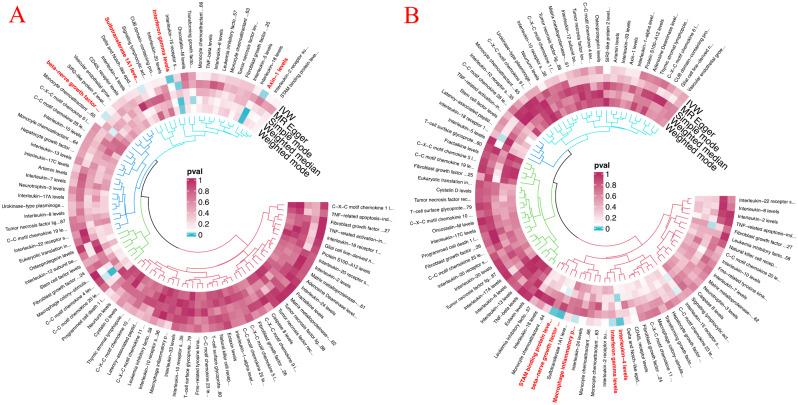
This study has shown that Beta-nerve growth factor(Beta-NGF) and Interferon gamma(IFN-gamma) are both involved in the occurrence of LPF and PLI, and they are reducing the risk of occurrence(OR:0.800, 95%CI: 0.650-0.983; OR:0.723, 95%CI:0.568-0.920 and OR:0.812, 95%CI:0.703-0.937; OR:0.828, 95%CI:0.700-0.980). Similarly, Axin-1 and Sulfotransferase 1A1 (SULT-1A1) were causally associated with LPF(OR:0.687, 95%CI:0.501-0.942 and OR:1.178,95%CI:1.010-1.373). Furthermore, Interleukin-4(IL-4), Macrophage inflammatory protein 1a(MIP-1a), and STAM binding protein(STAM-BP) were causally associated with PLI(OR:1.236, 95% CI: 1.058-1.443; OR:1.107, 95% CI: 1.008-1.214 and OR:0.759, 95% CI: 0.617-0.933). The influence of heterogeneity and horizontal pleiotropy were further excluded by sensitivity analysis.
CONCLUSION
This study provides new insights into the relationship between circulating inflammatory proteins and LPF and PLI, and may provide new clues for predicting this risk.
目的
腰椎和骨盆骨折(LPF)常伴有外周韧带损伤(PLI)。据报道,骨折损伤部位通常与炎症蛋白的分泌平行。本研究旨在通过双样本 Mendelian 随机化(MR)分析,研究 91 种循环炎症蛋白与 LPF 和 PLI 的因果关系。
方法
选择与 91 种循环炎症蛋白相关的单核苷酸多态性(SNP)作为暴露因素,这些 SNP 来自一项大型全基因组关联研究(GWAS)。LPF 和 PLI 的遗传变异数据来自 FinnGen 联合会。使用逆方差加权(IVW)法作为主要分析方法,对暴露因素和结局进行分析。此外,还使用 MR Egger、加权中位数、简单模式和加权模式等方法对最终结果进行了强化。敏感性分析用于验证结果的稳健性,并确保不存在异质性和水平多效性。使用 MR-Steiger 评估因果关系的方向是否正确,以避免反向因果关系。
结果
本研究表明,β-神经生长因子(Beta-NGF)和γ-干扰素(IFN-gamma)都参与了 LPF 和 PLI 的发生,并且降低了发生的风险(OR:0.800,95%CI:0.650-0.983;OR:0.723,95%CI:0.568-0.920 和 OR:0.812,95%CI:0.703-0.937;OR:0.828,95%CI:0.700-0.980)。同样,轴突蛋白-1(Axin-1)和磺基转移酶 1A1(SULT-1A1)与 LPF 也存在因果关系(OR:0.687,95%CI:0.501-0.942 和 OR:1.178,95%CI:1.010-1.373)。此外,白细胞介素 4(IL-4)、巨噬细胞炎症蛋白 1a(MIP-1a)和 STAM 结合蛋白(STAM-BP)与 PLI 也存在因果关系(OR:1.236,95%CI:1.058-1.443;OR:1.107,95%CI:1.008-1.214 和 OR:0.759,95%CI:0.617-0.933)。通过敏感性分析进一步排除了异质性和水平多效性的影响。
结论
本研究为循环炎症蛋白与 LPF 和 PLI 之间的关系提供了新的见解,可能为预测这种风险提供了新的线索。

 Zotero 插件