
经颅磁刺激联合训练改善精神分裂症社会认知障碍:一项初步随机对照试验
Combining transcranial magnetic stimulation with training to improve social cognition impairment in schizophrenia: a pilot randomized controlled trial.
作者信息
Vergallito Alessandra, Gramano Bianca, La Monica Kevin, Giuliani Luigi, Palumbo Davide, Gesi Camilla, Torriero Sara
机构信息
Department of Psychology and Neuromi, University of Milano-Bicocca, Milan, Italy.
Department of Mental Health and Addictions, ASST Fatebenefratelli-Sacco, Milan, Italy.
出版信息
Front Psychol. 2024 Feb 20;15:1308971. doi: 10.3389/fpsyg.2024.1308971. eCollection 2024.
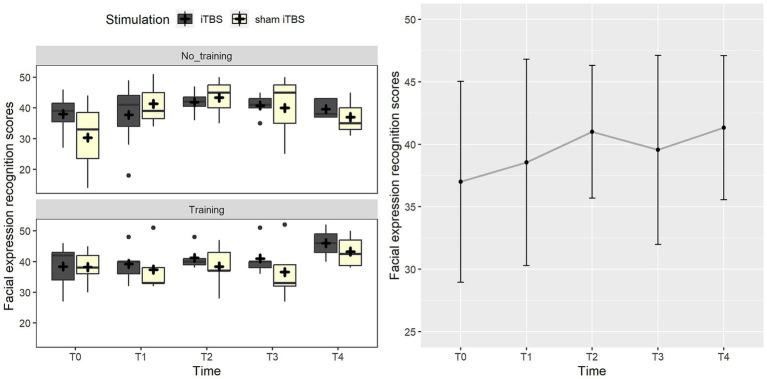
Schizophrenia is a severe, chronic mental disorder that profoundly impacts patients' everyday lives. The illness's core features include positive and negative symptoms and cognitive impairments. In particular, deficits in the social cognition domain showed a tighter connection to patients' everyday functioning than the other symptoms. Social remediation interventions have been developed, providing heterogeneous results considering the possibility of generalizing the acquired improvements in patients' daily activities. In this pilot randomized controlled trial, we investigated the feasibility of combining fifteen daily cognitive and social training sessions with non-invasive brain stimulation to boost the effectiveness of the two interventions. We delivered intermittent theta burst stimulation (iTBS) over the left dorsolateral prefrontal cortex (DLPFC). Twenty-one patients were randomized into four groups, varying for the assigned stimulation condition (real vs. sham iTBS) and the type of cognitive intervention (training vs. no training). Clinical symptoms and social cognition tests were administered at five time points, i.e., before and after the treatment, and at three follow-ups at one, three, and six months after the treatments' end. Preliminary data show a trend in improving the competence in managing emotion in participants performing the training. Conversely, no differences were found in pre and post-treatment scores for emotion recognition, theory of mind, and attribution of intentions scores. The iTBS intervention did not induce additional effects on individuals' performance. The methodological approach's novelty and limitations of the present study are discussed.
精神分裂症是一种严重的慢性精神障碍,对患者的日常生活产生深远影响。该疾病的核心特征包括阳性和阴性症状以及认知障碍。特别是,社会认知领域的缺陷与患者的日常功能之间的联系比其他症状更为紧密。已经开发了社会康复干预措施,但考虑到在患者日常活动中获得的改善能否普遍化,其结果存在差异。在这项试点随机对照试验中,我们研究了将为期15天的认知和社会培训课程与非侵入性脑刺激相结合以提高这两种干预措施有效性的可行性。我们在左侧背外侧前额叶皮层(DLPFC)进行间歇性theta爆发刺激(iTBS)。21名患者被随机分为四组,根据指定的刺激条件(真实iTBS与假iTBS)和认知干预类型(培训与不培训)而有所不同。在五个时间点进行临床症状和社会认知测试,即治疗前、治疗后以及治疗结束后1个月、3个月和6个月的三次随访。初步数据显示,接受培训的参与者在情绪管理能力方面有改善趋势。相反,在情绪识别、心理理论和意图归因得分的治疗前后分数上未发现差异。iTBS干预并未对个体表现产生额外影响。本文讨论了该方法的新颖性和本研究的局限性。


 Zotero 插件