
间歇性θ波爆发刺激联合认知训练改善精神分裂症的阴性症状和认知障碍:一项初步研究。
Intermittent Theta Burst Stimulation Combined with Cognitive Training to Improve Negative Symptoms and Cognitive Impairment in Schizophrenia: A Pilot Study.
作者信息
Vergallito Alessandra, Gesi Camilla, Torriero Sara
机构信息
Department of Psychology & Neuromi, University of Milano-Bicocca, 20126 Milan, Italy.
Department of Mental Health and Addictions, ASST Fatebenefratelli-Sacco, 20157 Milan, Italy.
出版信息
Brain Sci. 2024 Jul 8;14(7):683. doi: 10.3390/brainsci14070683.
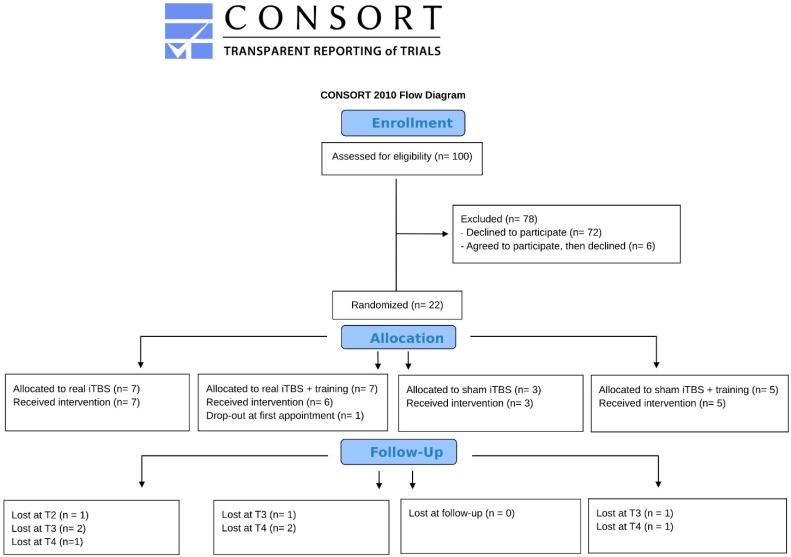
Schizophrenia is a chronic psychiatric disorder severely affecting patients' functioning and quality of life. Unlike positive symptoms, cognitive impairment and negative symptoms cannot be treated pharmacologically and represent consistent predictors of the illness's prognosis. Cognitive remediation (CR) interventions have been applied to target these symptoms. Brain stimulation also provides promising yet preliminary results in reducing negative symptoms, whereas its effect on cognitive impairment remains heterogeneous. Here, we combined intermittent theta burst stimulation (iTBS) with CR to improve negative symptoms and cognitive impairment in schizophrenia spectrum patients. One hundred eligible patients were invited, and twenty-one participated. We randomized them into four groups, manipulating the stimulation condition (real vs. sham) and CR (no training vs. training). We delivered fifteen iTBS sessions over the left dorsolateral prefrontal cortex for three weeks, followed (or not) by 50 min of training. Consensus-based clinical and cognitive assessment was administered at baseline and after the treatment, plus at three follow-ups occurring one, three, and six months after the intervention. Mixed-model analyses were run on cognitive and negative symptom scores. The preliminary findings highlighted a marginal modulation of iTBS on negative symptoms, whereas CR improved isolated cognitive functions. We herein discuss the limitations and strengths of the methodological approach.
精神分裂症是一种慢性精神疾病,严重影响患者的功能和生活质量。与阳性症状不同,认知障碍和阴性症状无法通过药物治疗,并且是该疾病预后的一致预测指标。认知康复(CR)干预已被用于针对这些症状。脑刺激在减轻阴性症状方面也取得了有前景但仍属初步的结果,而其对认知障碍的影响仍然存在异质性。在此,我们将间歇性theta爆发刺激(iTBS)与CR相结合,以改善精神分裂症谱系患者的阴性症状和认知障碍。邀请了100名符合条件的患者,其中21名参与。我们将他们随机分为四组,操纵刺激条件(真实刺激与假刺激)和CR(无训练与训练)。在左侧背外侧前额叶皮层进行了为期三周的15次iTBS治疗,随后(或不)进行50分钟的训练。在基线、治疗后以及干预后1个月、3个月和6个月的三次随访时进行基于共识的临床和认知评估。对认知和阴性症状评分进行混合模型分析。初步结果突出显示iTBS对阴性症状有轻微调节作用,而CR改善了孤立的认知功能。我们在此讨论了该方法的局限性和优势。



 Zotero 插件