
处于十字路口的中性粒细胞:解析其在肿瘤微环境中的多面作用
Neutrophils at the Crossroads: Unraveling the Multifaceted Role in the Tumor Microenvironment.
作者信息
Awasthi Deepika, Sarode Aditya
机构信息
Department of Obstetrics and Gynecology, Weill Cornell Medicine, New York, NY 10065, USA.
Department of Microbiology and Immunology, Vagelos College of Physicians and Surgeons, Columbia University, New York, NY 10032, USA.
出版信息
Int J Mol Sci. 2024 Mar 2;25(5):2929. doi: 10.3390/ijms25052929.
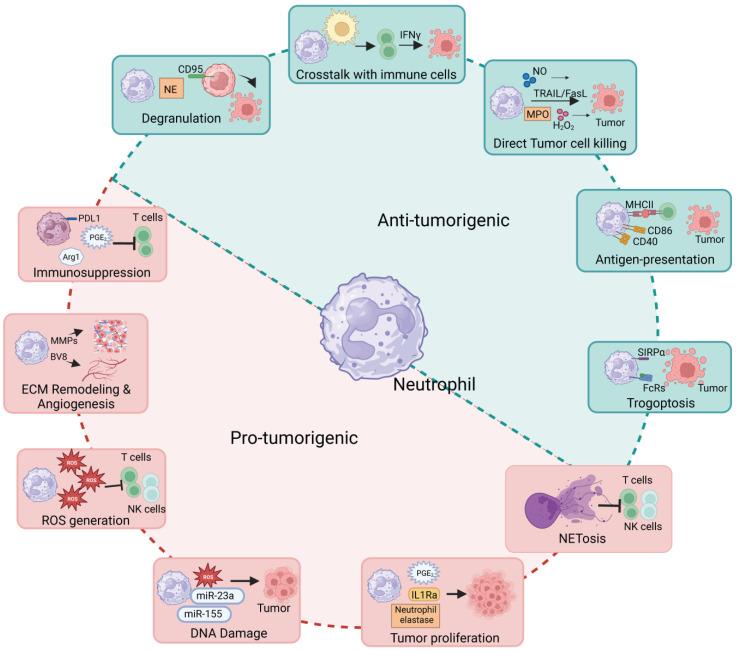
Over the past decade, research has prominently established neutrophils as key contributors to the intricate landscape of tumor immune biology. As polymorphonuclear granulocytes within the innate immune system, neutrophils play a pivotal and abundant role, constituting approximately ∼70% of all peripheral leukocytes in humans and ∼10-20% in mice. This substantial presence positions them as the frontline defense against potential threats. Equipped with a diverse array of mechanisms, including reactive oxygen species (ROS) generation, degranulation, phagocytosis, and the formation of neutrophil extracellular traps (NETs), neutrophils undeniably serve as indispensable components of the innate immune system. While these innate functions enable neutrophils to interact with adaptive immune cells such as T, B, and NK cells, influencing their functions, they also engage in dynamic interactions with rapidly dividing tumor cells. Consequently, neutrophils are emerging as crucial regulators in both pro- and anti-tumor immunity. This comprehensive review delves into recent research to illuminate the multifaceted roles of neutrophils. It explores their diverse functions within the tumor microenvironment, shedding light on their heterogeneity and their impact on tumor recruitment, progression, and modulation. Additionally, the review underscores their potential anti-tumoral capabilities. Finally, it provides valuable insights into clinical therapies targeting neutrophils, presenting a promising approach to leveraging innate immunity for enhanced cancer treatment.
在过去十年中,研究已显著确立中性粒细胞是肿瘤免疫生物学复杂领域的关键贡献者。作为固有免疫系统中的多形核粒细胞,中性粒细胞发挥着关键且重要的作用,在人类中约占所有外周白细胞的70%,在小鼠中约占10 - 20%。这种大量存在使其成为抵御潜在威胁的一线防御力量。中性粒细胞具备多种机制,包括活性氧(ROS)生成、脱颗粒、吞噬作用以及中性粒细胞胞外陷阱(NETs)的形成,无疑是固有免疫系统不可或缺的组成部分。虽然这些固有功能使中性粒细胞能够与T、B和NK细胞等适应性免疫细胞相互作用,影响它们的功能,但它们也与快速分裂的肿瘤细胞进行动态相互作用。因此,中性粒细胞正在成为肿瘤免疫中促肿瘤和抗肿瘤的关键调节因子。这篇全面的综述深入探讨了近期研究,以阐明中性粒细胞的多方面作用。它探讨了中性粒细胞在肿瘤微环境中的多种功能,揭示了它们的异质性以及对肿瘤募集、进展和调节的影响。此外,该综述强调了它们潜在的抗肿瘤能力。最后,它为针对中性粒细胞的临床治疗提供了有价值的见解,提出了一种利用固有免疫增强癌症治疗的有前景的方法。
 Zotero 插件