
CA1737/04与传染性支气管炎病毒流行基因型对蛋鸡的致病性比较
Comparative pathogenicity of CA1737/04 and Mass infectious bronchitis virus genotypes in laying chickens.
作者信息
Ali Ahmed, Farooq Muhammad, Altakrouni Danah, Najimudeen Shahnas M, Hassan Mohamed S H, Isham Ishara M, Shalaby Adel A, Gallardo Rodrigo A, Abdul-Careem Mohamed Faizal
机构信息
Faculty of Veterinary Medicine, University of Calgary, Calgary, AB, Canada.
Department of Pathology, Faculty of Veterinary Medicine, Beni-Suef University, Beni Suef, Egypt.
出版信息
Front Vet Sci. 2024 Feb 28;11:1338563. doi: 10.3389/fvets.2024.1338563. eCollection 2024.
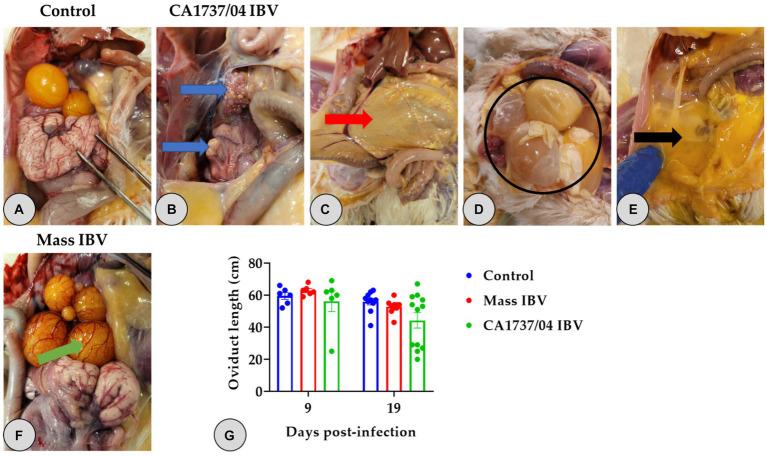
Infectious bronchitis virus (IBV) is a respiratory virus causing atropism in multiple body systems of chickens. Recently, the California 1737/04 (CA1737/04) IBV strain was identified as one of the circulating IBV variants among poultry operations in North America. Here, the pathogenicity and tissue tropism of CA1737/04 IBV strain in specific-pathogen-free (SPF) hens were characterized in comparison to Massachusetts (Mass) IBV. In 30 weeks-old SPF hens, Mass or CA1737/04 IBV infections were carried out, while the third group was maintained as a control group. Following infection, we evaluated clinical signs, egg production, viral shedding, serology, necropsy examination, and histopathology during a period of 19 days. Also, certain tissue affinity parameters were investigated, which involved the localization of viral antigens and the detection of viral RNA copies in designated tissues. Our findings indicate that infection with CA1737/04 or Mass IBV strain could induce significant clinical signs, reduced egg production, and anti-IBV antibodies locally in oviduct wash and systemically in serum. Both IBV strains showed detectable levels of viral RNA copies and induced pathology in respiratory, renal, enteric, and reproductive tissues. However, the CA1737/04 IBV strain had higher pathogenicity, higher tissue tropism, and higher replication in the kidney, large intestine, and different segments of the oviduct compared to the Mass IBV strain. Both IBV strains shed viral genome from the cloacal route, however, the Mass IBV infected hens shed higher IBV genome loads via the oropharyngeal route compared to CA1737/04 IBV-infected hens. Overall, the current findings could contribute to a better understanding of CA1737/04 IBV pathogenicity in laying hens.
传染性支气管炎病毒(IBV)是一种可在鸡的多个身体系统中引发嗜性的呼吸道病毒。最近,加利福尼亚1737/04(CA1737/04)IBV毒株被确定为北美家禽养殖场中流行的IBV变体之一。在此,与马萨诸塞州(Mass)IBV相比,对CA1737/04 IBV毒株在无特定病原体(SPF)母鸡中的致病性和组织嗜性进行了表征。在30周龄的SPF母鸡中,进行了Mass或CA1737/04 IBV感染,而第三组作为对照组。感染后,我们在19天的时间内评估了临床症状、产蛋量、病毒脱落、血清学、尸检检查和组织病理学。此外,还研究了某些组织亲和参数,包括病毒抗原的定位以及指定组织中病毒RNA拷贝的检测。我们的研究结果表明,感染CA1737/04或Mass IBV毒株可在输卵管冲洗液中局部和血清中全身诱导明显的临床症状、产蛋量下降和抗IBV抗体。两种IBV毒株在呼吸道、肾脏、肠道和生殖组织中均显示出可检测水平的病毒RNA拷贝并引发病变。然而,与Mass IBV毒株相比,CA1737/04 IBV毒株具有更高的致病性、更高的组织嗜性以及在肾脏、大肠和输卵管不同节段中的更高复制率。两种IBV毒株均通过泄殖腔途径排出病毒基因组,然而,与感染CA1737/04 IBV的母鸡相比,感染Mass IBV的母鸡通过口咽途径排出的IBV基因组载量更高。总体而言,目前的研究结果有助于更好地了解CA1737/04 IBV在蛋鸡中的致病性。




 Zotero 插件