
邻苯二甲酸酯代谢物和性激素与美国成年人肥胖的关系:NHANES 2013-2016。
Phthalate metabolites and sex steroid hormones in relation to obesity in US adults: NHANES 2013-2016.
机构信息
Department of Cardiology, Zhuhai People's Hospital (Zhuhai Clinical Medical College of Jinan University), Zhuhai, Guangdong, China.
Department of Biostatistics, School of Public Health, Xuzhou Medical University, Xuzhou, Jiangsu, China.
出版信息
Front Endocrinol (Lausanne). 2024 Mar 8;15:1340664. doi: 10.3389/fendo.2024.1340664. eCollection 2024.
BACKGROUND
Obesity and metabolic syndrome pose significant health challenges in the United States (US), with connections to disruptions in sex hormone regulation. The increasing prevalence of obesity and metabolic syndrome might be associated with exposure to phthalates (PAEs). Further exploration of the impact of PAEs on obesity is crucial, particularly from a sex hormone perspective.
METHODS
A total of 7780 adult participants in the National Health and Nutrition Examination Survey (NHANES) from 2013 to 2016 were included in the study. Principal component analysis (PCA) coupled with multinomial logistic regression was employed to elucidate the association between urinary PAEs metabolite concentrations and the likelihood of obesity. Weighted quartiles sum (WQS) regression was utilized to consolidate the impact of mixed PAEs exposure on sex hormone levels (total testosterone (TT), estradiol and sex hormone-binding globulin (SHBG)). We also delved into machine learning models to accurately discern obesity status and identify the key variables contributing most to these models.
RESULTS
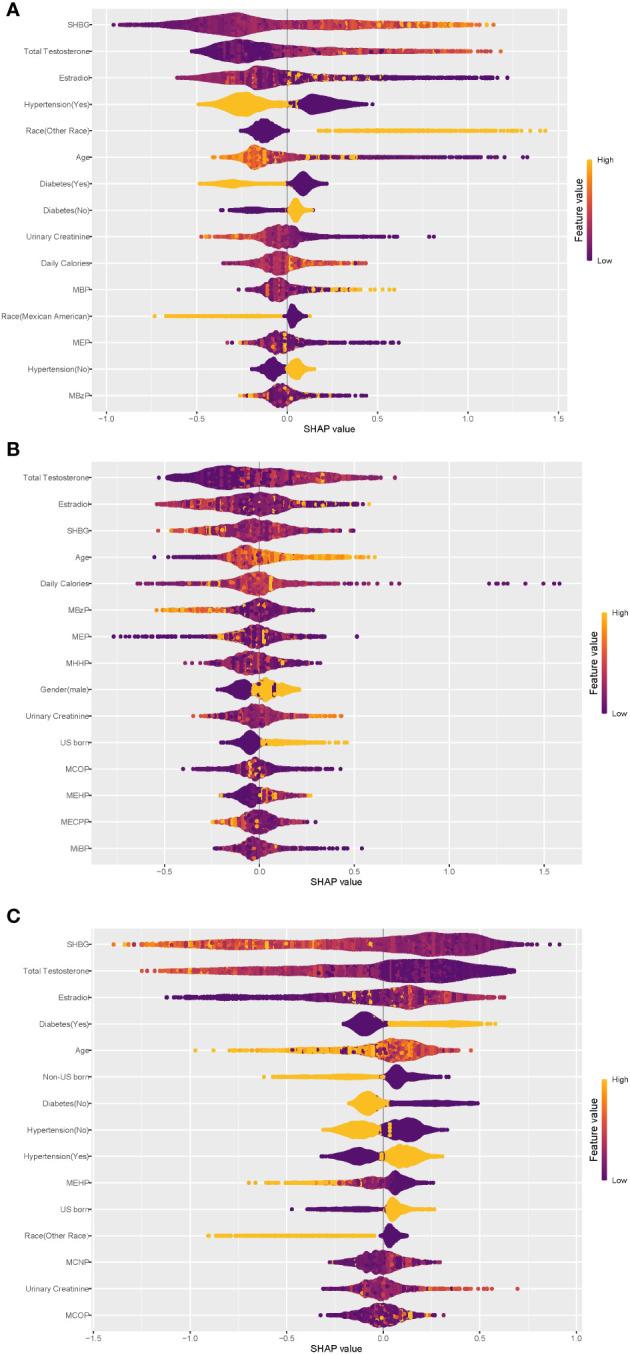
Principal Component 1 (PC1), characterized by mono(2-ethyl-5-carboxypentyl) phthalate (MECPP), mono(2-ethyl-5-hydroxyhexyl) phthalate (MEHHP), and mono(2-ethyl-5-oxohexyl) phthalate (MEOHP) as major contributors, exhibited a negative association with obesity. Conversely, PC2, with monocarboxyononyl phthalate (MCNP), monocarboxyoctyl phthalate (MCOP), and mono(3-carboxypropyl) phthalate (MCPP) as major contributors, showed a positive association with obesity. Mixed exposure to PAEs was associated with decreased TT levels and increased estradiol and SHBG. During the exploration of the interrelations among obesity, sex hormones, and PAEs, models based on Random Forest (RF) and eXtreme Gradient Boosting (XGBoost) algorithms demonstrated the best classification efficacy. In both models, sex hormones exhibited the highest variable importance, and certain phthalate metabolites made significant contributions to the model's performance.
CONCLUSIONS
Individuals with obesity exhibit lower levels of TT and SHBG, accompanied by elevated estradiol levels. Exposure to PAEs disrupts sex hormone levels, contributing to an increased risk of obesity in US adults. In the exploration of the interrelationships among these three factors, the RF and XGBoost algorithm models demonstrated superior performance, with sex hormones displaying higher variable importance.
背景
肥胖和代谢综合征在美国构成了重大健康挑战,与性激素调节紊乱有关。肥胖和代谢综合征的患病率不断上升,可能与邻苯二甲酸酯(PAEs)的暴露有关。从性激素的角度进一步探讨 PAEs 对肥胖的影响至关重要。
方法
本研究共纳入了 2013 年至 2016 年参加国家健康和营养检查调查(NHANES)的 7780 名成年参与者。采用主成分分析(PCA)与多项逻辑回归相结合的方法,阐明了尿中 PAEs 代谢产物浓度与肥胖可能性之间的关系。采用加权四分位数和(WQS)回归法综合分析混合 PAEs 暴露对性激素水平(总睾酮(TT)、雌二醇和性激素结合球蛋白(SHBG))的影响。我们还深入研究了机器学习模型,以准确区分肥胖状态并确定对这些模型贡献最大的关键变量。
结果
主成分 1(PC1)主要由单(2-乙基-5-羧基戊基)邻苯二甲酸酯(MECPP)、单(2-乙基-5-羟基己基)邻苯二甲酸酯(MEHHP)和单(2-乙基-5-氧代己基)邻苯二甲酸酯(MEOHP)组成,与肥胖呈负相关。相反,主成分 2(PC2)主要由单羧基壬基邻苯二甲酸酯(MCNP)、单羧基辛基邻苯二甲酸酯(MCOP)和单(3-羧基丙基)邻苯二甲酸酯(MCPP)组成,与肥胖呈正相关。混合暴露于 PAEs 与 TT 水平降低、雌二醇和 SHBG 水平升高有关。在探讨肥胖、性激素和 PAEs 之间的相互关系时,基于随机森林(RF)和极端梯度提升(XGBoost)算法的模型表现出最佳的分类效果。在这两种模型中,性激素的变量重要性最高,某些邻苯二甲酸酯代谢产物对模型性能有重要贡献。
结论
肥胖个体的 TT 和 SHBG 水平较低,同时雌二醇水平升高。PAEs 的暴露会破坏性激素水平,导致美国成年人肥胖风险增加。在探讨这三个因素之间的相互关系时,RF 和 XGBoost 算法模型表现出更好的性能,性激素的变量重要性更高。


 Zotero 插件