
肠道微生物群、炎症因子与结直肠癌之间的关联:孟德尔随机化分析证据
Association between the gut microbiota, inflammatory factors, and colorectal cancer: evidence from Mendelian randomization analysis.
作者信息
Ma Mingwei, Zheng Zicheng, Li Jie, He Yixuan, Kang Weiming, Ye Xin
机构信息
Department of General Surgery, Peking Union Medical College Hospital, Chinese Academy of Medical Science and Peking Union Medical College, Beijing, China.
出版信息
Front Microbiol. 2024 Mar 18;15:1309111. doi: 10.3389/fmicb.2024.1309111. eCollection 2024.
BACKGROUND
Colorectal cancer (CRC) is one of the most common malignant tumors primarily affecting individuals over the age of 50 years. Recent studies have suggested that the dysbiosis of the gut microbiota, a community of microorganisms in the human gut, is closely associated with the occurrence and development of CRC. Additionally, inflammatory factors (IFs) have also been reported to play a significant role in the development of CRC. However, the causal relationships between the gut microbiota, IFs, and CRC remain unclear.
METHODS
In this study, we performed Mendelian randomization (MR) analysis using publicly available genome-wide association study (GWAS) data to explore the causal relationship between the gut microbiota, IFs, and CRC. The gut microbiota GWAS data were obtained from the MiBioGen study, while the IFs GWAS data were derived from the comprehensive analysis of three independent cohorts. Causal relationship analysis was conducted using appropriate instrumental variables (IVs) and statistical models.
RESULTS
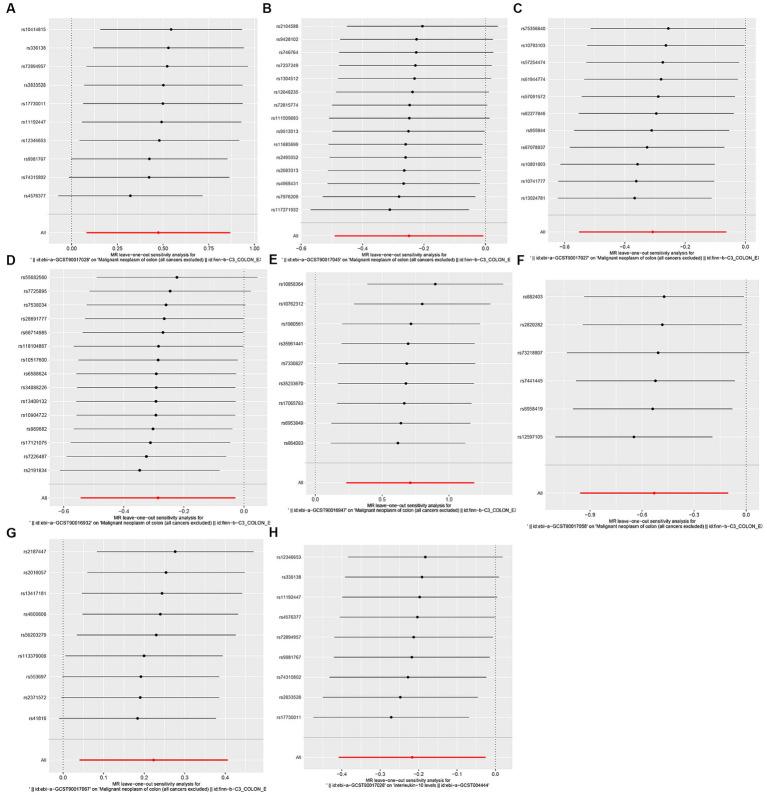
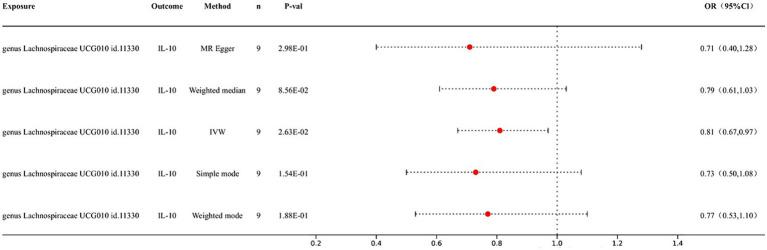
MR analysis of the gut microbiota and CRC revealed a negative correlation between the species in the gut and CRC risk, while a positive correlation was observed between species, UCG010 genus, genus, and genus in the gut, and CRC risk. Additionally, we observed a causal relationship between IL-10 and CRC risk. These findings suggest that the dysbiosis of the gut microbiota might be associated with an increased risk of CRC and that specific bacterial groups may play a crucial role in the occurrence and development of CRC.
CONCLUSION
Using MR analysis, this study revealed the causal relationships between the gut microbiota, IFs, and CRC. The negative correlation between the species in the gut and CRC risk, as well as the causal relationship between IL-10 and CRC, provide important clues for the potential roles of gut microbiota regulation and inflammatory factor control in the prevention and treatment of CRC.
背景
结直肠癌(CRC)是最常见的恶性肿瘤之一,主要影响50岁以上的人群。最近的研究表明,肠道微生物群(人类肠道中的微生物群落)的生态失调与CRC的发生和发展密切相关。此外,炎症因子(IFs)在CRC的发展中也起着重要作用。然而,肠道微生物群、IFs和CRC之间的因果关系仍不清楚。
方法
在本研究中,我们使用公开可用的全基因组关联研究(GWAS)数据进行孟德尔随机化(MR)分析,以探索肠道微生物群、IFs和CRC之间的因果关系。肠道微生物群GWAS数据来自MiBioGen研究,而IFs GWAS数据来自对三个独立队列的综合分析。使用适当的工具变量(IVs)和统计模型进行因果关系分析。
结果
肠道微生物群与CRC的MR分析显示,肠道中的物种与CRC风险呈负相关,而肠道中的物种、UCG010属、属和属与CRC风险呈正相关。此外,我们观察到IL-10与CRC风险之间存在因果关系。这些发现表明,肠道微生物群的生态失调可能与CRC风险增加有关,并且特定细菌群可能在CRC的发生和发展中起关键作用。
结论
本研究使用MR分析揭示了肠道微生物群、IFs和CRC之间的因果关系。肠道中的物种与CRC风险之间的负相关以及IL-10与CRC之间的因果关系,为肠道微生物群调节和炎症因子控制在CRC预防和治疗中的潜在作用提供了重要线索。


 Zotero 插件