
基于生物发光法测定. 中细胞质内抗生素的蓄积量。
Bioluminescence-Based Determination of Cytosolic Accumulation of Antibiotics in .
机构信息
Department of Chemistry, University of Virginia, Charlottesville, Virginia 22904, United States.
出版信息
ACS Infect Dis. 2024 May 10;10(5):1602-1611. doi: 10.1021/acsinfecdis.3c00684. Epub 2024 Apr 9.
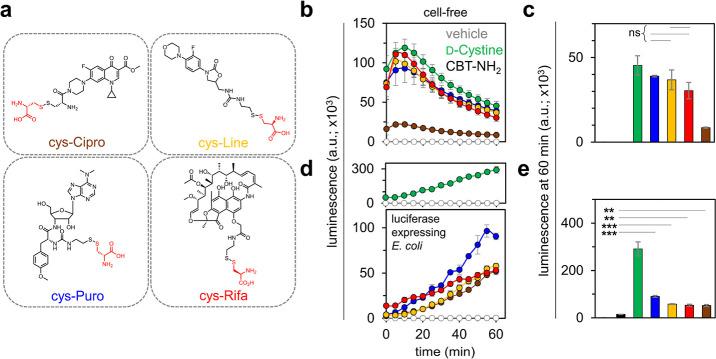
Antibiotic resistance is an alarming public health concern that affects millions of individuals across the globe each year. A major challenge in the development of effective antibiotics lies in their limited ability to permeate cells, noting that numerous susceptible antibiotic targets reside within the bacterial cytosol. Consequently, improving the cellular permeability is often a key consideration during antibiotic development, underscoring the need for reliable methods to assess the permeability of molecules across cellular membranes. Currently, methods used to measure permeability often fail to discriminate between the arrival within the cytoplasm and the overall association of molecules with the cell. Additionally, these techniques typically possess throughput limitations. In this work, we describe a luciferase-based assay designed for assessing the permeability of molecules in the cytosolic compartment of Gram-negative bacteria. Our findings demonstrate a robust system that can elucidate the kinetics of intracellular antibiotic accumulation in live bacterial cells in real time.
抗生素耐药性是一个令人震惊的公共卫生问题,每年影响着全球数百万人。有效抗生素的开发面临的一个主要挑战是它们穿透细胞的能力有限,因为许多易受影响的抗生素靶标存在于细菌细胞质内。因此,提高细胞通透性通常是抗生素开发过程中的一个关键考虑因素,这凸显了需要可靠的方法来评估分子穿过细胞膜的通透性。目前,用于测量通透性的方法往往无法区分分子在细胞质内的到达和与细胞的整体结合。此外,这些技术通常具有通量限制。在这项工作中,我们描述了一种基于荧光素酶的测定方法,用于评估革兰氏阴性菌细胞质部分分子的通透性。我们的研究结果表明,这是一个强大的系统,可以实时阐明活细菌细胞内抗生素积累的动力学。


 Zotero 插件