
高吲哚胺2,3-双加氧酶转录水平预示一线癌症免疫治疗后预后更佳。
High indoleamine 2,3-dioxygenase transcript levels predict better outcome after front-line cancer immunotherapy.
作者信息
Fujiwara Yu, Kato Shumei, Nishizaki Daisuke, Miyashita Hirotaka, Lee Suzanna, Nesline Mary K, Conroy Jeffrey M, DePietro Paul, Pabla Sarabjot, Lippman Scott M, Kurzrock Razelle
机构信息
Department of Medicine, Roswell Park Comprehensive Cancer Center, Buffalo, NY 14263, USA.
Department of Medicine, Icahn School of Medicine at Mount Sinai, Mount Sinai Beth Israel, New York, NY 10003, USA.
出版信息
iScience. 2024 Mar 28;27(4):109632. doi: 10.1016/j.isci.2024.109632. eCollection 2024 Apr 19.
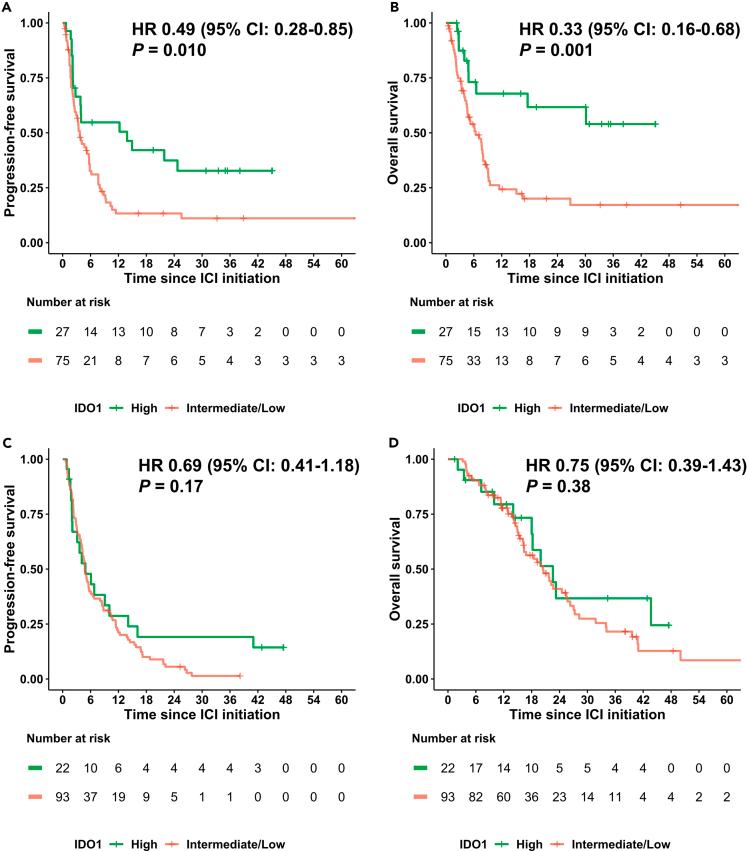
Indoleamine 2,3-dioxygenase 1 (IDO1), which catabolizes tryptophan, is a potential target to unlock the immunosuppressive tumor microenvironment. Correlations between IDO1 and immune checkpoint inhibitor (ICI) efficacy remain unclear. Herein, we investigated IDO1 transcript expression across cancers and clinical outcome correlations. High IDO1 transcripts were more frequent in uterine (54.2%) and ovarian cancer (37.2%) but varied between and within malignancies. High IDO1 RNA expression was associated with high expression of PD-L1 (immune checkpoint ligand), CXCL10 (an effector T cell recruitment chemokine), and STAT1 (a component of the JAK-STAT pathway) (all multivariable < 0.05). and alterations were more frequent in the high IDO1 group. High IDO1 expression was an independent predictor of progression-free survival (adjusted HR = 0.44, 95% CI 0.20-0.99, = 0.049) and overall survival (adjusted HR = 0.31, 95% CI 0.11-0.87, = 0.026) after front-line ICIs. IDO1 expression warrants further exploration as a predictive biomarker for immunotherapy. Moreover, co-expressed immunoregulatory molecules merit exploration for co-targeting.
吲哚胺2,3-双加氧酶1(IDO1)可分解色氨酸,是解开免疫抑制性肿瘤微环境的潜在靶点。IDO1与免疫检查点抑制剂(ICI)疗效之间的相关性仍不明确。在此,我们研究了IDO1在各种癌症中的转录表达及其与临床结局的相关性。IDO1高转录在子宫癌(54.2%)和卵巢癌(37.2%)中更为常见,但在不同恶性肿瘤之间以及同一恶性肿瘤内部存在差异。IDO1高RNA表达与PD-L1(免疫检查点配体)、CXCL10(一种效应T细胞募集趋化因子)和STAT1(JAK-STAT途径的一个组成部分)的高表达相关(所有多变量<0.05)。 和 改变在IDO1高表达组中更为频繁。IDO1高表达是一线ICI治疗后无进展生存期(调整后HR = 0.44,95%CI 0.20-0.99, = 0.049)和总生存期(调整后HR = 0.31,95%CI 0.11-0.87, = 0.026)的独立预测指标。IDO1表达作为免疫治疗的预测生物标志物值得进一步探索。此外,共表达的免疫调节分子作为联合靶向治疗也值得探索。


 Zotero 插件