
肿瘤浸润淋巴细胞上PD-1的表达可预测对抗PD-1/PD-L1免疫疗法的反应。
Tumor Infiltrating Lymphocyte Expression of PD-1 Predicts Response to Anti-PD-1/PD-L1 Immunotherapy.
作者信息
Bevins Nicholas J, Okamura Ryosuke, Montesion Meagan, Adashek Jacob J, Goodman Aaron M, Kurzrock Razelle
机构信息
Department of Pathology, University of California San Diego, San Diego, CA USA.
Department of Gastrointestinal Surgery, Kyoto University Hospital, Japan.
出版信息
J Immunother Precis Oncol. 2022 Sep 22;5(4):90-97. doi: 10.36401/JIPO-22-9. eCollection 2022 Nov.
INTRODUCTION
Many studies have focused on the role of programmed death receptor ligand 1 (PD-L1) expression in predicting immunotherapy outcomes. Limited clinical data are available regarding the role of programmed death receptor 1 (PD-1; the PD-L1 receptor) expressing tumor-infiltrating lymphocytes (TILs) in PD-1/PD-L1 antibody responsiveness. However, preclinical studies demonstrate that TILs expressing PD-1 contribute to tumor immune evasion.
METHODS
This study analyzed the association between TIL-PD-1 status and outcome after immune checkpoint blockade (ICB) therapy. We evaluated 123 patients with various solid tumors treated with monoclonal antibodies targeting the PD-1/PD-L1 signaling axis. Additionally, 8706 solid tumor specimens were assessed for TIL-PD-1 and tumor mutational burden (TMB) status.
RESULTS
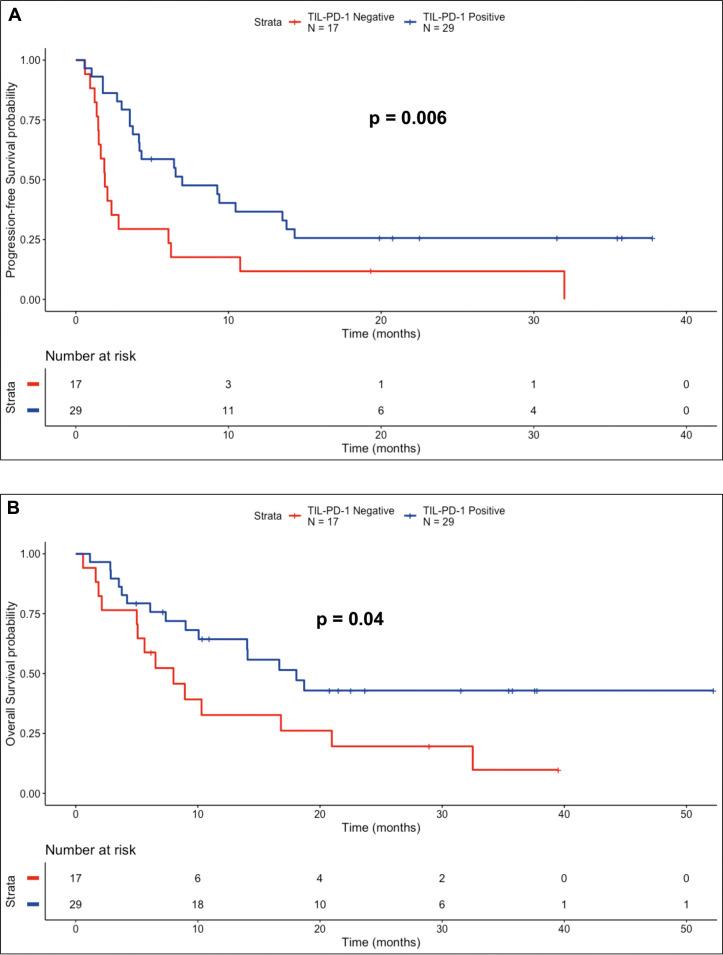
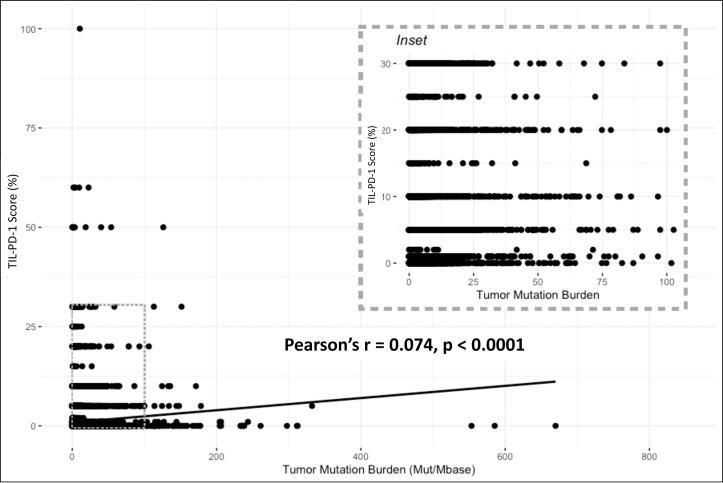
The presence of PD-1-expressing TILs in tumors was associated with increased median progression-free survival (7.0 vs 1.9 months; = 0.006) and overall survival (18.1 vs 8.0 months; = 0.04) after treatment with ICB. TIL-PD-1-positive patients had an objective response rate (ORR) of 41% (95% CI, 24-61; = 12/29) compared with 17% (95% CI, 4-43; = 3/17) for TIL-PD-1-negative patients ( = 0.18). Analyzed as continuous variables, TIL-PD-1 and TMB showed a weak correlation in 8706 solid tumor samples (Pearson = 0.074); when analyzed as categorical variables (cutoffs: TIL-PD-1 ≥ 1% and TMB ≥ 10 mutations/Mb), the two variables are correlated ( < 0.0001). TIL-PD-1-positive status is also associated with enrichment of pathologic variants within several genes, most notably (adjusted < 0.05).
CONCLUSION
TIL-PD-1 positivity in tumors (≥ 1%) is associated with significantly longer progression-free and overall survival after ICB. .
引言
许多研究聚焦于程序性死亡受体配体1(PD-L1)表达在预测免疫治疗结果中的作用。关于表达程序性死亡受体1(PD-1;PD-L1的受体)的肿瘤浸润淋巴细胞(TILs)在PD-1/PD-L1抗体反应性中的作用,临床数据有限。然而,临床前研究表明,表达PD-1的TILs有助于肿瘤免疫逃逸。
方法
本研究分析了TIL-PD-1状态与免疫检查点阻断(ICB)治疗后结果之间的关联。我们评估了123例接受靶向PD-1/PD-L1信号轴单克隆抗体治疗的各种实体瘤患者。此外,对8706份实体瘤标本进行了TIL-PD-1和肿瘤突变负荷(TMB)状态评估。
结果
肿瘤中存在表达PD-1的TILs与ICB治疗后无进展生存期(7.0个月对1.9个月;P = 0.006)和总生存期(18.1个月对8.0个月;P = 0.04)的中位数增加相关。TIL-PD-1阳性患者的客观缓解率(ORR)为41%(95%CI,24-61;n = 12/29),而TIL-PD-1阴性患者为17%(95%CI,4-43;n = 3/17)(P = 0.18)。作为连续变量分析时,在8706份实体瘤样本中TIL-PD-1和TMB显示出弱相关性(Pearson r = 0.074);作为分类变量分析时(临界值:TIL-PD-1≥1%和TMB≥10个突变/Mb),这两个变量相关(P < 0.0001)。TIL-PD-1阳性状态还与几个基因内的病理变异富集相关,最显著的是 (校正P < 0.05)。
结论
肿瘤中TIL-PD-1阳性(≥1%)与ICB治疗后显著更长的无进展生存期和总生存期相关。


 Zotero 插件