
二线纳武利尤单抗联合白蛋白紫杉醇治疗晚期胆道癌的疗效及生物标志物分析。
Efficacy and biomarker analysis of second-line nab-paclitaxel plus sintilimab in patients with advanced biliary tract cancer.
机构信息
Department of Medical Oncology, Cancer Center, West China Hospital, Sichuan University, Chengdu, China.
Division of Abdominal Tumor Multimodality Treatment, Cancer Center, West China Hospital, Sichuan University, Chengdu, China.
出版信息
Cancer Sci. 2024 Jul;115(7):2371-2383. doi: 10.1111/cas.16179. Epub 2024 Apr 18.
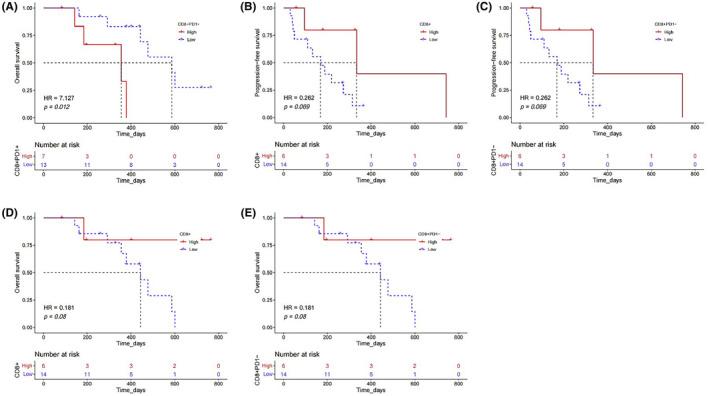
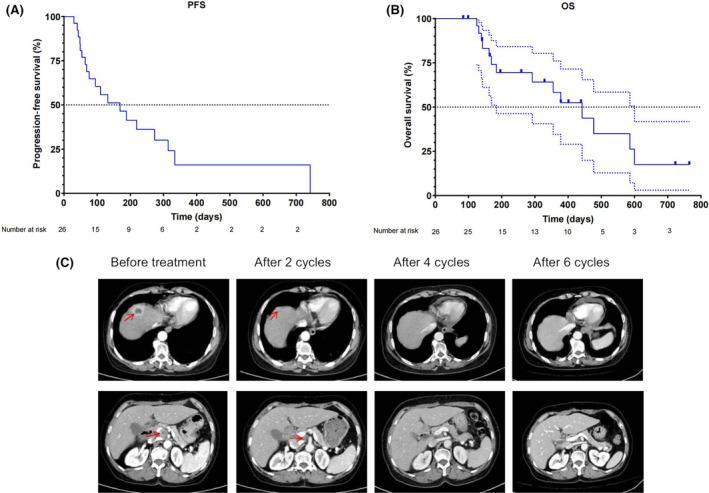
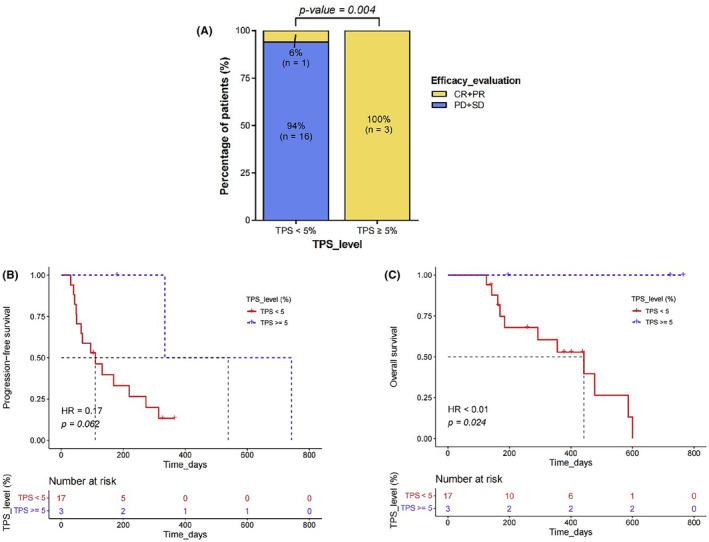
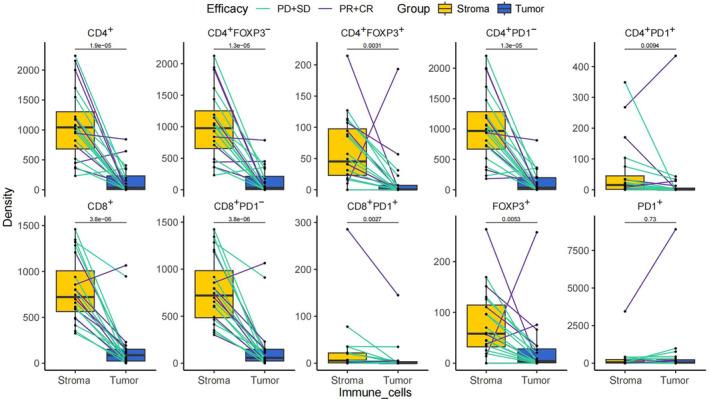
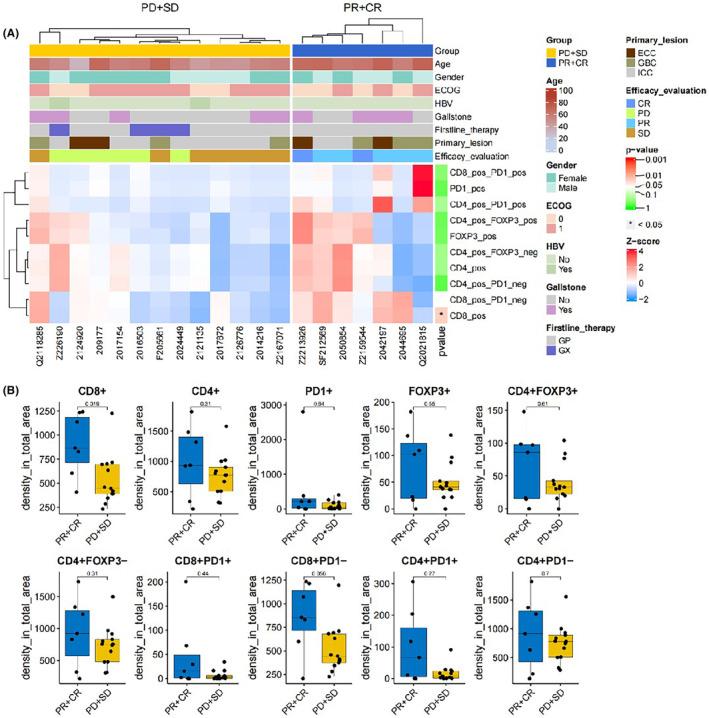
Biliary tract cancer (BTC) is a highly aggressive malignancy with limited second-line therapy. We conducted this phase 2 trial to evaluate the efficacy and safety of second-line nab-paclitaxel plus sintilimab in advanced BTC. Histologically confirmed advanced BTC patients with documented disease progression after first-line chemotherapy were enrolled. Subjects received nab-paclitaxel 125 mg/m on days 1 and 8 plus sintilimab 200 mg on day 1, administered every 3 weeks. The primary end point was the objective response rate (ORR). The secondary end points were progression-free survival (PFS), overall survival (OS), and adverse reactions. Simultaneously, next-generation sequencing, programmed cell death ligand 1 immunohistochemistry and multiplex immunofluorescence of tumor-infiltrating lymphocytes were applied to explore potential biomarkers. Twenty-six subjects were consecutively enrolled. The ORR was 26.9% (7/26), including two complete responses and five partial responses, which met the primary end point. The disease control rate was 61.5% (16/26). The median PFS was 169 days (about 5.6 months, 95% confidence interval [CI] 60-278 days). The median OS was 442 days (about 14.7 months, 95% CI 298-586 days). Grade 3 treatment-related adverse events (TRAEs) were mainly anemia (27%), leukopenia (23%), neutropenia (19%), and peripheral sensory neuropathy (8%). No grade 4 or 5 TRAEs occurred. Biomarker analysis suggested that positive PD-L1 and high proportions of CD8 T-cell infiltration were correlated with improved clinical outcome. Nab-paclitaxel plus sintilimab is a potentially effective and tolerable second-line regimen for advanced BTC that deserves to be studied in large-scale trials. PD-L1 status and CD8 T cell infiltration might be promising biomarkers for efficacy prediction.
胆道癌(BTC)是一种侵袭性很强的恶性肿瘤,二线治疗选择有限。我们开展了这项 2 期临床试验,以评估二线纳武利尤单抗联合替雷利珠单抗在晚期 BTC 中的疗效和安全性。组织学证实的晚期 BTC 患者在一线化疗后疾病进展,入组本研究。受试者接受nab-紫杉醇 125mg/m2 第 1 天和第 8 天+替雷利珠单抗 200mg 第 1 天,每 3 周给药 1 次。主要终点是客观缓解率(ORR)。次要终点是无进展生存期(PFS)、总生存期(OS)和不良反应。同时,进行下一代测序、程序性死亡配体 1 免疫组化和肿瘤浸润淋巴细胞的多重免疫荧光检测,以探索潜在的生物标志物。连续入组 26 例患者。ORR 为 26.9%(7/26),包括 2 例完全缓解和 5 例部分缓解,达到主要终点。疾病控制率为 61.5%(16/26)。中位 PFS 为 169 天(约 5.6 个月,95%置信区间[CI]60-278 天)。中位 OS 为 442 天(约 14.7 个月,95%CI 298-586 天)。3 级治疗相关不良事件(TRAEs)主要为贫血(27%)、白细胞减少(23%)、中性粒细胞减少(19%)和周围感觉神经病变(8%)。无 4 级或 5 级 TRAEs 发生。生物标志物分析提示,PD-L1 阳性和 CD8 T 细胞浸润比例高与临床结局改善相关。纳武利尤单抗联合替雷利珠单抗是晚期 BTC 一种有潜在疗效且耐受良好的二线治疗方案,值得在大规模临床试验中进一步研究。PD-L1 状态和 CD8 T 细胞浸润可能是预测疗效的有前途的生物标志物。


 Zotero 插件