
自噬和脂褐素从胎儿发育到青春期向人视网膜色素上皮细胞基底外侧细胞外空间的外排。
Autophagy and Exocytosis of Lipofuscin Into the Basolateral Extracellular Space of Human Retinal Pigment Epithelium From Fetal Development to Adolescence.
机构信息
Bosch Institute, The University of Sydney, Sydney, Australia.
Now at Cell, Tissue & Organ Bank, Forensic Medicine Research Centre, Tehran, Iran.
出版信息
Invest Ophthalmol Vis Sci. 2024 Apr 1;65(4):32. doi: 10.1167/iovs.65.4.32.
PURPOSE
To undertake the first ultrastructural characterization of human retinal pigment epithelial (RPE) differentiation from fetal development to adolescence.
METHODS
Ten fetal eyes and three eyes aged six, nine, and 17 years were examined in the temporal retina adjacent to the optic nerve head by transmission electron microscopy. The area, number, and distribution of RPE organelles were quantified and interpreted within the context of adjacent photoreceptors, Bruch's membrane, and choriocapillaris maturation.
RESULTS
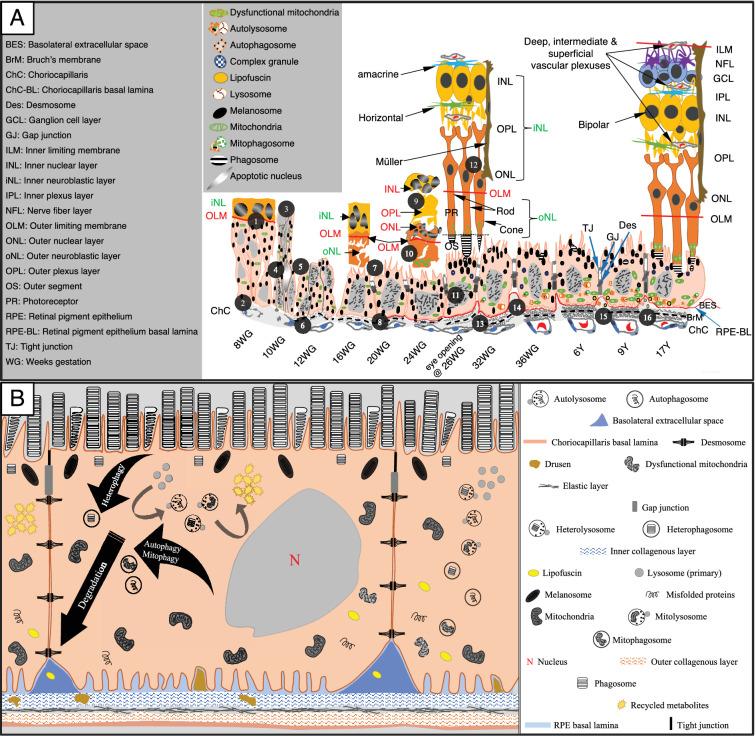
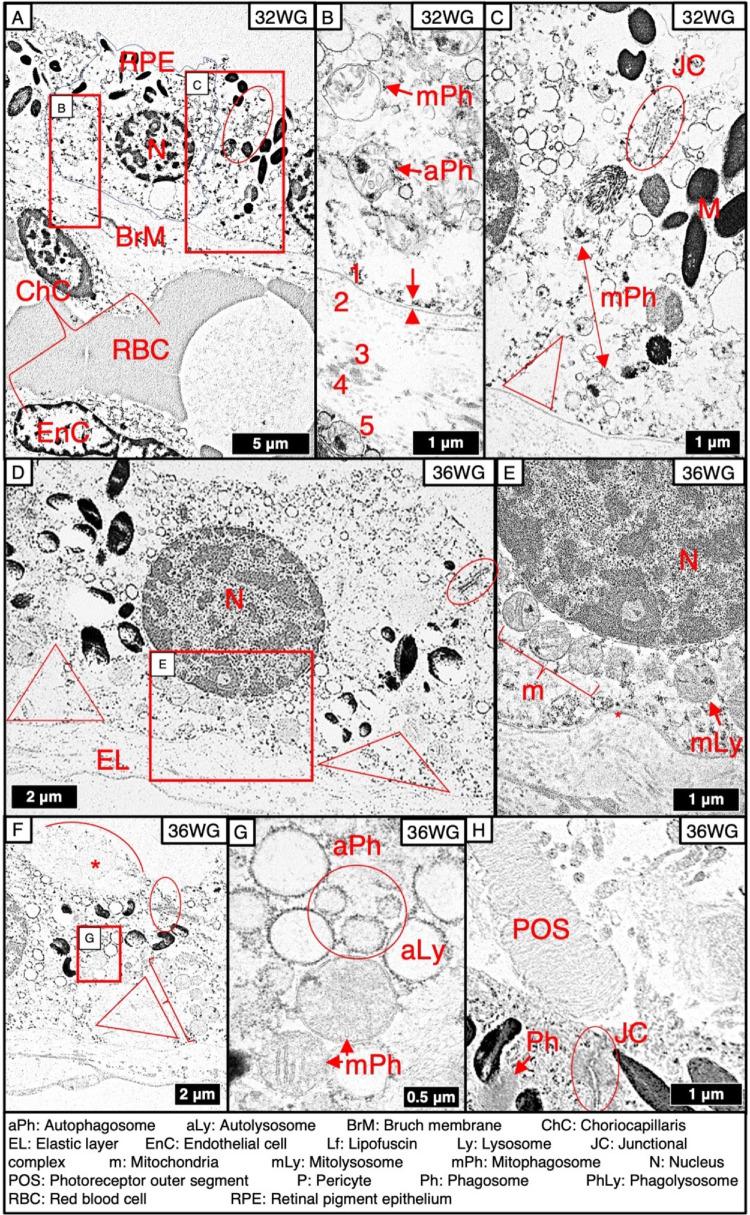
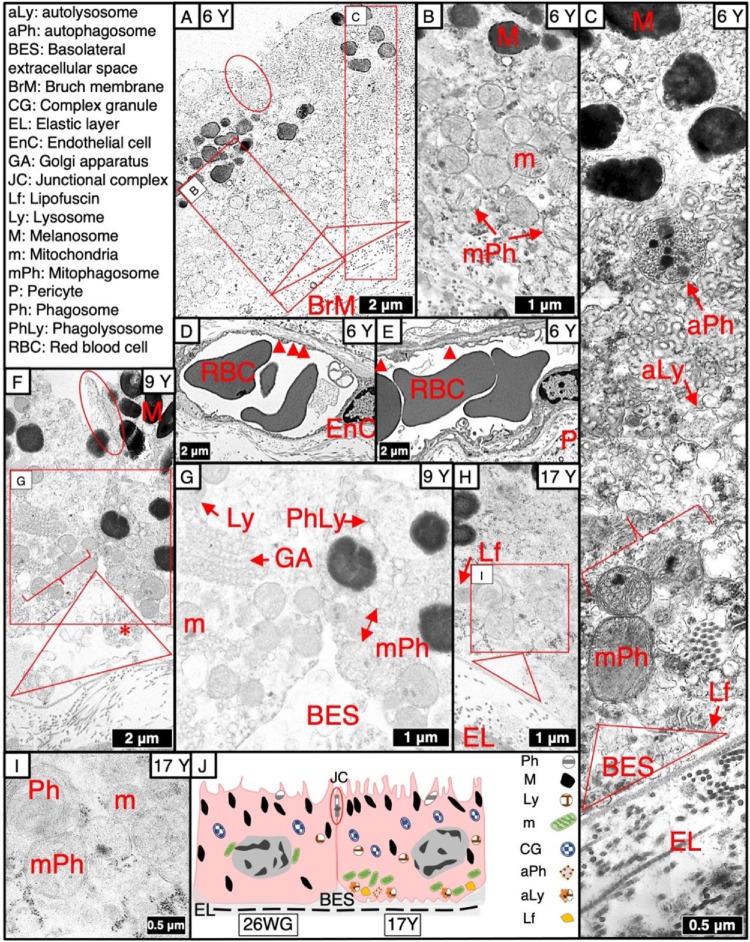
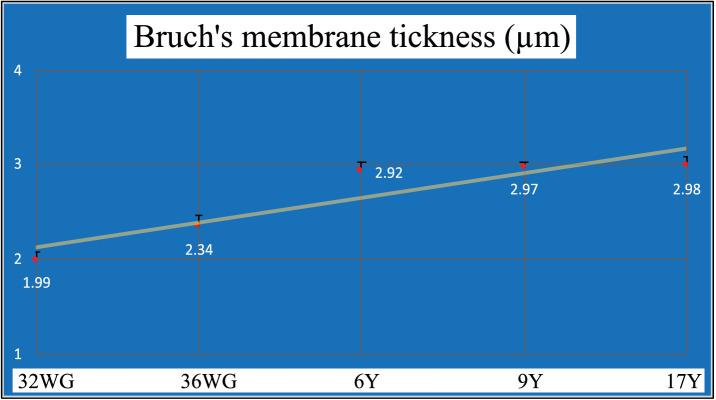
Between eight to 12 weeks' gestation (WG), pseudostratified columnar epithelia with apical tight junctions differentiate to a simple cuboidal epithelium with random distribution of melanosomes and mitochondria. Between 12 to 26 WG, cells enlarge and show long apical microvilli and apicolateral junctional complexes. Coinciding with eye opening at 26 WG, melanosomes migrate apically whereas mitochondria distribute to perinuclear regions, with the first appearance of phagosomes, complex granules, and basolateral extracellular space (BES) formation. Significantly, autophagy and heterophagy, as evidenced by organelle recycling, and the gold standard of ultrastructural evidence for autophagy of double-membrane autophagosomes and mitophagosomes were evident from 32 WG, followed by basal infoldings of RPE cell membrane at 36 WG. Lipofuscin formation and deposition into the BES evident at six years increased at 17 years.
CONCLUSIONS
We provide compelling ultrastructural evidence that heterophagy and autophagy begins in the third trimester of human fetal development and that deposition of cellular byproducts into the extracellular space of RPE takes place via exocytosis. Transplanted RPE cells must also demonstrate the capacity to subserve autophagic and heterophagic functions for effective disease mitigation.
目的
对从胎儿发育到青春期的人视网膜色素上皮 (RPE) 分化进行首次超微结构特征描述。
方法
通过透射电子显微镜检查 10 只胎儿眼和 3 只 6、9 和 17 岁儿童眼的颞侧视神经头附近的视网膜。在邻近光感受器、Bruch 膜和脉络膜毛细血管成熟的背景下,对 RPE 细胞器的面积、数量和分布进行量化和解释。
结果
在妊娠 8 至 12 周 (WG) 期间,具有顶紧密连接的假复层柱状上皮分化为具有随机分布黑素体和线粒体的简单立方上皮。在 12 至 26 WG 期间,细胞增大并显示长的顶微绒毛和顶侧连接复合体。与 26 WG 时眼睛张开同时,黑素体向顶部分化,而线粒体分布到核周区域,出现第一个吞噬体、复杂颗粒和基底外侧细胞外空间 (BES) 形成。重要的是,自噬和异噬作用,如细胞器再循环所证明的,以及双层自噬体和噬线粒体的超微结构证据的金标准,从 32 WG 开始出现,随后在 36 WG 时出现 RPE 细胞膜的基底内褶。在 6 岁时明显的脂褐素形成和沉积到 BES 在 17 岁时增加。
结论
我们提供了令人信服的超微结构证据,表明异噬作用和自噬作用始于人类胎儿发育的第三个三个月,并且细胞产物通过胞吐作用沉积到 RPE 的细胞外空间。移植的 RPE 细胞还必须表现出进行自噬和异噬作用的能力,以有效缓解疾病。



 Zotero 插件