
静息态成体神经干细胞:发育起源与调控机制。
Quiescent Adult Neural Stem Cells: Developmental Origin and Regulatory Mechanisms.
机构信息
Department of Neurobiology and Institute of Neurosciences, School of Basic Medicine, Fourth Military Medical University, Xi'an, 710032, China.
Department of Neurosurgery, General Hospital of Northern Theater Command, Shenyang, 110016, China.
出版信息
Neurosci Bull. 2024 Sep;40(9):1353-1363. doi: 10.1007/s12264-024-01206-1. Epub 2024 Apr 24.
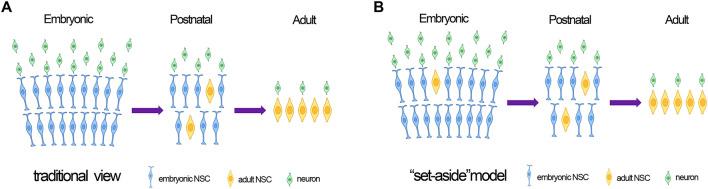
The existence of neural stem cells (NSCs) in the adult mammalian nervous system, although small in number and restricted to the sub-ventricular zone of the lateral ventricles, the dentate gyrus of the hippocampus, and the olfactory epithelium, is a gift of evolution for the adaptive brain function which requires persistent plastic changes of these regions. It is known that most adult NSCs are latent, showing long cell cycles. In the past decade, the concept of quiescent NSCs (qNSCs) has been widely accepted by researchers in the field, and great progress has been made in the biology of qNSCs. Although the spontaneous neuronal regeneration derived from adult NSCs is not significant, understanding how the behaviors of qNSCs are regulated sheds light on stimulating endogenous NSC-based neuronal regeneration. In this review, we mainly focus on the recent progress of the developmental origin and regulatory mechanisms that maintain qNSCs under normal conditions, and that mobilize qNSCs under pathological conditions, hoping to give some insights for future study.
成体哺乳动物神经系统中存在神经干细胞(NSCs),虽然数量很少,且局限于侧脑室下区、海马齿状回和嗅上皮,但这是进化赋予的礼物,使大脑能够适应持续的可塑性变化。已知大多数成体 NSCs 处于休眠状态,表现出长细胞周期。在过去的十年中,静止 NSCs(qNSCs)的概念已被该领域的研究人员广泛接受,并且在 qNSCs 的生物学方面取得了很大的进展。尽管源自成体 NSCs 的自发神经元再生并不显著,但了解 qNSCs 行为如何受到调节为刺激内源性 NSC 为基础的神经元再生提供了线索。在这篇综述中,我们主要关注 qNSCs 在正常条件下维持其干性的发育起源和调控机制,以及在病理条件下动员 qNSCs 的调控机制,希望为未来的研究提供一些见解。


 Zotero 插件