
在以豆粕为基础日粮喂养的杂交条纹鲈(条纹鲈♀×金眼鲈♂)组织中,日粮添加甘氨酸可增强肌酸和谷胱甘肽的合成。
Dietary glycine supplementation enhances syntheses of creatine and glutathione by tissues of hybrid striped bass (Morone saxatilis ♀ × Morone chrysops ♂) fed soybean meal-based diets.
作者信息
He Wenliang, Li Xinyu, Wu Guoyao
机构信息
Department of Animal Science, Texas A&M University, College Station, TX, 77843, USA.
出版信息
J Anim Sci Biotechnol. 2024 May 9;15(1):67. doi: 10.1186/s40104-024-01024-5.
BACKGROUND
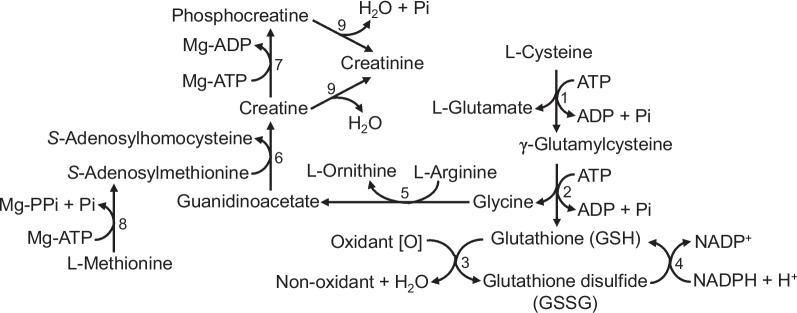
We recently reported that supplementing glycine to soybean meal-based diets is necessary for the optimum growth of 5- to 40-g (Phase-I) and 110- to 240-g (Phase-II) hybrid striped bass (HSB), as well as their intestinal health. Although glycine serves as an essential substrate for syntheses of creatine and glutathione (GSH) in mammals (e.g., pigs), little is known about these metabolic pathways or their nutritional regulation in fish. This study tested the hypothesis that glycine supplementation enhances the activities of creatine- and GSH-forming enzymes as well as creatine and GSH availabilities in tissues of hybrid striped bass (HSB; Morone saxatilis♀ × Morone chrysops♂).
METHODS
Phase-I and Phase-II HSB were fed a soybean meal-based diet supplemented with 0%, 1%, or 2% glycine for 8 weeks. At the end of the 56-d feeding, tissues (liver, intestine, skeletal muscle, kidneys, and pancreas) were collected for biochemical analyses.
RESULTS
In contrast to terrestrial mammals and birds, creatine synthesis occurred primarily in skeletal muscle from all HSB. The liver was most active in GSH synthesis among the HSB tissues studied. In Phase-I HSB, supplementation with 1% or 2% glycine increased (P < 0.05) concentrations of intramuscular creatine (15%-19%) and hepatic GSH (8%-11%), while reducing (P < 0.05) hepatic GSH sulfide (GSSG)/GSH ratios by 14%-15%, compared with the 0-glycine group; there were no differences (P > 0.05) in these variables between the 1% and 2% glycine groups. In Phase-II HSB, supplementation with 1% and 2% glycine increased (P < 0.05) concentrations of creatine and GSH in the muscle (15%-27%) and liver (11%-20%) in a dose-dependent manner, with reduced ratios of hepatic GSSG/GSH in the 1% or 2% glycine group. In all HSB, supplementation with 1% and 2% glycine dose-dependently increased (P < 0.05) activities of intramuscular arginine:glycine amidinotransferase (22%-41%) and hepatic γ-glutamylcysteine synthetase (17%-37%), with elevated activities of intramuscular guanidinoacetate methyltransferase and hepatic GSH synthetase and GSH reductase in the 1% or 2% glycine group. Glycine supplementation also increased (P < 0.05) concentrations of creatine and activities of its synthetic enzymes in tail kidneys and pancreas, and concentrations of GSH and activities of its synthetic enzymes in the proximal intestine.
CONCLUSIONS
Skeletal muscle and liver are the major organs for creatine and GSH syntheses in HSB, respectively. Dietary glycine intake regulates creatine and GSH syntheses by both Phase-I and Phase-II HSB in a tissue-specific manner. Based on the metabolic data, glycine is a conditionally essential amino acid for the growing fish.
背景
我们最近报道,在以豆粕为基础的饲料中添加甘氨酸对于5至40克(第一阶段)和110至240克(第二阶段)杂交条纹鲈(HSB)的最佳生长及其肠道健康是必要的。尽管甘氨酸是哺乳动物(如猪)中肌酸和谷胱甘肽(GSH)合成的必需底物,但对于鱼类中的这些代谢途径或其营养调控知之甚少。本研究检验了以下假设:添加甘氨酸可增强杂交条纹鲈(HSB;Morone saxatilis♀×Morone chrysops♂)组织中肌酸和GSH形成酶的活性以及肌酸和GSH的可利用性。
方法
将第一阶段和第二阶段的HSB投喂添加0%、1%或2%甘氨酸的以豆粕为基础的饲料,持续8周。在56天的投喂期结束时,采集组织(肝脏、肠道、骨骼肌、肾脏和胰腺)进行生化分析。
结果
与陆生哺乳动物和鸟类不同,所有HSB的肌酸合成主要发生在骨骼肌中。在所研究的HSB组织中,肝脏在GSH合成方面最为活跃。在第一阶段的HSB中,与0%甘氨酸组相比,添加1%或2%甘氨酸可使肌肉内肌酸浓度(提高15% - 19%)和肝脏GSH浓度(提高8% - 11%)增加(P < 0.05),同时使肝脏谷胱甘肽二硫化物(GSSG)/GSH比值降低(P < 0.05)14% - 15%;1%和2%甘氨酸组之间这些变量无差异(P > 0.05)。在第二阶段的HSB中,添加1%和2%甘氨酸以剂量依赖方式使肌肉(提高15% - 27%)和肝脏(提高11% - 20%)中的肌酸和GSH浓度增加(P < 0.05),1%或2%甘氨酸组的肝脏GSSG/GSH比值降低。在所有HSB中,添加1%和2%甘氨酸剂量依赖性地增加(P < 0.05)肌肉内精氨酸:甘氨酸脒基转移酶活性(提高22% - 41%)和肝脏γ-谷氨酰半胱氨酸合成酶活性(提高17% - 37%),1%或2%甘氨酸组的肌肉内胍基乙酸甲基转移酶以及肝脏GSH合成酶和GSH还原酶活性升高。添加甘氨酸还使尾肾和胰腺中肌酸浓度及其合成酶活性增加(P < 0.05),并使近端肠道中GSH浓度及其合成酶活性增加。
结论
骨骼肌和肝脏分别是HSB中肌酸和GSH合成的主要器官。日粮甘氨酸摄入量以组织特异性方式调节第一阶段和第二阶段HSB的肌酸和GSH合成。基于代谢数据,甘氨酸是生长中鱼类的一种条件必需氨基酸。
 Zotero 插件