
哌喹治疗后不完全生长抑制导致寄生虫减少比率测定中寄生虫活力增加。
Incomplete growth inhibition following piperaquine treatment translates into increased parasite viability in the parasite reduction ratio assay.
机构信息
Department of Medical Parasitology and Infection Biology, Swiss Tropical and Public Health Institute, Allschwil, Switzerland.
University of Basel, Basel, Switzerland.
出版信息
Front Cell Infect Microbiol. 2024 Apr 30;14:1396786. doi: 10.3389/fcimb.2024.1396786. eCollection 2024.
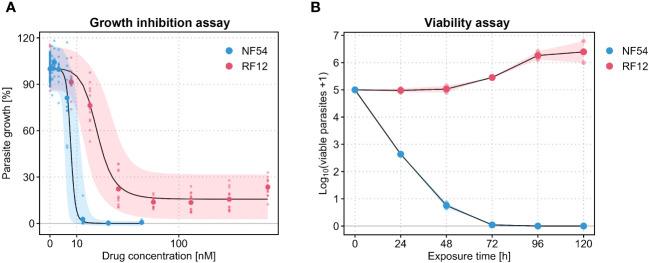
Antimalarial resistance to the first-line partner drug piperaquine (PPQ) threatens the effectiveness of artemisinin-based combination therapy. piperaquine resistance is characterized by incomplete growth inhibition, i.e. increased parasite growth at higher drug concentrations. However, the 50% inhibitory concentrations (IC) remain relatively stable across parasite lines. Measuring parasite viability of a drug-resistant Cambodian isolate in a parasite reduction ratio (PRR) assay helped to better understand the resistance phenotype towards PPQ. In this parasite isolate, incomplete growth inhibition translated to only a 2.5-fold increase in IC but a dramatic decrease of parasite killing in the PRR assay. Hence, this pilot study reveals the potential of parasite viability assays as an important, additional tool when it comes to guiding decision-making in preclinical drug development and post approval. To the best of our knowledge, this is the first time that a compound was tested against a drug-resistant parasite in the PRR assay.
抗疟药物哌喹(PPQ)的耐药性威胁到基于青蒿素的联合疗法的有效性。哌喹耐药性的特征是不完全生长抑制,即在较高药物浓度下寄生虫生长增加。然而,在寄生虫系中,50%抑制浓度(IC)相对稳定。在寄生虫减少比(PRR)测定中测量抗药性柬埔寨分离株的寄生虫活力有助于更好地理解对 PPQ 的耐药表型。在这种寄生虫分离株中,不完全生长抑制仅导致 IC 增加 2.5 倍,但 PRR 测定中的寄生虫杀伤急剧下降。因此,这项初步研究揭示了寄生虫活力测定作为一种重要的、附加工具的潜力,当涉及到指导临床前药物开发和批准后的决策时。据我们所知,这是第一次在 PRR 测定中用化合物对抗耐药性寄生虫进行测试。
 Zotero 插件