
基于 CRISPR 的基因治疗:从临床前治疗到临床治疗。
CRISPR-Based Gene Therapies: From Preclinical to Clinical Treatments.
机构信息
INTEGRARE, UMR_S951, Genethon, Inserm, Univ Evry, Université Paris-Saclay, 91190 Evry, France.
SQY Therapeutics, 78180 Montigny-le-Bretonneux, France.
出版信息
Cells. 2024 May 8;13(10):800. doi: 10.3390/cells13100800.
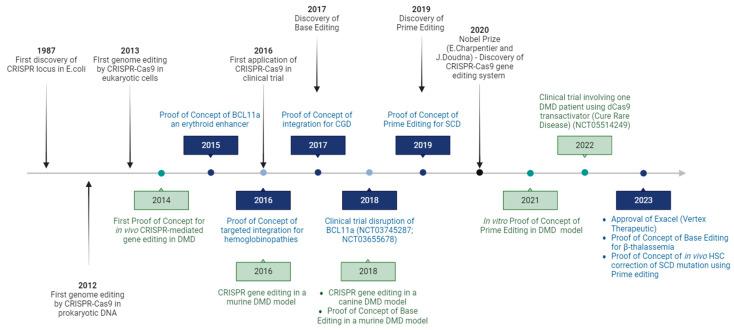
In recent years, clustered regularly interspaced short palindromic repeats (CRISPRs) and CRISPR-associated (Cas) protein have emerged as a revolutionary gene editing tool to treat inherited disorders affecting different organ systems, such as blood and muscles. Both hematological and neuromuscular genetic disorders benefit from genome editing approaches but face different challenges in their clinical translation. The ability of CRISPR/Cas9 technologies to modify hematopoietic stem cells ex vivo has greatly accelerated the development of genetic therapies for blood disorders. In the last decade, many clinical trials were initiated and are now delivering encouraging results. The recent FDA approval of Casgevy, the first CRISPR/Cas9-based drug for severe sickle cell disease and transfusion-dependent β-thalassemia, represents a significant milestone in the field and highlights the great potential of this technology. Similar preclinical efforts are currently expanding CRISPR therapies to other hematologic disorders such as primary immunodeficiencies. In the neuromuscular field, the versatility of CRISPR/Cas9 has been instrumental for the generation of new cellular and animal models of Duchenne muscular dystrophy (DMD), offering innovative platforms to speed up preclinical development of therapeutic solutions. Several corrective interventions have been proposed to genetically restore dystrophin production using the CRISPR toolbox and have demonstrated promising results in different DMD animal models. Although these advances represent a significant step forward to the clinical translation of CRISPR/Cas9 therapies to DMD, there are still many hurdles to overcome, such as in vivo delivery methods associated with high viral vector doses, together with safety and immunological concerns. Collectively, the results obtained in the hematological and neuromuscular fields emphasize the transformative impact of CRISPR/Cas9 for patients affected by these debilitating conditions. As each field suffers from different and specific challenges, the clinical translation of CRISPR therapies may progress differentially depending on the genetic disorder. Ongoing investigations and clinical trials will address risks and limitations of these therapies, including long-term efficacy, potential genotoxicity, and adverse immune reactions. This review provides insights into the diverse applications of CRISPR-based technologies in both preclinical and clinical settings for monogenic blood disorders and muscular dystrophy and compare advances in both fields while highlighting current trends, difficulties, and challenges to overcome.
近年来,成簇规律间隔短回文重复序列(CRISPRs)和 CRISPR 相关(Cas)蛋白已成为一种革命性的基因编辑工具,可用于治疗影响不同器官系统(如血液和肌肉)的遗传性疾病。血液系统和神经肌肉遗传性疾病都受益于基因组编辑方法,但在临床转化方面面临着不同的挑战。CRISPR/Cas9 技术修饰造血干细胞的能力极大地加速了血液疾病基因治疗的发展。在过去的十年中,许多临床试验已经启动,并取得了令人鼓舞的结果。最近 FDA 批准了 Casgevy,这是第一种用于严重镰状细胞病和输血依赖型β-地中海贫血的基于 CRISPR/Cas9 的药物,这是该领域的一个重要里程碑,突显了这项技术的巨大潜力。类似的临床前努力目前正在将 CRISPR 疗法扩展到其他血液疾病,如原发性免疫缺陷。在神经肌肉领域,CRISPR/Cas9 的多功能性对于生成新的杜氏肌营养不良症(DMD)的细胞和动物模型至关重要,为加速治疗解决方案的临床前开发提供了创新平台。已经提出了几种矫正干预措施,使用 CRISPR 工具箱来恢复肌营养不良蛋白的产生,并在不同的 DMD 动物模型中显示出有希望的结果。尽管这些进展代表了将 CRISPR/Cas9 疗法向 DMD 临床转化的重要一步,但仍有许多障碍需要克服,例如与高病毒载体剂量相关的体内递送方法,以及安全性和免疫问题。总之,血液学和神经肌肉学领域的研究结果强调了 CRISPR/Cas9 对受这些衰弱性疾病影响的患者的变革性影响。由于每个领域都存在不同的特定挑战,因此 CRISPR 疗法的临床转化可能会根据遗传疾病的不同而有所不同。正在进行的研究和临床试验将解决这些疗法的风险和局限性,包括长期疗效、潜在的遗传毒性和不良免疫反应。本综述提供了在单基因血液疾病和肌营养不良症的临床前和临床环境中使用基于 CRISPR 的技术的多样性,并比较了这两个领域的进展,同时强调了当前的趋势、困难和需要克服的挑战。


 Zotero 插件