
缺血性卒中中的小胶质细胞:发病机制见解与治疗挑战
Microglia in Ischemic Stroke: Pathogenesis Insights and Therapeutic Challenges.
作者信息
Shui Xinyao, Chen Jingsong, Fu Ziyue, Zhu Haoyue, Tao Hualin, Li Zhaoyinqian
机构信息
Clinical Medical College, Southwest Medical University, Luzhou, People's Republic of China.
Department of Laboratory Medicine, the Affiliated Hospital of Southwest Medical University, Luzhou, People's Republic of China.
出版信息
J Inflamm Res. 2024 May 22;17:3335-3352. doi: 10.2147/JIR.S461795. eCollection 2024.
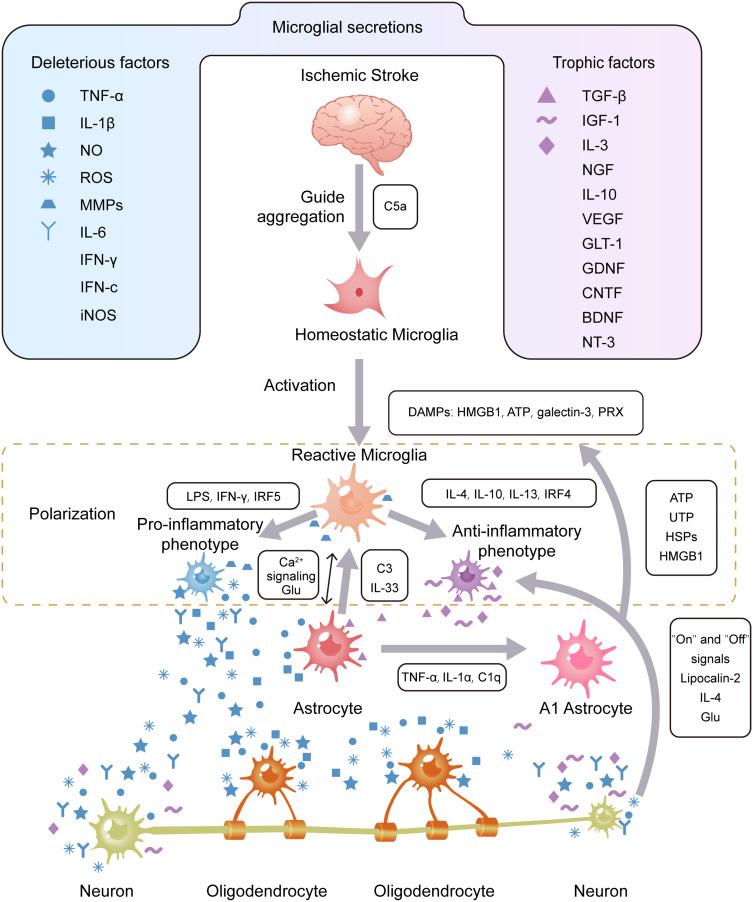
Ischemic stroke is the most common type of stroke, which is the main cause of death and disability on a global scale. As the primary immune cells in the brain that are crucial for preserving homeostasis of the central nervous system microenvironment, microglia have been found to exhibit dual or even multiple effects at different stages of ischemic stroke. The anti-inflammatory polarization of microglia and release of neurotrophic factors may provide benefits by promoting neurological recovery at the lesion in the early phase after ischemic stroke. However, the pro-inflammatory polarization of microglia and secretion of inflammatory factors in the later phase of injury may exacerbate the ischemic lesion, suggesting the therapeutic potential of modulating the balance of microglial polarization to predispose them to anti-inflammatory transformation in ischemic stroke. Microglia-mediated signaling crosstalk with other cells may also be key to improving functional outcomes following ischemic stroke. Thus, this review provides an overview of microglial functions and responses under physiological and ischemic stroke conditions, including microglial activation, polarization, and interactions with other cells. We focus on approaches that promote anti-inflammatory polarization of microglia, inhibit microglial activation, and enhance beneficial cell-to-cell interactions. These targets may hold promise for the creation of innovative therapeutic strategies.
缺血性中风是最常见的中风类型,是全球范围内死亡和残疾的主要原因。作为大脑中对维持中枢神经系统微环境稳态至关重要的主要免疫细胞,小胶质细胞在缺血性中风的不同阶段表现出双重甚至多种作用。小胶质细胞的抗炎极化和神经营养因子的释放可能通过促进缺血性中风后早期病变处的神经恢复而带来益处。然而,损伤后期小胶质细胞的促炎极化和炎症因子的分泌可能会加重缺血性病变,这表明调节小胶质细胞极化平衡使其倾向于抗炎转化在缺血性中风中具有治疗潜力。小胶质细胞介导的与其他细胞的信号串扰也可能是改善缺血性中风后功能结局的关键。因此,本综述概述了生理和缺血性中风条件下小胶质细胞的功能和反应,包括小胶质细胞的激活、极化以及与其他细胞的相互作用。我们重点关注促进小胶质细胞抗炎极化、抑制小胶质细胞激活以及增强有益细胞间相互作用的方法。这些靶点可能为创新治疗策略的开发带来希望。
 Zotero 插件