
黏膜相关恒定 T 细胞在儿童和青年患者接受异基因造血干细胞移植后功能受损,其恢复与临床结局相关。
Mucosal-associated invariant T cells are functionally impaired in pediatric and young adult patients following allogeneic hematopoietic stem cell transplantation and their recovery correlates with clinical outcomes.
机构信息
Research Area of Hematology and Oncology, Cell and Gene Therapy, Bambino Gesù Children's Hospital, IRCCS, Rome.
Department of Maternal and Child Health, Sapienza University of Rome, Piazzale Aldo Moro 5, 00185 Rome.
出版信息
Haematologica. 2024 Oct 1;109(10):3222-3236. doi: 10.3324/haematol.2023.284649.
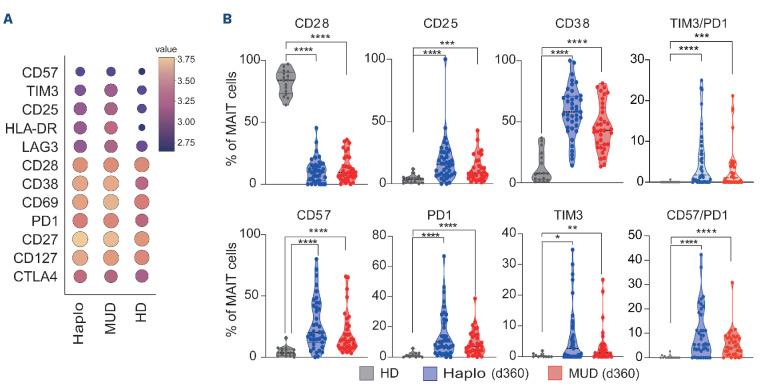
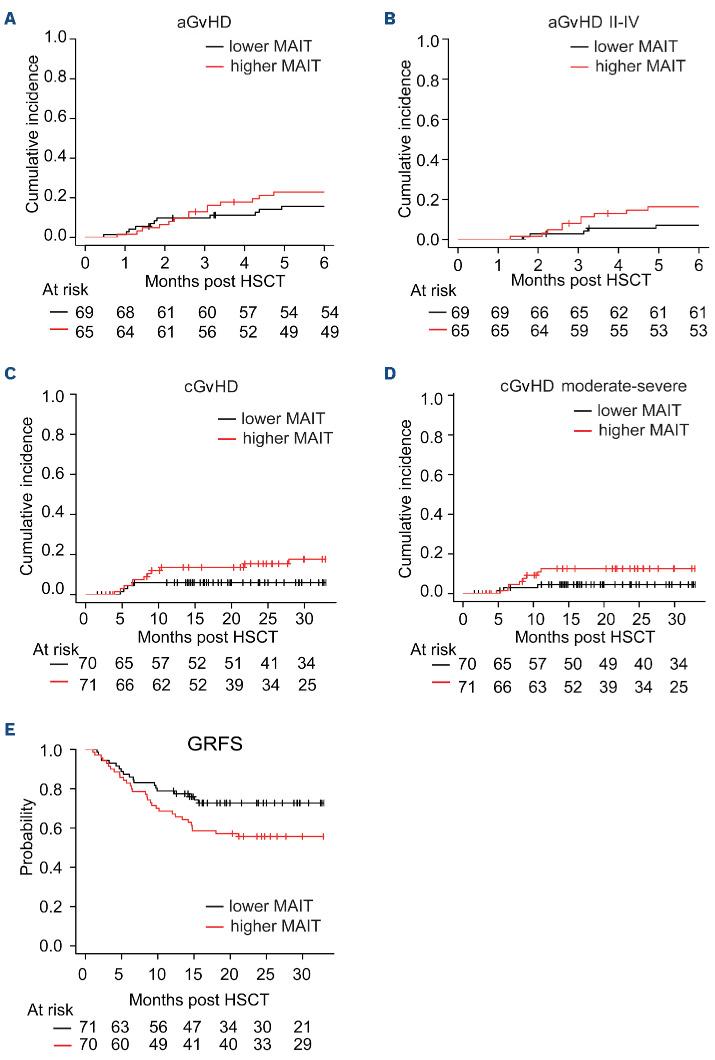
Mucosal-associated invariant T (MAIT) cells are innate-like T cells implicated in the response to fungal and bacterial infections. Their contribution to restoring T-cell immunity and influencing hematopoietic stem cell transplant (HSCT) outcomes remains poorly understood. We retrospectively studied MAIT-cell recovery in 145 consecutive children and young adults with hematologic malignancies undergoing allogeneic (allo)-HSCT between April 2019 and May 2022, from unrelated matched donor (MUD, N=52), with standard graft-versus-host-disease (GvHD) prophylaxis, or HLA-haploidentical (Haplo, N=93) donor after in vitro αβT/CD19-cell depletion, without post-HSCT pharmacological prophylaxis. With a median follow-up of 33 months (range, 12-49 months), overall survival (OS), disease-free survival (DFS), and non-relapse mortality (NRM) were 79.5%, 72%, and 7%, respectively; GvHD-free relapse-free survival (GRFS) was 63%, while cumulative incidence of relapse was 23%. While αβT cells were reconstituted 1-2 years post HSCT, MAIT cells showed delayed recovery and prolonged functional impairment, characterized by expression of activation (CD25, CD38), exhaustion (PD1, TIM3) and senescence (CD57) markers, and suboptimal ex vivo response. OS, DFS, and NRM were not affected by MAIT cells. Interestingly, higher MAIT cells at day +30 correlated with higher incidence of grade II-IV acute GvHD (19% vs. 7%, P=0.06). Furthermore, a greater MAIT-cell count tended to be associated with a higher incidence of chronic GvHD (cGvHD) (17% vs. 6%, P=0.07) resulting in lower GRFS (55% vs. 73%, P=0.05). Higher MAIT cells also correlated with greater cytomegalovirus (CMV) reactivation and lower late blood stream infections (BSI) (44% vs. 24%, P=0.02 and 9% vs. 18%, P=0.08, respectively). Future studies are needed to confirm the impact of early MAIT-cell recovery on cGvHD, CMV reactivation, and late BSI.
黏膜相关恒定 T(MAIT)细胞是先天样 T 细胞,参与真菌和细菌感染的反应。它们对恢复 T 细胞免疫和影响造血干细胞移植(HSCT)结果的贡献仍知之甚少。我们回顾性研究了 145 例连续患有血液系统恶性肿瘤的儿童和年轻成人的 MAIT 细胞恢复情况,这些患者于 2019 年 4 月至 2022 年 5 月期间接受了同种异体(allo)HSCT,供者分别为无关匹配供者(MUD,N=52)、标准移植物抗宿主病(GvHD)预防的 HLA 单倍体相合(Haplo,N=93)供者,后者在体外进行了 αβT/CD19 细胞耗竭,无 HSCT 后药物预防。中位随访 33 个月(范围 12-49 个月),总生存率(OS)、无疾病生存率(DFS)和非复发死亡率(NRM)分别为 79.5%、72%和 7%;无 GvHD 复发无病生存率(GRFS)为 63%,而累积复发率为 23%。虽然在 HSCT 后 1-2 年内恢复了 αβT 细胞,但 MAIT 细胞显示出延迟恢复和功能障碍,表现为表达激活(CD25、CD38)、衰竭(PD1、TIM3)和衰老(CD57)标志物,以及体外反应不佳。MAIT 细胞对 OS、DFS 和 NRM 没有影响。有趣的是,第 30 天 MAIT 细胞较高与更严重的 II-IV 级急性 GvHD 发生率相关(19% vs. 7%,P=0.06)。此外,MAIT 细胞计数较高与慢性 GvHD(cGvHD)发生率较高相关(17% vs. 6%,P=0.07),导致 GRFS 降低(55% vs. 73%,P=0.05)。MAIT 细胞较高还与巨细胞病毒(CMV)再激活和晚期血流感染(BSI)发生率较高相关(44% vs. 24%,P=0.02 和 9% vs. 18%,P=0.08)。需要进一步的研究来证实早期 MAIT 细胞恢复对 cGvHD、CMV 再激活和晚期 BSI 的影响。



 Zotero 插件