
特应性皮炎患儿的表观遗传和生物年龄加速
Epigenetic and biological age acceleration in children with atopic dermatitis.
作者信息
Jeremian Richie, Malinowski Alexandra, Oh Edward S, Gooderham Melinda, Sibbald Cathryn, Yeung Jensen, Asai Yuka, Piguet Vincent, Jack Carolyn S
机构信息
Faculty of Medicine & Health Sciences, McGill University, Montreal, Quebec, Canada.
McGill University Health Centre (MUHC) Center of Excellence for Atopic Dermatitis, Montreal, Quebec, Canada.
出版信息
J Allergy Clin Immunol Glob. 2024 May 3;3(3):100275. doi: 10.1016/j.jacig.2024.100275. eCollection 2024 Aug.
BACKGROUND
Atopic dermatitis (AD) is a chronic inflammatory skin disease resulting from the complex interplay of genetic and environmental factors, meriting exploration using temporally dynamic biomarkers. DNA methylation-based algorithms have been trained to accurately estimate biological age, and deviation of predicted age from true age (epigenetic age acceleration) has been implicated in several inflammatory diseases, including asthma.
OBJECTIVE
We sought to determine the role of epigenetic and biological aging, telomere length, and epigenetically inferred abundance of 7 inflammatory biomarkers in AD.
METHODS
We performed DNA methylation-based analyses in a pediatric AD cohort (n = 24, mean ± standard deviation [SD] age 2.56 ± 0.28 years) and age-matched healthy subjects (n = 24, age 2.09 [0.15] years) derived from blood using 5 validated algorithms that assess epigenetic age (Horvath, Skin&Blood) and biological age (PhenoAge, GrimAge), telomere length (TelomereLength), and inflammatory biomarker levels.
RESULTS
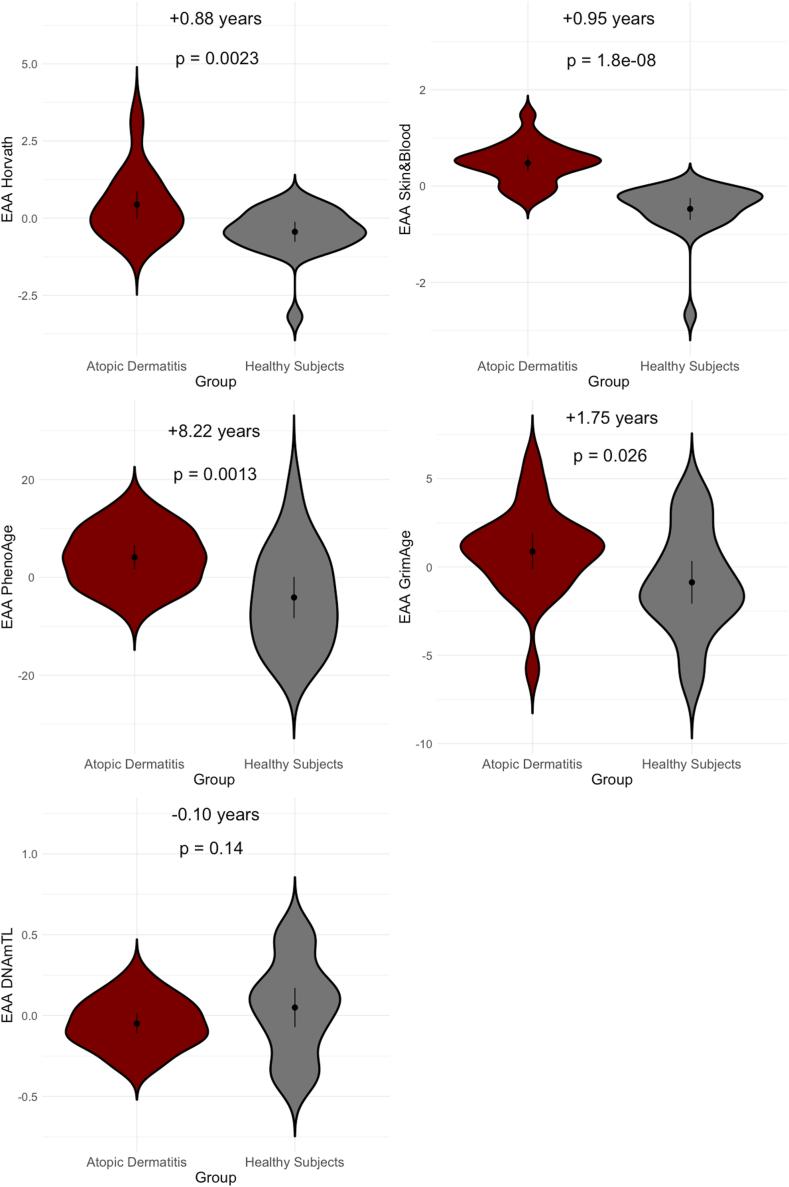
Epigenetic and biological age, but not telomere length, were accelerated in AD patients for 4 algorithms: Horvath (+0.88 years; 95% confidence interval [CI], 0.33 to 1.4; = 2.3 × 10), Skin&Blood (+0.95 years; 95% CI, 0.67 to 1.2; = 1.8 × 10), PhenoAge (+8.2 years; 95% CI, 3.4 to 13.0; = 1.3 × 10), and GrimAge (+1.8 years 95% CI, 0.22 to 3.3; = .026). Moreover, patients had increased levels of β microglobulin (+47,584.4 ng/mL; = .029), plasminogen activation inhibitor 1 (+3,432.9 ng/mL; = 1.1 × 10), and cystatin C (+31,691 ng/mL; = 4.0 × 10), while levels of tissue inhibitor metalloproteinase 1 (-370.7 ng/mL; = 7.5 × 10) were decreased compared to healthy subjects.
CONCLUSION
DNA methylation changes associated with epigenetic and biological aging, and inflammatory proteins appear early in life in pediatric AD and may be relevant clinical biomarkers of pathophysiology.
背景
特应性皮炎(AD)是一种由遗传和环境因素复杂相互作用导致的慢性炎症性皮肤病,值得利用具有时间动态性的生物标志物进行探索。基于DNA甲基化的算法已被训练用于准确估计生物学年龄,预测年龄与实际年龄的偏差(表观遗传年龄加速)与包括哮喘在内的几种炎症性疾病有关。
目的
我们试图确定表观遗传和生物学衰老、端粒长度以及7种炎症生物标志物的表观遗传推断丰度在AD中的作用。
方法
我们在一个儿科AD队列(n = 24,平均±标准差[SD]年龄2.56±0.28岁)和年龄匹配的健康受试者(n = 24,年龄2.09[0.15]岁)中进行了基于DNA甲基化的分析,这些样本来自血液,使用了5种经过验证的算法来评估表观遗传年龄(Horvath、皮肤与血液)、生物学年龄(PhenoAge、GrimAge)、端粒长度(TelomereLength)和炎症生物标志物水平。
结果
对于4种算法,AD患者的表观遗传和生物学年龄加速,但端粒长度未加速:Horvath算法(+0.88岁;95%置信区间[CI],0.33至1.4;P = 2.3×10)、皮肤与血液算法(+0.95岁;95%CI,0.67至1.2;P = 1.8×10)、PhenoAge算法(+8.2岁;95%CI,3.4至13.0;P = 1.3×10)和GrimAge算法(+1.8岁,95%CI,0.22至3.3;P = 0.026)。此外,与健康受试者相比,患者的β微球蛋白水平升高(+47,584.4 ng/mL;P = 0.029)、纤溶酶原激活抑制剂1水平升高(+3,432.9 ng/mL;P = 1.1×10)、胱抑素C水平升高(+31,691 ng/mL;P = 4.0×10),而组织金属蛋白酶抑制剂1水平降低(-370.7 ng/mL;P = 7.5×10)。
结论
与表观遗传和生物学衰老以及炎症蛋白相关的DNA甲基化变化在儿科AD患者生命早期就已出现,可能是病理生理学的相关临床生物标志物。

 Zotero 插件