
一项在晚期实体瘤和复发性/难治性 B 细胞淋巴瘤患者中进行的每日口服泽仑司他(一种 N-豆蔻酰转移酶抑制剂)的首次人体 I 期临床试验。
A first-in-human phase I trial of daily oral zelenirstat, a N-myristoyltransferase inhibitor, in patients with advanced solid tumors and relapsed/refractory B-cell lymphomas.
机构信息
Cross Cancer Institute, Edmonton, AB, Canada.
Cross Cancer Institute, 11560 University Avenue NW, Edmonton, AB, T6G 1Z2, Canada.
出版信息
Invest New Drugs. 2024 Aug;42(4):386-393. doi: 10.1007/s10637-024-01448-w. Epub 2024 Jun 5.
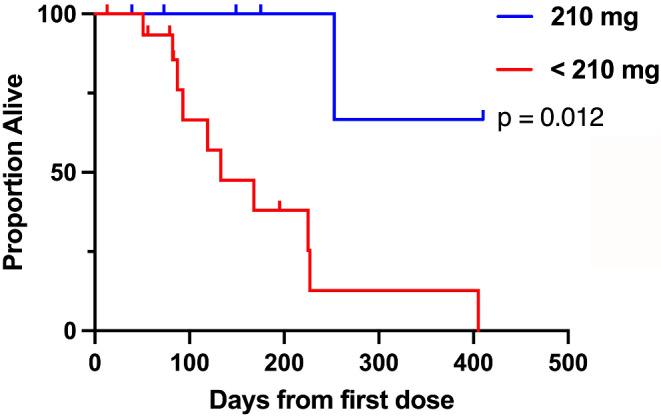
Myristoylation, the N-terminal addition of the fatty acid myristate to proteins, regulates membrane-bound signal transduction pathways important in cancer cell biology. This modification is catalyzed by two N-myristoyltransferases, NMT1 and NMT2. Zelenirstat is a first-in-class potent oral small molecule inhibitor of both NMT1 and NMT2 proteins. Patients with advanced solid tumors and relapsed/refractory (R/R) B-cell lymphomas were enrolled in an open label, phase I dose escalation trial of oral daily zelenirstat, administered in 28-day cycles until progression or unacceptable toxicity. The endpoints were to evaluate dose-limiting toxicities (DLT) to establish a maximum tolerated dose (MTD), pharmacokinetic parameters, and anticancer activity. Twenty-nine patients were enrolled (25 advanced solid tumor; 4 R/R B-cell lymphoma) and 24 were DLT-evaluable. Dosing ranged from 20 mg once daily (OD) to 210 mg OD without DLT, but gastrointestinal DLTS were seen in the 280 mg cohort. MTD and recommended phase 2 dose were 210 mg OD. Common adverse events were predominantly Gr ≤ 2 nausea, vomiting, diarrhea, and fatigue. Plasma concentrations peaked at 2 h with terminal half-lives averaging 10 h. Steady state was achieved by day 15, and higher doses achieved trough concentrations predicted to be therapeutic. Stable disease as best response was seen in eight (28%) patients. Progression-free survival and overall survival were significantly better in patients receiving 210 mg OD compared to those receiving lower doses. Zelenirstat is well-tolerated, achieves plasma exposures expected for efficacy, and shows early signs of anticancer activity. Further clinical development of zelenirstat is warranted.
豆蔻酰化作用,即脂肪酸豆蔻酸在蛋白质 N 端的添加,调节了癌症细胞生物学中重要的膜结合信号转导途径。这种修饰是由两种 N-豆蔻酰转移酶(NMT1 和 NMT2)催化的。泽来司他是一种首创的、强效的 NMT1 和 NMT2 蛋白口服小分子抑制剂。患有晚期实体瘤和复发性/难治性(R/R)B 细胞淋巴瘤的患者参加了一项泽来司他口服每日剂量递增的开放标签、I 期临床试验,每 28 天为一个周期,直至疾病进展或出现不可接受的毒性。终点是评估剂量限制性毒性(DLT)以确定最大耐受剂量(MTD)、药代动力学参数和抗癌活性。共招募了 29 名患者(25 名晚期实体瘤;4 名 R/R B 细胞淋巴瘤),其中 24 名可评估 DLT。剂量范围从每日 20mg 单次给药(OD)到 210mg OD,没有 DLT,但在 280mg 队列中观察到胃肠道 DLT。MTD 和推荐的 II 期剂量为 210mg OD。常见的不良反应主要是 Gr≤2 级的恶心、呕吐、腹泻和疲劳。血浆浓度在 2 小时时达到峰值,平均终末半衰期为 10 小时。在第 15 天达到稳态,更高的剂量达到预测有治疗作用的谷浓度。最佳反应为疾病稳定的患者有 8 名(28%)。接受 210mg OD 治疗的患者无进展生存期和总生存期明显长于接受较低剂量治疗的患者。泽来司他具有良好的耐受性,达到了预期疗效的血浆暴露量,并显示出早期抗癌活性的迹象。需要进一步开展泽来司他的临床开发。

 Zotero 插件